
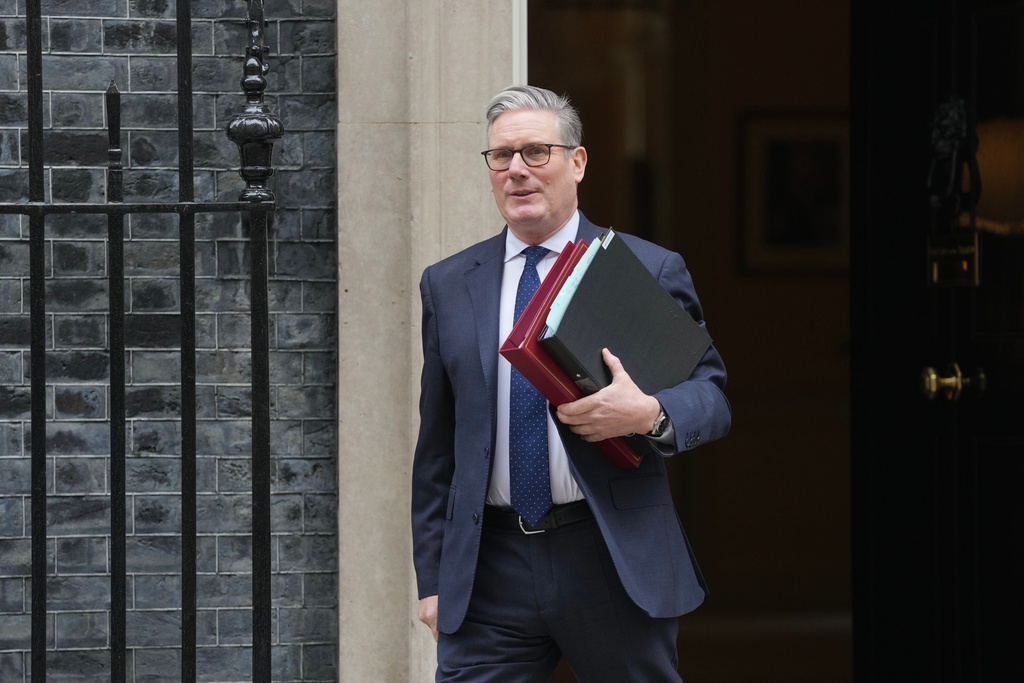
On April 1, the United Kingdom Home Secretary announced that British police would no longer record details of every “offensive” social media post, a move that was partially greeted with praise and with “this better not be an April Fool’s Day trick” by free speech advocates both in the U.K. and globally.
It now looks like it wasn’t a prank — well, not quite, anyway. Unfortunately, the U.K.’s disturbingly anti-free-speech regime remains largely unchanged and overbroad. The dirtiest trick, though, is the ongoing effort by U.S. policymakers to replicate Britain’s anti-free speech approach that has diverted police away from addressing serious crime, including violent crime like robberies in London’s most chi-chi districts, erroneously believing this will somehow be of use in protecting our citizens, including and most especially children.
Recommended Stories


The truth is, in Jolly Old England (and Wales, and Scotland, and Northern Ireland), not only will “non-crime hate incidents,” which can include everything from jokes to posts that legitimately help fuel riots, continue to be recorded where they “may be relevant to policing for preventing or solving crime, safeguarding individuals or communities or fulfilling other statutory policing purposes,” — a pretty undefined standard that will make application of rules inconsistent and subjective.
The Public Order Act, suspicion of violation of which was the justification for the detention of comedian Graham Linehan last year, remains in full force and effect despite calls from London’s Metropolitan Police to “change or clarify” it. Health Secretary Wes Streeting, who sits on the conservative end of the Socialist (or Socialist-light) Labour Party, agreed that in view of that incident, online speech laws needed to be reviewed — but not much concrete has happened.
Another of those laws, the Online Safety Act, which ostensibly exists to protect children but has famously blocked Brits from ordering pizzas, listening to Spotify, and threatened to take Wikipedia offline, remains in full force and effect despite debates related to it continuing to play out in Parliament.
Sadly, too, Conservative Party leaders are currently backing an absolute ban on social media (however one even defines that) for under-16s. There’s a huge irony in trying to “protect kids” by limiting their cellphone communication options to unsecured standard text messages, because depending on how you write a law, end-to-end encrypted WhatsApp could be banned for kids like mine.
And here in the US, we’re still seeing all sorts of policies that would sideline free speech in the name of “protecting kids,” especially, being pushed by both parties.
Previous iterations of this have included the Kids Online Safety Act (in its original form, it too would have targeted WhatsApp) or Hillary Clinton’s New York-specific push to treat social media like cigarettes. While I’m no fan of loud, obnoxious videos featuring teenagers screaming about hunting particular “Brainrots” (whatever that even means) served on a continuous loop via video platforms, it still feels a tad excessive to compare such content to literal death sticks.
Newer editions include the App Store Accountability Act, which Republicans are once again pushing under the guise of “protecting the children,” and whose functional result would be the creation of a national digital identity checkpoint. This outcome would be rather similar to the pizza-and-Spotify blocking of the Online Safety Act across the pond.
Section 3 of that act would require companies like Apple and Google (the major app store operators) to collect government IDs, biometric data, and credit card information from every user who downloads an app. In turn, that would mean that Big Tech companies actually get more of adults’ and kids’ sensitive data.
Because the act contains provisions allowing the FTC and state Attorneys General to enforce it, it also puts that data in the hands of the government, whether actually or theoretically, as yet undetermined. If that sounds like a bad idea to you in view of a CFPB staffer having leaked 250,000 consumers’ data just a couple of years ago — still with no apparent consequence other than that staffer’s termination — or in view of the 2020 Solar Winds hack, or the 2015 OPM hack in which 21.5 million people’s data was stolen, you’re not alone.
As President Ronald Reagan once said, “The nine most terrifying words in the English language are ‘I’m from the government, and I’m here to help.’” God knows that no one except ragebaiters making coin off of, well, ragebait, plus literal Nazis, actually likes social media content that is hateful or drifts close to incitement. And, no, I obviously don’t want my kid checking out Pornhub videos (and no more endless loops of “Brainrot” videos, please).
DEMOCRATS ARE LOSING THE WORKING CLASS
But my other country has demonstrated that, where regulation of online speech is concerned, even when it is ostensibly aimed at “helping the children,” there is a massively slippery slope—and a lot of unforeseen consequences.
Now, just as the U.K. seems to maybe finally be righting wrongs (maybe), is not the time for the U.S. to go copying the country of which we were once a part, and split off from, clearly establishing freedom of speech that the government, constitutionally, cannot restrict — a freedom that notably does not exist in the U.K., though it certainly should.