

The Governor of Maine vetoed what would have become the nation’s first statewide ban on the construction of large data centers. At least 11 other states have introduced similar bills this session. In Washington, D.C., Sen. Bernie Sanders (I-VT) and Rep. Alexandria Ocasio-Cortez (D-NY) have introduced a bill to freeze all new data center construction nationwide.
The sponsors say they want to protect communities from rising electricity costs, environmental harm, and unchecked corporate power. The impulse is understandable, but a blanket moratorium would harm the communities it was supposed to protect.
Recommended Stories


These proposals rest on a premise that doesn’t hold up: that data centers are unregulated. In fact, they are heavily regulated. Federal law subjects them to the Clean Air Act, the National Environmental Policy Act, and the Endangered Species Act. States add their own layers: California enforces energy efficiency benchmarks, Illinois mandates community impact assessments, and Oregon’s POWER Act requires large energy users to pay their share of grid upgrades. More than 300 data center bills have been filed in over 30 state legislatures in 2026, with at least 18 states creating special rate classes for large energy users. Since 2024, local opposition has blocked or delayed more than $160 billion worth of projects.
The central concern driving these bans, that data centers will raise household electricity costs, is already being addressed. On March 4, President Donald Trump announced the Ratepayer Protection Pledge, under which seven major technology companies guaranteed that their data centers would not increase household electricity costs. They committed to building or buying their own generation, paying for all infrastructure upgrades, and negotiating separate rate structures, paying whether or not they use the electricity.
Where communities have had problems with data centers, the cause hasn’t been a lack of regulation. It was a lack of developer engagement. Two examples from North Dakota illustrate the point. In Williston, Atlas Power chose a site 800 feet from homes, overwhelmed the local grid, and ignored residents until the county commission voted unanimously to cut their power. In Ellendale, Applied Digital did the opposite: They chose a remote site, purchased stranded wind power that reduced local electricity rates by $5 million in a single year, and held open town hall meetings before breaking ground. Same state, same industry, opposite outcomes, all determined locally.
A blanket ban can’t distinguish between these two projects. It freezes them both.
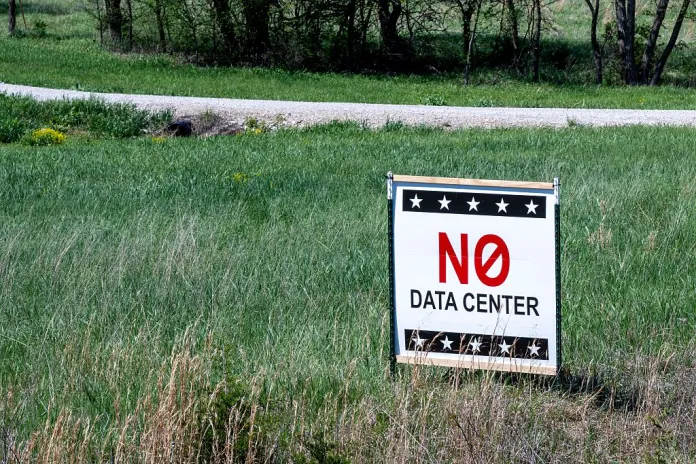
Freezing beneficial projects has real costs. In Maine, the moratorium would kill a planned data center at a former paper mill in Jay that closed in 2023, eliminating 1 million square feet of new economic activity on a site that once employed over 1,000 people. A state senator warned the ban would also cost his district 100 long-term jobs from a separate project that planned to generate its own power. These are not predatory developments. They’re exactly the kind of investment struggling communities need.
The economic stakes are real. The United States hosts 54% of the world’s hyperscale data centers, and every month of delay pushes investment toward China, Europe, and the Middle East. Writing in opposition, Sen. John Fetterman (D-PA) put it bluntly: “I refuse to help hand the lead in AI to China.”
South Dakota saw the same question and answered it differently. It rejected its proposed moratorium and instead passed a “Data Center Bill of Rights” that requires large facilities to cover their own costs and gives local governments the authority to regulate or block projects as they see fit. That’s the right model: targeted rules that protect communities without freezing an entire industry.
AI IS FUELING MAIN STREET GROWTH. POLICYMAKERS SHOULD KEEP UP
The concerns behind these moratoriums deserve serious attention. But between federal environmental law, hundreds of state bills moving through legislatures, local zoning authority, and industry commitments to cover its own infrastructure costs, the tools to address them already exist.
Blanket bans don’t protect communities. They strip away the leverage communities need to negotiate investments, infrastructure upgrades, and local benefits on their own terms. That’s not protection. It’s paralysis.
Robert Mayo, PhD, is a research specialist at the Sheila and Robert Challey Institute for Global Innovation & Growth at North Dakota State University.