

Stop me if you think you’ve already heard this story.
On Jan. 6, a violent mob stormed the Capitol and confronted armed guards amid partisan charges of vote tampering and election rigging. Early ballot counts pointed to a Republican victory, but the seemingly secret ballot certification dragged on for weeks, and suspicions fueled charges of corruption. When the Democrats were declared the victors, an armed mob sought to overthrow the government. At any moment, insurrection could explode.
Stay informed.Stay ahead.
Join Washington Examiner for unlimited access to the news, analysis, and commentary that matter most.
Already a member? Log in
The year was 1880. The capital was Augusta, Maine. And for the second time in his life, Joshua L. Chamberlain stepped into the deadly breach.
Chamberlain was born in 1828 and graduated from Bowdoin College in 1852. After attending theological seminary, Chamberlain returned to Bowdoin in 1855 as professor of languages and rhetoric.
Chamberlain embraced the Victorian values of masculinity, chivalry, and morality. In 1905, he wrote, “Manhood is one of the noblest of God’s gifts or manifestations.”
This statement didn’t spring out of hubris or misogyny. It revealed his dedication to a lifestyle focused on duty, the cultivation and exercise of one’s talents, and the discovery and fulfillment of one’s true purpose.
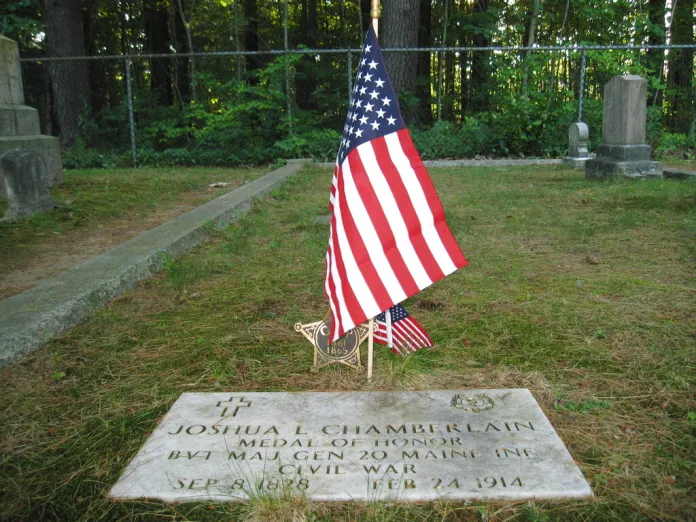
This is the man who, on July 2, 1863 — now a volunteer colonel leading the 20th Maine Regiment — was told by his commander to hold the Union’s far left flank on Little Round Top at the Battle of Gettysburg. “Hold the ground at all hazards,” he was told.
“At all hazards” included death, not retreat. After withstanding multiple attacks and with ammunition dwindling, Chamberlain swung his troops in a bayonet charge that secured the Union’s left flank. Congress awarded Chamberlain the Medal of Honor for “conspicuous gallantry.”
After serving with great distinction and being wounded six times, including a near-fatal wound in Petersburg, Virginia, Chamberlain left the army in 1866, returned to Maine, and was elected governor for four one-year terms. After leaving office, he returned to Bowdoin and was appointed president in 1871.
Now, back to 1880 and the original Jan. 6 Capitol riot. Because no one emerged with a popular majority in Maine’s 1879 election for governor, state law required the newly elected legislature to elect the governor. And it appeared that Republicans had won the legislature’s majority.
That is until the incumbent Democratic governor, Alonzo Garcelon, and his executive council worked in secret to reject Republican ballots on arbitrary technicalities. After many weeks, the council reversed the election of 12 Republicans, replacing them with Democrats and Greenbacks. The reversal was enough to ensure that the new governor would not be a Republican.
Garcelon stationed 100 men inside the Capitol and armed them with cartloads of weapons, which incited more threats of violence from the growing number of armed protesters gathering in Augusta. Soon Democrats, Greenbacks, and Republicans were each assembling their own armies, aiming to seize the statehouse and install their choice for governor. Garcelon realized that he could not stem the threat of armed conflict and called on Chamberlain to establish order.
Chamberlain became the interim governor. To avoid inflaming the crisis further, he refused to call up the state militia, and he had Garcelon’s goons and weapons removed from the Capitol.
Chamberlain remained neutral and faced plots from all sides of kidnapping and assassination. The story goes that Chamberlain stepped in front of a crowd that was calling for his death, tore open his coat, and challenged the mob to kill him. The crowd backed off, apparently cowed by his courage and historic stature.
WHY ‘ALL MEN ARE CREATED EQUAL’
Eventually, the courts reinstated the 12 Republican legislators, leading to the election of a Republican governor. Chamberlain returned home and continued as president of Bowdoin until 1883.
Our country has been blessed by the right person at the right time who stood in the breach and held the ground “at all hazards.” The state of Maine, the Union, and our entire nation have been blessed that Joshua Chamberlain stood and held twice.