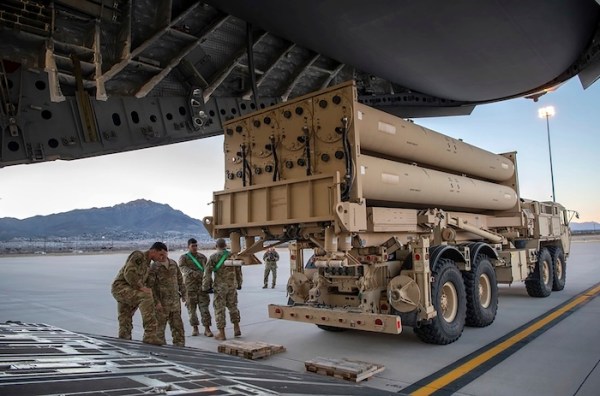
Whether you opt for President Donald Trump’s doctrine of Peace through Strength or the timeless words of Teddy Roosevelt: “Speak softly and carry a big stick,” wars are often won long before a shot is fired. As our nation’s resolve is tested constantly on multiple continents, America must always be prepared for any scenario that our enemies present.
On Nov. 7, 2025, War Secretary Pete Hegseth stated: “Our objective is to … rebuild the arsenal of freedom. American industry and its innovative spirit are begging to be unleashed to solve our most complex and dangerous warfighting problems.”
Recommended Stories

Thirty-five years of working in procurement for the U.S. Air Force has taught me that this will only be achievable if we take a multipronged approach, as the battlefields of today are changing quicker than our old methods can predict and respond.
The Department of War must expand the base, embrace advanced manufacturing methods, work more closely with our allies, and fix bottlenecks to transform weapons design and production.
We, the military, need the ability to rapidly scale at a rate faster than the rate of replenishment.
Here is my four-point plan to build a true Arsenal of Freedom:
Expand the base
COVID-19, Ukraine, and now Iran revealed the fragility and limitations of our industrial base and supply chains. For too long, we have self-limited our sources for weapons because of overly restrictive requirements, red tape and selection processes. Through agile acquisition approaches, less rigid requirements, and broader acceptance of commercial technology, there are now many new suppliers in the mix.
The addition of new contractors gives us more options, increases competition to accelerate innovation, and improves affordability. It also contributes to geographic dispersion for increased redundancy and reduced risk to continuity of operations.
Advanced manufacturing methods
The old ways don’t scale fast enough. New companies are applying automation, digital methods, and machines broadly applicable across multiple product lines.
This approach reduces lead-time from design to production, requires less up-front investment, and requires less specialized workforce training.
By maximizing commercial technology and manufacturing methods, we also maximize dual-use potential for continuity of operations. This means that companies can focus on military equipment when demand is high and use the same machinery for commercial products when military demand is low.
The key is to start by designing for manufacturing instead of building the prototype and then figuring out how to make it. This approach not only unlocks the ability to scale rapidly, but it also allows for more participants because they are using common machinery and methods.
Allies and partners
Innovation is occurring worldwide. There is so much untapped potential in the commercial sector today. The United States needs to harness that by partnering with allies and partners like Israel, Australia, and the United Kingdom. Let’s build the “base models” anywhere with the potential to scale up rapidly, and specialize according to the means available in those regional supply chains.
How do we do that? We use a weapon open systems architecture in our designs. We define the interfaces, and then industry supplies the critical components to “plug and play.”
Each allied partner can tailor the configuration to meet their unique requirements. This creates even more production nodes in multiple theaters and, with cooperation on interoperability, a broader inventory of military equipment to draw upon between allies.
Attack the bottlenecks
We can’t afford to produce weapons at a full tilt forever, nor should we. Stockpiling too many of the best weapons available today will only limit our ability to buy the best weapons available in three to five years.
We must stress the system to reveal the pinch points, including the business process for managing them. We should surge production in spurts until it breaks, identify the reasons why, and then aggressively drive down the risks for future production runs.
I WENT TO ISRAEL WHERE MANY EXPECT CONFLICT. I FOUND A HOSPITAL THAT’S SOLVING IT
Weapons have unique sourcing requirements. We also need multiple sources for warheads, rocket motors, jet engines, sensors, etc. Stressing the system will build confidence that we can rapidly scale when necessary. That confidence also equates to deterrence for our possible adversaries. Speed to the ramp: A factory delivering weapons as quickly as possible to the warfighter is a weapon in itself.
Pursuing one or two of these initiatives at the exclusion of others will be good, but insufficient. It’s through the combination of all of them that we build a competitive environment, an innovation engine, a formidable arsenal, and a range of options that our strategic leaders require to preserve our national security and bolster our allies. We don’t need to have perfect knowledge about what the future holds — we simply need to be better prepared and postured to respond.
Brigadier Gen. (Ret.) Chris ”Alf” Athearn spent over three decades working in procurement for the U.S. Air Force and now acts as strategic adviser to Massivit-RapidWings.