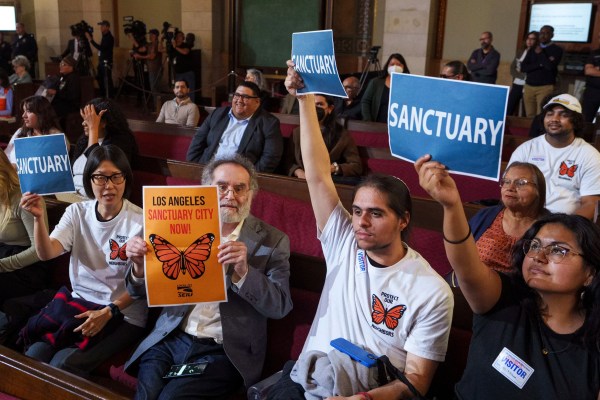
The immigration debate rarely leaves room for practical governance, compromising public health integrity while trapped in partisan bickering. From my vantage point as a physician, a local judge, and a former county official, communities cannot be managed through political slogans. They run on finite resources, infrastructure, and the law. Looked at through this nonpartisan lens, sanctuary policies fail to live up to their name. They trigger a systemic breakdown in coordinated governance that strains local infrastructure while leaving undocumented individuals trapped in a vulnerable limbo.
A functional society relies on predictable frameworks. Local municipalities and state governments cannot choose to opt out of federal systems without fracturing the rule of law and eroding public trust. This fracture is evident as the U.S. Department of Justice sues states such as Maryland to stop local mandates, specifically the state’s Community Trust Act, from deliberately obstructing unified federal operations. True civic compassion requires clear, enforceable, and unified laws. When cities create arbitrary safe havens, they bypass necessary federal accountability, leaving local systems to handle a national issue without national support.
Recommended Stories
This lack of coordination creates an immediate fiscal conflict. Advocates frequently point to the macroeconomic contributions of undocumented immigrants, noting that these individuals pay billions in sales, property, and payroll taxes. While these aggregate figures are real, they represent a fundamental misunderstanding of local municipal budgeting. Local governance operates under rigid, annual cash-flow realities funded by localized tax revenues to provide essential public services, ranging from K-12 classrooms to overstretched emergency response teams.
The macro-level tax contributions cited by economists do not flow back down symmetrically or rapidly enough to localized budgets. A county school district or municipal health department cannot balance its current annual budget on theoretical, future federal redistribution models. Local governance operates under the rigid reality of finite tax dollars; there is no mathematical justification for pretending these resources are infinitely scalable. Recent congressional oversight investigations into sanctuary costs highlight how billions in unbudgeted municipal allocations drain local capabilities, forcing hard trade-offs on communities.
This strain on infrastructure directly undermines the public health metrics cited by officials who champion sanctuary policies. Proponents argue that by extending sanctuary status and local health benefits, undocumented individuals are encouraged to seek preventive care at community clinics, reducing the burden on expensive emergency departments. Yet, true medical provision requires predictable demographics, structured funding, and stable infrastructure.
This theory collapses under the weight of sheer volume. Public health infrastructure is not infinitely flexible. When state and local officials bypass federal coordination, they introduce unmeasured, unbudgeted demand that quickly overwhelms community clinics. Once these localized primary care options are saturated, individuals are systematically forced back into emergency room triage, which remains the most expensive and least effective form of primary care.
From an epidemiological standpoint, a fragmented public health system acting independently of federal oversight cannot properly manage long-term communicable diseases or tracking protocols. This operational friction delivers substandard, fragmented treatment to undocumented individuals while degrading the quality, speed, and availability of care for the legal citizens who fund these facilities. Severe fiscal realities have already forced a growing number of states to scale back immigrant health coverage due to mounting, unsustainable budget pressures on public safety nets.
This operational fracture extends past hospital walls and directly compromises broader community safety. A foundational argument for sanctuary policies is that if local police cooperate with federal immigration authorities, immigrant communities will fear deportation and refuse to report crimes. While maintaining open lines of communication is a valid law enforcement objective, using it to justify a blanket policy of noncooperation creates a dangerous administrative blind spot.
Federal databases are only as useful as the real-time access allowed by local authorities. When a jurisdiction ignores civil immigration detainers, it actively breaks the chain of federal vetting. While the overwhelming majority of undocumented individuals seek a peaceful livelihood, a completely noncooperative system strips away the vital vetting mechanisms required to screen out dangerous bad actors. As constitutional legal scholars from the Federalist Society network have noted in lectures published in the Hillsdale College Imprimis digest, bypassing uniform federal authority dismantles the foundational legal protections built to ensure domestic tranquility.
WE ALREADY HAVE AMNESTY. THE DIGNITY ACT WILL END IT, SECURE THE BORDER, AND RESTORE ORDER
Beyond public safety, promising sanctuary creates a multilayered illusion of safety. Advocates claim sanctuary status protects vulnerable individuals from labor exploitation by letting them report corporate abuses without fear of deportation. In reality, the exact opposite occurs. Local sanctuary policies cannot grant federal work authorizations. By encouraging people to reside where they cannot legally work, these policies lock individuals into the underground economy, leaving them at the mercy of unscrupulous employers and substandard housing.
Turning cities and states into political statement zones helps no one. This is a reality check on structural capacity and the rule of law. We cannot run a nation on conflicting rules where local choices undermine federal responsibilities. True reform requires an integrated approach. The federal government must fulfill its role in managing immigration, and local infrastructure budgets must be protected. It is time to move past the rhetoric of sanctuary cities and states, and return to a system of accountable governance that respects the law, protects local communities, and preserves human dignity.
Eric Wargotz, MD, is a practicing physician, a Clinical Professor Emeritus at the George Washington University School of Medicine and Health Sciences, a Judge of the Orphans’ Court of Queen Anne’s County, Maryland, Judiciary, and the former elected President of the Queen Anne’s County Board of County Commissioners. He serves as the 178th president of MedChi (The Maryland State Medical Society). The views expressed in this article are solely his own and do not represent the official positions of any of his affiliates.