

President Donald Trump threatened to bomb Oman if it “gets in the way” of American plans for the future of the Strait of Hormuz. Despite the threat, Iran and Oman announced that they are nearing an agreement to open and manage a single corridor through the strait. While this statement doesn’t address tolling, Muscat has previously signaled that it would accept a joint fee-collection mechanism with Iran. This stands in direct opposition to promises from Trump that Hormuz will be “open, safe, and free.”
Operation Economic Outcast, the Trump administration’s campaign to cut off Tehran’s remaining financial lifelines, can offer an outlet for that frustration. Washington should tell Muscat that unless it ends its financial enabling of Iran and its proxies, Omani financial institutions will be disconnected from the U.S.-led financial system.
Stay informed.Stay ahead.
Join Washington Examiner for unlimited access to the news, analysis, and commentary that matter most.
Already a member? Log in
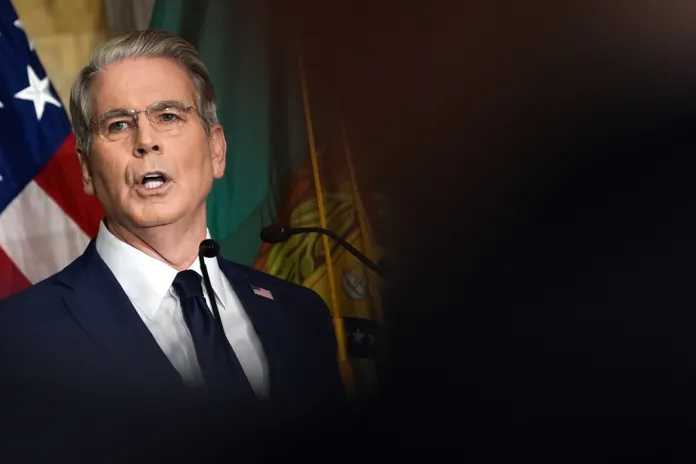
Treasury Secretary Scott Bessent has described the foreign infrastructure sustaining Tehran in broad terms, including exchange houses, banks, shipping services, and entities supporting Iran’s aviation sector. Oman offers examples across each of these categories.
Oman’s utility to Iran is most evident in the commercial infrastructure that has enabled Iranian sanctions evasion for years. Since January, the Treasury Department has sanctioned three Oman-based companies for helping transport Iranian oil, arranging vessels on behalf of the Islamic Revolutionary Guard Corps, and processing payments tied to Iran’s proxies.
These actions, however, appear to capture only a small part of Iran’s footprint in Oman. Open-source research identified several companies that openly advertise services facilitating Tehran’s commercial activity abroad. Some promote cargo routes between Iranian and Omani ports, while others market petroleum and petrochemical products to foreign buyers through their presence in Oman.
Persian-language exchange services also advertise arrangements in which customers hand over Omani rials in Muscat while the equivalent amount is credited to an account in Iran, a mechanism commonly associated with the hawala system. OmanEx, for example, advertises converting Omani rials into Iranian currency and depositing the funds into Iranian bank accounts. It also says customers can settle transactions through cash or Omani bank accounts. The service has even advertised an Iranian point-of-sale terminal in Muscat that connects to Iran’s domestic banking network, allowing Iranian bank cards to be used to withdraw Omani rials locally.
Iranian banks sanctioned by the United States, including Bank Melli and Bank Saderat, remain operational in Oman and continue to be listed by the country’s central bank as licensed institutions. Bessent made it clear that “every Bank Melli branch must be shuttered.”
Iranian air carriers continue to access Oman through local travel agents and sales representatives. Ummah Star Solution, an Omani company, was reportedly appointed as a sales partner for Mahan Air, the Iranian carrier sanctioned by Washington for providing support to the Quds Force, the Guard’s extraterritorial arm. The Treasury has recently sanctioned Mahan Air’s general sales agents in other countries for providing commercial support to the airline. Yet its Omani sales partner remains undesignated.
Oman also enables Iran’s partner in Yemen, the Houthis. The Yemeni terrorist group operates a headquarters out of Muscat under Mohammad Abdul Salam, the group’s chief negotiator and a U.S.-designated terrorist. While the ostensible purpose of this office is for dialogue on the peace process in Yemen and with the international community, it is also a financial and procurement hub for the Houthis. In 2025, the United Nations Panel of Experts on Yemen noted that border crossings between Oman and Yemen “are regularly used to bring in items intended for military use.”
The Houthis are increasingly shifting from relying on smuggled, complete weapons systems to importing parts and dual-use components to finish production in Yemen. Front companies in Oman play a key role in procuring these materials and then smuggling them to the Houthis.
As the Trump administration executes Operation Economic Outcast, support for Iran’s proxies should be treated as support for the regime itself. Washington should inform Muscat that it must expel Houthi officials, terminate the group’s access to the international financial system via Omani institutions, and close front companies supporting the Houthis.
WHITE HOUSE REPORT CARD: EVEN OUR REPUBLICAN STRATEGISTS SAY THERE’S NO GOOD NEWS THIS WEEK
Washington should give Oman a defined timeline to close Bank Melli and Bank Saderat branches and to prevent Omani banks and exchange services from facilitating sanctioned Iranian transactions. Muscat should also terminate commercial support for, and revoke the licenses of, entities that support designated Iranian airlines and oil and petroleum networks. If Muscat refuses or stalls, Treasury should begin imposing sanctions and correspondent-account restrictions on the Omani institutions involved.
Operation Economic Outcast was designed to force governments to choose between facilitating Tehran and retaining access to the U.S.-led financial system. Oman should not be exempt from that choice.
Ahmad Sharawi is a senior research analyst at the Foundation for Defense of Democracies, focusing on Middle East affairs.
Bridget Toomey is a research analyst at the Foundation for Defense of Democracies, focusing on Iranian proxies, specifically Iraqi militias and the Houthis.