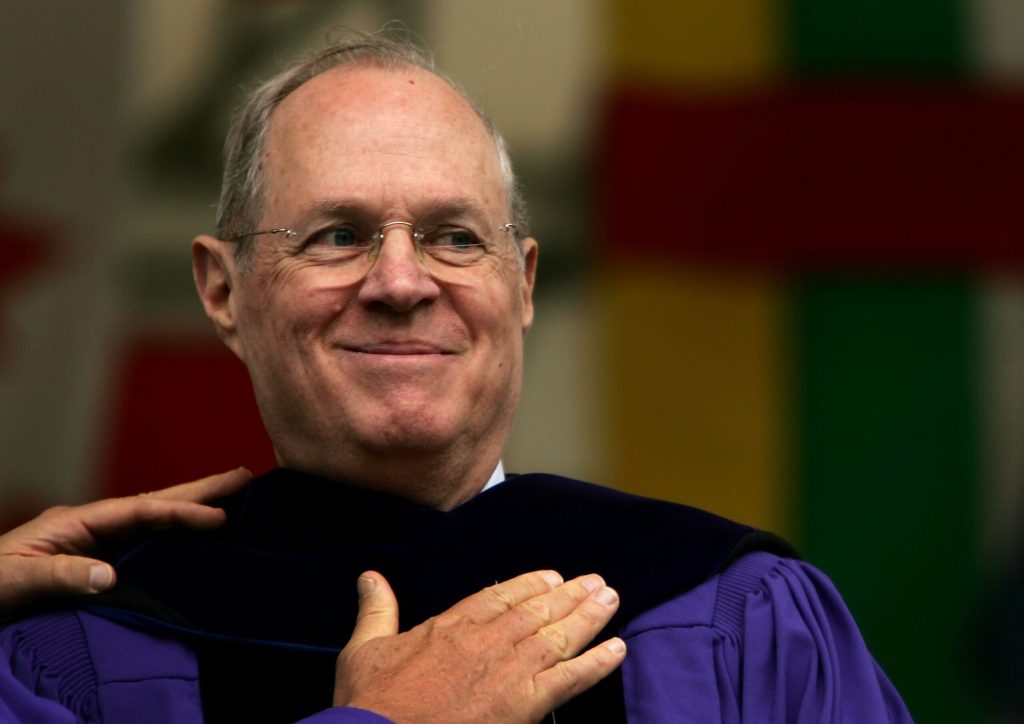
Justice Anthony Kennedy caused quite a stir in a Supreme Court death penalty decision in 2005, when he observed that in deciding such cases it might be appropriate to consider the laws of other nations or Article 37 of the United Nations Convention on the Rights of the Child — an international agreement that was never ratified by the U.S. Senate. For all the attention Kennedy’s observation received at the time, there was another aspect of the story that got no coverage but which legal scholar Walter Olson recently brought to light. Writing in the Capital Research Center’s Foundation Watch, Olson pointed out that the decision, including the suggestion regarding the role of international law in determining U.S. domestic statutes, “resulted from a campaign of legal and public advocacy built up over years, in which foundation grant-making was a driving force.”
Specifically, Olson was referring to a juvenile justice program at the Northwestern University School of Law in Chicago, which was directed by former Weather Underground terrorist Bernardine Dohrn and heavily supported by funds from the Ford Foundation and other liberal philanthropies. Olson’s point was not to criticize such funding decisions or to take a position one way or the other on the propriety of subverting U.S. law to foreign or international pronouncements. Rather, it was to highlight the degree to which philanthropies such as the Ford Foundation can have a decisive influence on the direction of American jurisprudence.