

For some, artificial intelligence and its related components represent a boon for the human community. A tool of unimaginable power that will finally enable us to control almost every aspect of our lives — even death and the afterlife. For others, it evokes a sense of impending doom.
“Don’t worry about it,” say the enthusiasts. People said that about the lightbulb, and the telephone, and computers, too. Don’t be a Luddite. And anyway, look around. Humanity survived.
Recommended Stories


Well yes, say those who look on with some trepidation. Human nature always reasserts itself.
But we seem to have deconstructed that, too. We have come to a place where we are not even sure human nature is a real thing. What happens when we decide to leave the real world behind?
Perhaps these conflicting views account for why there was real anticipation when word got out that Pope Leo XIV planned to publish an encyclical on the matter, not only among those in the Catholic community. The first American pope was going to weigh in on an issue of significance to just about everyone.
With the promulgation of Magnifica Humanitas on the 135th anniversary of Pope Leo XIII’s landmark encyclical in 1891, Rerum Novarum, Pope Leo XIV follows the trajectory established by his namesake and the practice of every pope since. But what distinguishes his particular contribution to the papal social tradition? Like Pope Leo XIII’s encyclical, which was a response to the excesses and perils of the industrial Revolution and a profound defense of the dignity of labor, Magnifica Humanitas is a response to the Digital Revolution and the advent of AI — a pending crisis with the potential to impact society at a similar scale.
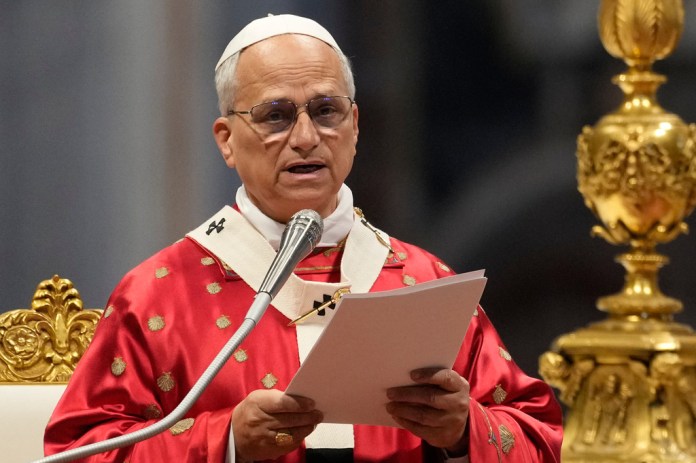
Magnifica Humanitas brings both nuance and not a little clarity to the questions we face. Pope Leo XIV is clear: “Technology should not be considered, in itself, as a force antagonistic to humanity.” It is “a profoundly human reality, linked to the autonomy and freedom of man,” which has significantly improved the living conditions of humanity.
But we now find ourselves facing a new situation, for “never has humanity had such power over itself.” And yet, even the creators of this new technology do not truly understand its workings and potential, making its long-term impact difficult to assess.
While in a mostly silent way, it has crept into every aspect of community life, from its impact on our children, to our understanding of ourselves and our relationships with one another, to the things we all think are important and worthy of imitation. Now seemingly orchestrated by people whom we do not know, did not elect, have no way of influencing, and who remain unaccountable to us.
Everything will depend on the criteria, that is, the moral principles, with which we evaluate our way forward. And the noble principles of the church’s social doctrine present us with such a framework, one that is fundamentally grounded in a coherent understanding of the human person and the conditions necessary to making life more human for all.
But these principles are not meant only for believers. They are essential to the workings of democracy and the hopes and dreams of all people.
Above all, we must resist the “technocratic paradigm” that reduces everything to the “logic of efficiency, control and profit.” And we must give up the idea that technology is “simply a tool” and therefore “morally neutral.”
This is an illusion. When this paradigm “becomes the standard by which everything is judged, it begins to dictate what matters and what can be discarded, reducing creation to an object of exploitation and human beings to mere cogs in a system driven toward ever greater efficiency.”
Magnifica Humanitas has weaknesses, yes. It is tempting to point them out. But I think we have reason to hope that, like Rerum Novarum, this present encyclical will provide a critical and timely counterweight to what appears to be an unstoppable force — a powerful and certainly useful technology that, at the same time, presents the human community with considerable risk.
RESTORING AMERICA: CAN AI AVERT THE IMPENDING FEDERAL BUDGET CRISIS?
The pope makes the choice we face crystal clear: Contemplate and deliberate the way forward — and determine to build something “profoundly human” and worthy of man. Or, driven by a false sense of urgency and deceitful promises, construct what amounts to another Tower of Babel.
Now is the time to stop and ask: What are we building? And to what end?
Dr. Deborah Savage is a professor of theology at Franciscan University of Steubenville and the director of the university’s Institute for the Study of Man and Woman.