
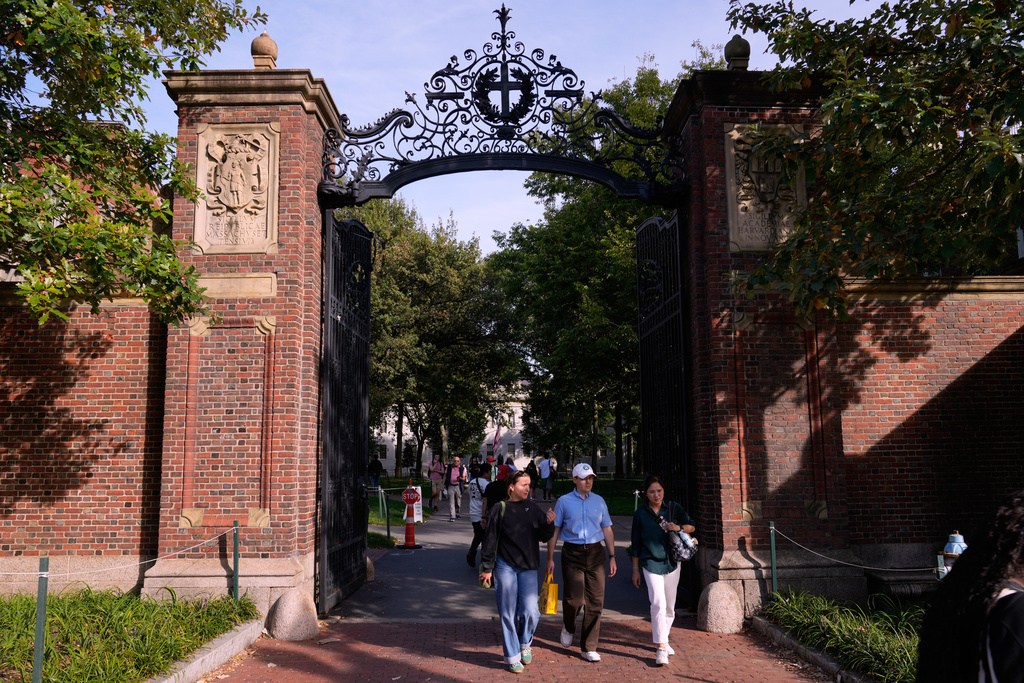
Harvard’s Faculty of Arts and Sciences voted to cap “A” grades in undergraduate courses at roughly 20 percent of enrollment beginning in fall 2027. Nearly 70 percent of voting faculty backed the measure. It’s one of the most aggressive reversals of grade inflation in modern American higher education.
The coverage has, predictably, focused on signaling. When two-thirds of letter grades are straight “A’s” and roughly 85 percent fall in the “A” range, the credential collapses under its own weight. Harvard’s report, written by Dean of Undergraduate Education Amanda Claybaugh, called the system “failing” and described grade inflation as a “race to the bottom.”
Recommended Stories
The signaling argument is correct as far as it goes. But it misses the more important consequence of capping “A’s,” the one that should matter most to anyone concerned about the intellectual culture of American higher education.
Grade inflation does not only corrupt transcripts. It corrupts the choices students make about what to learn and how to learn it. And it corrupts the choices faculty make about what to demand.
Years ago at Brown, one of us watched a colleague who had just won the university’s seminar teaching prize use her acceptance speech to celebrate giving every student in her class an “A”. The room applauded. That is the institutional culture Harvard’s cap is reacting against, a culture in which refusing to grade has become pedagogical virtue rather than abdication. By extension, it is a submersion of the more basic ideal of merit.
Claybaugh’s report named the student-side problem directly: The current system motivates students to “only enroll in classes where they could excel.” Joshua Greene, the psychology professor who co-wrote the proposal, put it more vividly: “It’s like every student starts college with a shiny new car, and their goal is to go four years without a scratch.”
Anyone who has taught undergraduates in the past decade has watched this play out. One of us has spent nearly two decades on a small liberal arts campus and seen students openly avoid specific courses, particular professors, or even departments because their grading was known to be honest. The conversations are explicit: Students will not risk a B. They drop classes when they discover the evaluations are real. They build schedules around perceived leniency rather than intellectual interest.

This is self-censorship by another name: not of speech, but of curiosity. The mechanism is identical. The cost of visible difficulty has become too high to bear. The very idea of achievement is dulled.
A National Bureau of Economic Research working paper found that grade-forgiveness policies measurably shifted students toward harder courses, particularly in STEM, with the effect concentrated among students who otherwise would have avoided the risk. Decades of motivation research reach the same conclusion: When grades dominate, students shift from grappling with ideas to protecting themselves.
The Harvard cap is an attempt to reintroduce information into a system that has lost the ability to convey it. But the deeper promise of the policy lies in what it could do for intellectual culture if other institutions follow. When a “B” is no longer catastrophic, students gain room to make choices they currently cannot afford and to take intellectual risks. Curiosity and authentic intellectual growth can once again motivate learning and exploration toward passions rather than grades. Students can speak in class while still working out what they think. They can be wrong, recover, and move on. Instead of being locked on a plateau of perfection, they can demonstrate improvement over time.
This matters far beyond grading. The campus speech climate has deteriorated in well-documented ways. Analysts typically treat grade inflation and speech climate as separate problems, but they are not. Both reflect institutions that punish intellectual exposure and reward conformity. Both teach students that the safest move is the unspoken thought, the easier class, the agreed-upon position. A grading reform serious about distinguishing real performance from safe performance is, indirectly, a speech-climate reform.
Some departments and whole disciplines may object to this more rigorous approach, where individual merit is recognized. But that will be useful information too, as universities undertake the brick-by-brick process of rebuilding public trust.
The policy is imperfect. “A-minus” grades fall outside the cap, creating an obvious workaround. Nearly 85 percent of students surveyed by the Harvard Undergraduate Association opposed the proposal, not because they wanted intellectual rigor, but because they wanted to defend the credential. That tells us something important: The students opposing grade reform are operating on the same logic that produced the problem.
ONE CHILD, ONE VOTE: END EDUCATION WITHOUT REPRESENTATION
Faculty critics warned that strict caps would treat students like statistics rather than human beings. The honest reply is that the current system already treats them like statistics; it simply produces a useless distribution. Capping “A’s” does not solve grade inflation by itself, and it does not solve the broader collapse of intellectual culture on American campuses. But it is the first serious move by a major university in a generation, and the second-order effects — on course selection, classroom participation, and the willingness to risk being wrong — deserve more attention than the transcript debate has received.
Other institutions are watching. They should follow.
Samuel J. Abrams is a professor of politics at Sarah Lawrence College and a senior fellow at the American Enterprise Institute. John Tomasi is the president of Heterodox Academy.