

Every time supporters of election reforms like voter ID and citizenship verification, which are intended to improve the security and integrity of our elections, win a case in the courts, opponents drag out the “mass disenfranchisement” claim. You can see that tiresome con game being played once again with the Supreme Court’s Sept. 25 decision in Department of Homeland Security v. League of Women Voters.
It’s not only that the claim has been disproven by the remarkable turnout numbers in states like Georgia that have implemented reforms like voter ID, but federal law specifically prevents disenfranchisement from occurring even when election officials make a mistake.
Stay informed.Stay ahead.
Join Washington Examiner for unlimited access to the news, analysis, and commentary that matter most.
Already a member? Log in
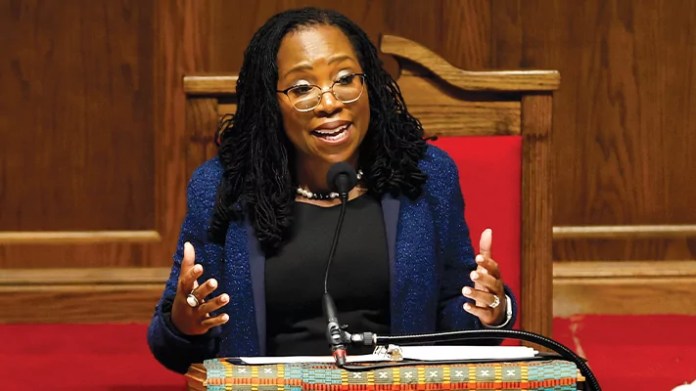
Of course, you wouldn’t know that because it’s never mentioned in any of the hysterical media coverage of the DHS case, nor was it mentioned by Justice Ketanji Brown Jackson in her hyperbolic dissent, which was joined by Justices Elena Kagan and Sonia Sotomayor.
What was the DHS case about? The use by state election officials of DHS’s Systematic Alien Verification for Entitlements (SAVE) database to verify the citizenship of registered voters. The database has existed since 1986, and no one has ever complained about its use by state agencies to verify the citizenship of aliens applying for federal welfare benefits administered by the states.
It was only when the Trump administration added information from the Social Security Administration to the database, supplementing information from DHS, the Justice Department, and the State Department, and upgraded the software to make bulk, not just individual, searches possible, that the usual opponents of election integrity suddenly decided that having a more effective, more accurate system couldn’t be allowed.
They found a willing federal judge in Sparkle Sooknanan, a Biden appointee, who enjoined use of the database because, she claimed, it violated the confidentiality provisions of the Social Security and Privacy Acts for DHS to receive Social Security information and implement a bulk searching capability. But as the Supreme Court pointed out in a per curiam (that is, unsigned) opinion dissolving her injunction while the case is being litigated, immigration law clearly overrides those Acts.
In 1996, Congress expressly authorized DHS to request and receive information “regarding the citizenship or immigration status, lawful or unlawful, of any individual” from other federal agencies. Not only that, but the statute, 8 U.S.C. § 1373, says that its provisions apply “[n]otwithstanding any other provision of Federal, State, or local law.” Moreover, “no person or agency may prohibit, or in any way restrict, a Federal, State, or local government entity” from requesting, sending, or receiving information on citizenship and immigration status.
This law could not be more straightforward. Everything DHS did to enhance the SAVE database was perfectly legal, and the injunction preventing states from using it was manifestly improper. Yet in her dissent, Jackson claimed the majority’s interpretation of this provision is “implausible” and that allowing state election officials to use the SAVE database will result in “disenfranchising” lawful voters.
It is Jackson and her two liberal colleagues who are making an implausible argument. Not only are they wrong on this immigration law, but their disenfranchisement claim is also wrong under another federal law that neither they nor liberal reporters ever mention.
In the Help America Vote Act of 2002, Congress implemented a provisional balloting requirement. Codified at 52 U.S.C. § 21082, this section mandates that if a voter’s name is either not on the registration list or an election official claims the person is not eligible to vote, the individual must “be permitted to cast a provisional ballot.” The voter also separately fills out a form explaining how and why that voter believes he or she is registered and eligible to vote. Election officials must investigate this, and if it turns out they made a mistake, the ballot “shall be counted.” No ifs, ands, or buts about it. Moreover, the would-be voter has to be notified about the results of the investigation and whether the ballot was counted.
What does this mean? That in the rare instances that election officials make a mistake, no one is going to be “disenfranchised” and not allowed to vote. Anyone who claims differently either doesn’t know the law or is deliberately trying to mislead the public. I don’t know which of these camps Jackson falls into.
At the end of her dissent, Jackson claims that “the harm” caused by “disenfranchising even a few lawful voters outweighs the nonexistent harm that the Government” will experience from allowing use of the SAVE system.
Really? No “few lawful voters” are going to be disenfranchised, since even if they are removed from the registration list because a state mistakenly believes they are not citizens, they will be able to vote through a provisional ballot that will be counted once it is verified that they are U.S. citizens.
And “nonexistent” harm to the government? How about the fact that, as the majority pointed out, DHS will be prohibited from complying with a federal law that says it must respond to citizenship inquiries. Or how about the harm caused by the many close elections we have in this country, particularly at the local level, potentially being decided by a handful of the 30,000 aliens found on the voter rolls by Reuters in its latest report on this issue?
The real harm being done to honest, fair elections and the public’s confidence in the election process is by those who oppose common-sense, legal election reforms and by judges who misrepresent and misapply the law.
Hans von Spakovsky is a Senior Legal Fellow at Advancing American Freedom and a former Commissioner on the Federal Election Commission.