

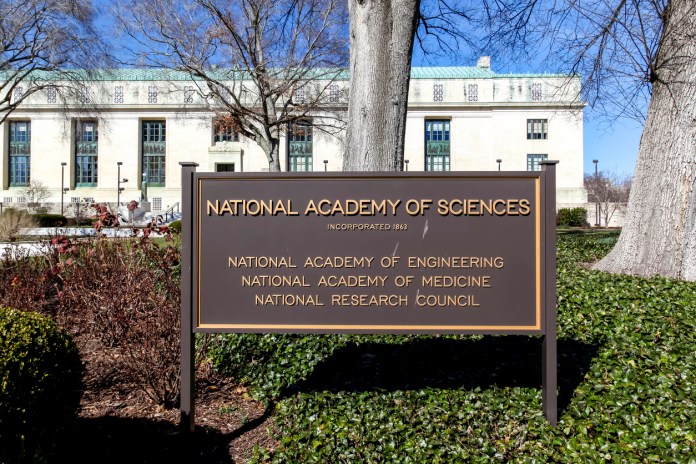
In a new report, the National Academy of Sciences endorses “extreme event attribution (EEA), a field of climate science that analyzes whether and to what extent human-caused climate change influenced an individual extreme weather or climate event.” This endorsement is based upon purported “expanded observational datasets, large-ensemble simulations, and methodological advancements over the past decade…”
This is balderdash, as the NAS itself concluded (p. 29) in 2016: “Event attribution questions are often posed in terms of a specific actual event, but definitive attribution of a specific event in a deterministic manner is generally not possible.” Have matters changed much in terms of climate predictions over the last decade? No, they have not: The climate models used by the Intergovernmental Panel on Climate Change were no better in 2021 than in 2014: They continue to overpredict atmospheric temperature trends by a factor of about 2.5.
Real journalism.Trusted by millions.
Unlimited access to in-depth reporting, expert analysis, and the stories that shape our country.
Already a member? Log in
NAS was correct then and wrong now. Climate models have enormous difficulty merely distinguishing the effects of natural influences from anthropogenic (“manmade”) factors when used to explain the causes of changes in broad, long-term climate phenomena. Because a specific weather event — statistically, a single observation — is driven by a complex mix of innumerable factors, it cannot be explained as the result of several factors, only one of which is increases in atmospheric concentrations of greenhouse gases. A given combination of factors might produce a given weather event, and a different combination of factors might do the same.
That is why IPCC (p. 1611) concludes that “Scientists cannot answer directly whether a particular event was caused by climate change, as extremes do occur naturally, and any specific weather and climate event is the result of a complex mix of human and natural factors.”
That is why a recent paper in the Journal of Climate concludes that changes in extreme weather events are difficult to attribute to anthropogenic climate change because the data for extreme weather events are not available over a time period sufficient to observe repeated specific weather events so as to allow for statistical analysis, and because of, again, the difficulty of separating the effects of manmade and natural factors.
The NAS report is useful nonetheless because it illustrates two political truths. At a narrow level, it demonstrates yet again that government “science” can be deeply problematic, subject to substantial political pressures and crucial biases. The bureaucracy is an interest group pursuing bigger budgets, more regulatory and policy authority, greater monopoly power in the delivery of given services, ever-higher compensation defined broadly, immunity from termination, and on and on. Accordingly, government studies should be subjected to the same scrutiny as those produced by an industry group.
This is particularly the case with the NAS report because Michael Burger is listed in the Acknowledgements section as having assisted those who prepared it. Burger’s assistance included a presentation in November 2024, laying out how litigation against oil companies has progressed. His affiliation in the report is listed as “Columbia University,” but that shunts aside the fact that he is Of Counsel at Sher Edling, a law firm heavily involved in climate litigation against fossil energy producers. In fact, Burger’s name is on the lawsuits filed by Delaware in 2020, Honolulu in 2020, and New York City in 2021. Why did NAS fail to disclose any of this?
More generally, the NAS report demonstrates that climate alarmism is very far from over, despite the IPCC abandonment only this past spring of the extreme GHG scenarios that were described broadly as “business as usual.” For the environmental left — the ideological opponents of fossil fuels — anthropogenic climate change is the perfect issue because it provides a rationale for government control of every aspect of people’s lives. Where they live. In what kinds of housing they live, with what kinds of appliances and equipment. What kinds of transportation they are allowed to use and where they are allowed to go. What kinds of foods and clothing and packaging are allowed. And above all: How many children they are allowed to have.
SLOWING DATA CENTER CONSTRUCTION SIGNALS THE NEED FOR PRO-GROWTH REFORMS
That is why the environmental left will not and cannot abandon “climate change” as an issue. They will argue that the effect of rising GHG concentrations in the atmosphere has been sharply understated. That rising ocean temperatures will cause a massive release of methane from the deep-ocean clathrates. The carbon dioxide greening effect will increase the size of forests, and because forest canopies are dark, the earth’s reflection of sunlight will diminish, with a net warming impact.
This is the context in which the NAS report should be viewed. It is a document primarily political rather than scientific.
Benjamin Zycher is a senior fellow at the American Enterprise Institute.