

Welcome to Byron York’s Daily Memo newsletter.
Was this email forwarded to you? Sign up here to receive the newsletter.
POST-TRUMP REPUBLICANS AND THE BLACK VOTE. Republican strategists have long sought to improve the party’s performance with minority voters in presidential elections. Much of their attention has focused on the Hispanic vote — after Mitt Romney’s loss in 2012, top GOP officials engaged in a long self-examination (known as “The Autopsy”) in which they predicted dire consequences for the party if it failed to appeal to the growing number of Hispanic voters.
Republicans paid less attention to the African-American vote, perhaps because it seemed so completely out of reach. It certainly was in the Obama years. In 2008, candidate Barack Obama won 95 percent of the black vote to John McCain’s four percent. In 2012, President Barack Obama won 93 percent of the black vote to Mitt Romney’s six percent.
Then, in 2016, candidate Donald Trump did a bit better with black voters, winning eight percent to Hillary Clinton’s 89 percent. And then, in 2016, President Donald Trump did even better, winning 12 percent of the black vote to Joe Biden’s 87 percent.
Subscribe today to the Washington Examiner magazine that will keep you up to date with what’s going on in Washington. SUBSCRIBE NOW: Just $1.00 an issue!
The numbers are still hugely lopsided, but is there something going on? Commentary at the time of the 2020 election pointed to Trump’s campaign effort among black voters, especially his emphasis on increasing black employment, as the reason for his improved performance.
Now, there is another possible explanation — one that could bode well for the Republican future. “Black Protestants are slowly and surely drifting toward Republicans,” tweeted Ryan Burge, a political science professor at Eastern Illinois University who studies the interplay of religion and voting. “Romney got 3% in 2012. Trump got 7% in 2016. Trump got 9% in 2020. This is something to keep an eye on.”
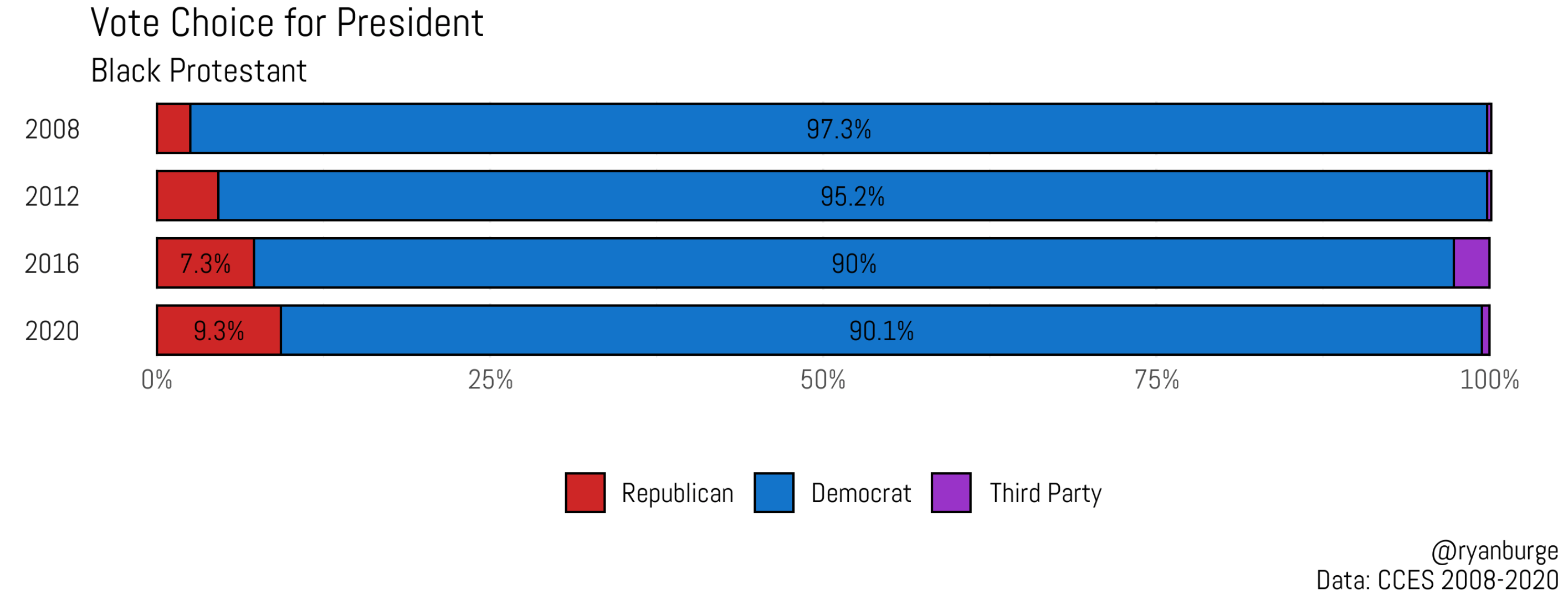
I asked Burge what he thinks is going on. Does it have something to do with religion and longer-term trends? Or did some black voters just like Donald Trump better than Mitt Romney? Burge pointed to the decline in religiosity in America, and especially among Democrats.
“People are starting to understand that to be religious in the United States is to be Republican,” Burge said in an email exchange. “That linkage is growing stronger over the last couple of years. For instance, there’s some pretty compelling evidence that young, religiously devout African-Americans have really shifted away from the Democrats since Trump’s election.”
“For men, it’s a bit more pronounced,” Burge continued. “Just a decade ago, three-quarters of young black men who went to church weekly were Democrats. Today, it’s closer to 60 percent. For women, it’s more subtle — maybe down eight points from the peak. But it’s still there.”
Burge said he expects the move to Republicans to continue. “I do think Republicans are going to continue to make inroads with devout African-Americans,” he said. “In the last few years, 12 to 13 percent of black evangelicals identify as Republicans. That’s up from six to seven percent around 2012.”
And then there is what is happening with the two political parties. The short version is, Democrats are far less likely than Republicans to belong to a church today. According to a new Gallup analysis released Monday, church membership among Republicans fell from 77 percent in 1998 to 65 percent in 2020. Among Democrats, it fell from 71 percent in 1998 to 46 percent today. So church members are now a minority in the Democratic Party. Some black voters who are religious may feel less and less at home among Democrats. And that might be an opportunity for Republicans.
One last caution. Donald Trump was such an unusual candidate, and such an unusual president, that it is impossible to gauge whether the changes in voting behavior that occurred during his presidential runs will last. Many religious voters felt under attack in 2016 and 2020, and they looked to Trump as someone who would protect their interests. Those voters will undoubtedly still feel threatened in 2024, but it is unclear whether they will see the Republican candidate the same way they saw Trump.
For a deeper dive into many of the topics covered in the Daily Memo, please listen to my podcast, The Byron York Show — available on the Ricochet Audio Network and everywhere else podcasts can be found. You can use this link to subscribe.
