

Welcome to Byron York’s Daily Memo newsletter.
Was this email forwarded to you? Sign up here to receive the newsletter.
WHERE THINGS STAND. It’s now less than two weeks until election day. One candidate, President Trump, is campaigning furiously around the country. The other, former Vice President Joe Biden, is staying home, out of sight for days at a time — a strategy of hibernation unprecedented in the modern campaign era. It’s a very, very weird race.
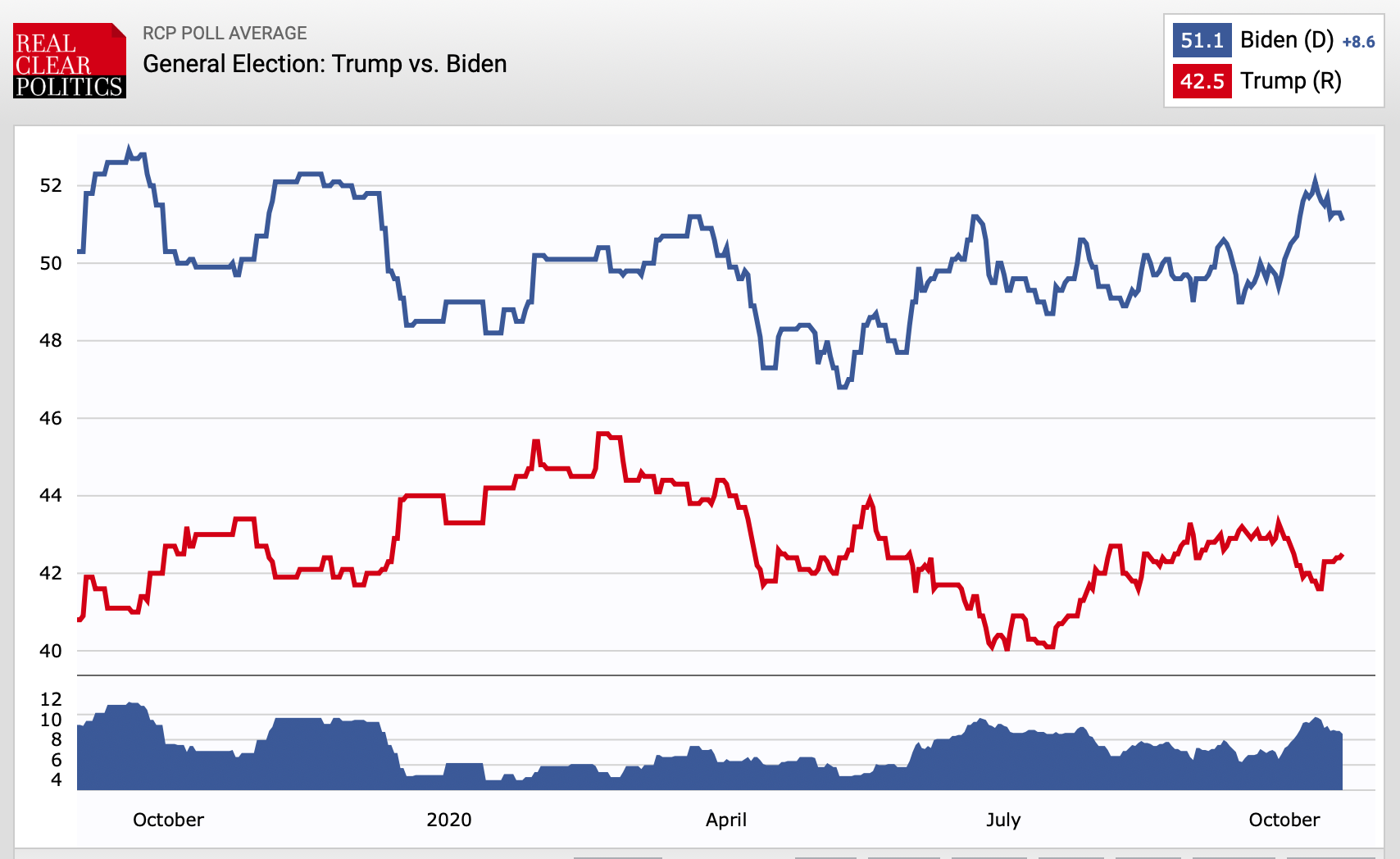
The hibernating candidate is in the lead. According to the latest RealClearPolitics average of national polls, Biden has an 8.6 percentage point lead over the president, 51.1 percent to 42.5 percent. In recent weeks, Biden’s lead has been as large as 10.3 points and as small as 5.8 points. But Biden has led Trump in one-on-one polling matchups since RealClearPolitics began keeping the average in September 2019. This is a graph of the race since then, with Biden in blue and Trump in red:
Subscribe today to the Washington Examiner magazine that will keep you up to date with what’s going on in Washington. SUBSCRIBE NOW: Just $1.00 an issue!
On this day, October 21, in 2016, Hillary Clinton held a 6.2 point lead over Trump in the RealClearPolitics national average. As you can see from the graph below, it was a much more volatile race. Clinton led nearly all of the way, but Trump caught up with her twice, in May and then in July. He got within a point of Clinton in September. At this moment in the race, Clinton appeared to be pulling away for a final victory. This is a graph of the race, from RealClearPolitics:
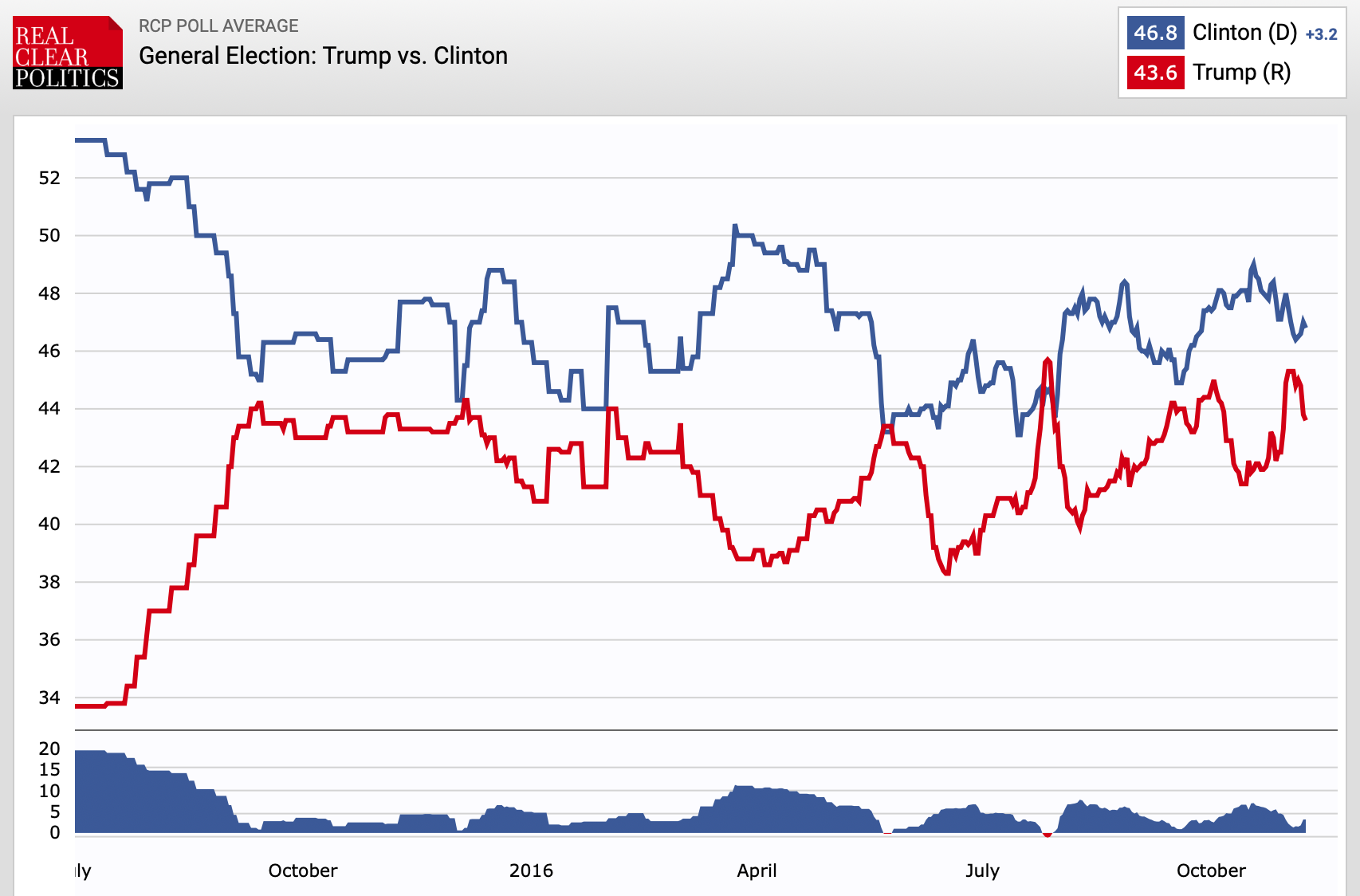
Remember that Clinton did in fact win the popular vote. The final RealClearPolitics average before election day showed her with a lead of 3.2 points, and she ended up winning the popular vote by 2.1 points, with 48.2 percent of the vote to Trump’s 46.1 percent. But that wasn’t enough to win the presidency because Trump, in a success unseen from a Republican since Reagan, won the big states of Florida, Ohio, Pennsylvania, Michigan, and Wisconsin to score a decisive victory in the Electoral College.
Now, with Biden’s lead over Trump a couple of points bigger than Clinton’s was at the time, and more stable over the course of the race, the question is whether Trump will be able to mount a surge in the campaign’s final days like he did in 2016. There’s no doubt he’s trying. And Democrats, despite Biden’s lead, are afraid. The Washington Examiner’s David Drucker reports that some Democrats refer to themselves as “scarred by 2016” and are “bracing for the possibility that the race could tighten, either naturally or because of surprise developments.”
The Trump 2016 surge happened in key states, particularly in Pennsylvania, Michigan, and Wisconsin. Certainly Trump needs to win at least one of them again. Remember that the polling in the states is not as good as nationally — that was a big problem in 2016 — but it appears Biden has clear but not insurmountable leads in all three battleground states. In Pennsylvania, Biden is up by 3.7 points in the RealClearPolitics average. But the race is tightening there; Biden’s lead was nearly twice as large just ten days ago. And on this day, October 21, in 2016, Clinton had a significantly bigger lead, 6.2 points, in the RealClearPolitics average in Pennsylvania. So the state definitely appears to be in play.
In Michigan, Biden has a 7.2 point lead in the RealClearPolitics average — again, with all the warnings about state polls. On this day in 2016, Clinton had a 12 point lead. So that’s a pretty big difference. In Wisconsin, Biden has a 6.3 point lead. On this day in 2016, Clinton had a 6.5 point lead.
Of course there are other vitally important states, too — Florida, North Carolina, Arizona, and others. But at the moment, Biden’s lead over Trump, while bigger nationally than Clinton’s was at this point in 2016, is smaller in Pennsylvania, Michigan, and Wisconsin than Clinton’s was four years ago. That doesn’t mean the result will be the same. But it does mean that Democrats are right to be nervous about their hibernating candidate’s lead.
