

Judge Amy Coney Barrett, whose Catholic faith came under fire from Senate Democrats three years ago, has emerged as the favorite as President Trump seeks to fill the Supreme Court vacancy following the death of liberal Justice Ruth Bader Ginsburg.
Barrett, 48, a Notre Dame Law School graduate and former clerk for conservative Justice Antonin Scalia, is currently a judge on the U.S. Court of Appeals for the 7th Circuit, where she has served since making it through a contentious confirmation process in 2017 during which multiple Democratic senators expressed wariness about her Catholicism.
Criticism from Sen. Dianne Feinstein, particularly when the California Democrat used the pejorative “the dogma lives loudly within you,” has become a rallying cry for her supporters and solidified Barrett’s position as the top choice of many Republicans for the high court.
When Trump selected Judge Brett Kavanaugh in 2018 to fill the vacancy from retiring Justice Anthony Kennedy, he said of Barrett, “I’m saving her for Ruth’s seat,” a Republican Senate staffer told the Washington Examiner. Ginsburg died on Friday at age 87 following a battle with pancreatic cancer.
A senior administration official told the Washington Examiner that Barrett, who visited the White House and met with Trump on Monday, is well-liked by the president and many in the White House, with support from Vice President Mike Pence and chief of staff Mark Meadows, but noted that other judges, including Barbara Lagoa and Allison Jones Rushing, also have supporters and that all the top choices are considered strong conservatives.
An advantage for Barrett, besides her backing among Catholics and conservatives, is that all her vetting is already done since she was so close to being picked last time.
Trump said he will announce his selection Saturday, and Republican leadership in the Senate is setting up for a confirmation fight before November.
Barrett was confirmed to the appellate court by a 55-43 vote in the Senate three years ago. A Republican source told the Washington Examiner that Trump “saw the way that Amy Coney Barrett was mistreated” last time and is likely “spoiling for a fight.”
“Why is it that so many of us on this side have this very uncomfortable feeling that, you know, dogma and law are two different things? And I think whatever a religion is, it has its own dogma,” Feinstein told Barrett as she testified before the Senate Judiciary Committee in September 2017. “The law is totally different, and I think, in your case, professor, when you read your speeches, the conclusion one draws is that the dogma lives loudly within you, and that’s of concern when you come to big issues that large numbers of people have fought for for years in this country.”
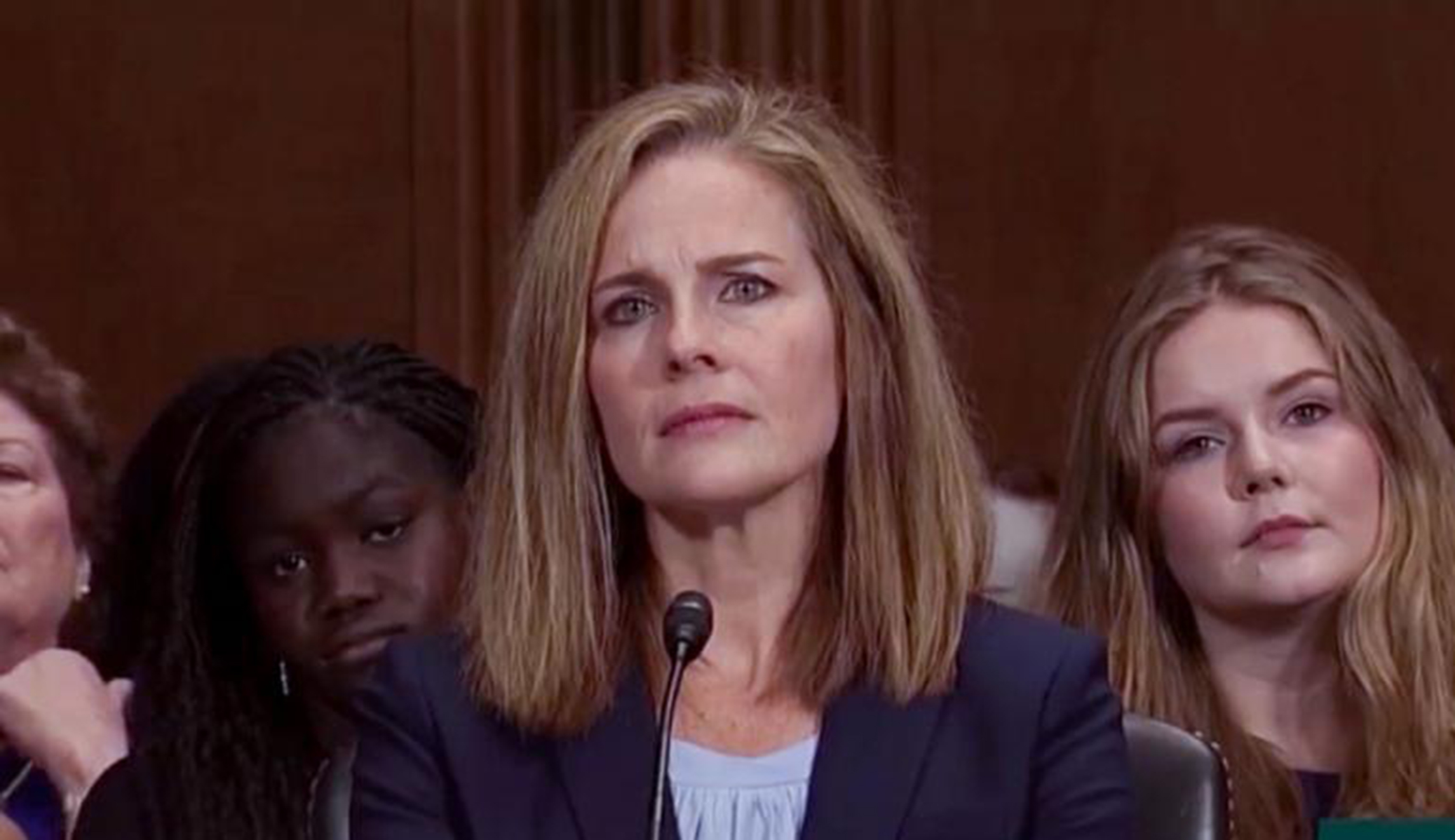
Democratic Sen. Dick Durbin of Illinois asked her bluntly: “Do you consider yourself an orthodox Catholic?”
“I am a Catholic, Sen. Durbin,” Barrett responded, adding, “if you’re asking whether I take my faith seriously and I’m a faithful Catholic, I am — although I would stress that my personal church affiliation or religious belief would not bear on the discharge of my duties as a judge.”
Senators repeatedly questioned Barrett about a 1998 law review article from her third year of law school titled “Catholic Judges in Capital Cases” in which she and her co-author, then-Notre Dame professor (now Catholic University president) John Garvey, grappled with the Catholic Church’s teaching against the death penalty, writing that “in a system that effectively leaves the decision up to the judge, these are questions that responsible Catholics must consider seriously” and “judges cannot — nor should they try to — align our legal system with the Church’s moral teaching whenever the two diverge.”
“It is never appropriate for a judge to impose that judge’s personal convictions, whether they derive from faith or anywhere else, on the law,” Barrett told then-Senate Judiciary Committee Chairman Chuck Grassley of Iowa in 2017, adding, “if there is ever a conflict between a judge’s personal conviction and that judge’s duty under the rule of law, that it is never, ever permissible for that judge to follow their personal convictions in the case rather than what the law requires.” Barrett pointed out that she had no problem working on death penalty appeals in Scalia’s office and argued, “In the rare circumstance that might ever arise — I can’t imagine one sitting here now — where I felt that I head some conscientious objection to the law, I would recuse.”
Republican Sen. Ben Sasse of Nebraska pushed back against critiques of Barrett’s faith and asked, “What sort of damage would that present to the republic if people with particular religious views were excluded from public life” through ignoring the Constitution’s No Religious Test Clause. Barrett replied, “I think it could cause all kinds of harm, including infringements on religious freedom.”
Beyond Senate Democrats, a number of left-wing activist groups criticized Barrett, including Planned Parenthood Action, which tweeted in 2017: “Amy Coney Barrett — who was already confirmed, despite only having one case — said judges shouldn’t follow the law if it clashes with their religious beliefs. #BadForWomen.”
Barrett further addressed her faith during a speech at Hillsdale College in 2019. “We have a long tradition of religious tolerance in this country and, in fact, the religious tests clause in the Constitution makes it unconstitutional to impose a religious test on anyone who holds public office,” she said. “So whether someone is, you know, Catholic or Jewish or Evangelical or Muslim or has no faith at all, is irrelevant to the job, and, in fact, it’s unconstitutional to consider it as a qualification for office.”
Justice Clarence Thomas defended Barrett when asked about Feinstein’s comments in 2019.
“I thought we got away from religious tests … I don’t think I know a single judge who has allowed religion to interfere with their jobs,” Thomas said. “I think if you start the day on your knees, you approach your job differently from when you start thinking that someone anointed you to impose your will on others.”
Barrett, born and raised in Louisiana, is married to former Assistant U.S. Attorney Jesse Barrett, and the couple have seven children, including two adopted from Haiti and one with Down syndrome. She told the Senate in 2017 that her youngest child’s special needs “presents unique challenges for all of us, but I think all you need to know about Benjamin’s place in the family is summed up by the fact that the other children unreservedly identify him as their favorite sibling.” The family lives in South Bend, Indiana.
Barrett graduated magna cum laude in 1994 from Rhodes College and summa cum laude in 1997 from Notre Dame Law School, where she was executive editor of the law review. Barrett clerked for two Ronald Reagan-appointees: Judge Laurence Silberman of the U.S. Court of Appeals for the District of Columbia Circuit from 1997 to 1998 and Scalia from 1998 to 1999. She worked for a couple of law firms in the nation’s capital and taught at George Washington University before returning to her alma mater Notre Dame in 2002, where she taught civil procedure, federal courts, constitutional law, and more.
While at Notre Dame, she joined the conservative Federalist Society and signed a 2012 letter criticizing the Affordable Care Act’s “HHS mandate for coverage (without cost sharing) of abortion-inducing drugs, sterilization, and contraception” as a “grave infringement on religious liberty” and a 2015 letter with which she endorsed the Catholic Church’s teachings on “the value of human life from conception to natural death.”
Barrett won the Distinguished Professor of the Year award in 2006 and 2016. Republican Sen. Todd Young of Indiana, introduced Barrett in 2017, calling her “eminently qualified,” praising her “expertise,” and noting that all of her fellow Supreme Court clerks and all 49 full-time Notre Dame law school faculty members, plus 450 Notre Dame law students she’d taught, endorsed her for the appeals court. The Notre Dame professors praised Barrett’s “discipline, intellect, wisdom, impeccable temperament, and above all, fundamental decency and humanity.” Her students said that “despite the many and genuine differences among us, we are united in our conviction that Professor Barrett would make an exceptional federal judge.”
Barrett still teaches at Notre Dame part time while serving as a judge, and she has written dozens of opinions and dissents on key issues, including gun rights, abortion, immigration, due process, employment discrimination, and sexual harassment.
In a Heritage Foundation podcast in March, Barrett was asked how she balanced family life with the demands of being a judge, and she said, “My very wonderful husband — we are totally a team, and we share the responsibility.” She added that “my husband once described my Google calendar as a cubist painting because it has so many different colors and blocks on it, and his looks like that too.” Barrett also talked about what she does for fun, including New Orleans cooking, Michigan beach trips with the family, watching Notre Dame football, and running.
Barrett’s Catholic faith has already reemerged as a target. Newsweek claimed a Catholic group Barrett belonged to was an inspiration for the book The Handmaid’s Tale but had to issue a correction that it wasn’t true. Reuters published a similarly titled piece, “Handmaid’s Tale? U.S. Supreme Court candidate’s religious community under scrutiny.” Richard Painter, former White House ethics lawyer from 2005-2007 and an outspoken Trump critic, tweeted: “Your handmaiden has arrived. Welcome to the Republic of Gilead.” Yahoo! Life shared an article titled “This Is Amy Coney Barrett, The Potential RBG Replacement Who Hates Your Uterus.”
The potential Supreme Court candidate has many outspoken defenders too.
Marjorie Dannenfelser, the president of the anti-abortion Susan B. Anthony List, told the New York Times this week that Barrett “is the perfect combination of brilliant jurist and a woman who brings the argument to the court that is potentially the contrary to the views of the sitting women justices.”
Carrie Severino, president of the conservative Judicial Crisis Network, wrote in National Review last month that Barrett “has been a champion of originalism.”
Sasse tweeted that “these ugly smears against Judge Barrett are a combination of anti-Catholic bigotry and QAnon-level stupidity” and called for senators to “condemn this wacky McCarthyism.”
Three years ago, Republican Sen. Ted Cruz of Texas asked Barrett was she believed makes a good judge.
“I think a good federal appellate judge is one who is impartial, who is unyieldingly committed to the rule of law, who gives equal rights to the rich and to the poor, who is willing to take the consequences of rulings that might be unpopular,” Barrett said in 2017. “So, one who is brave.”
