

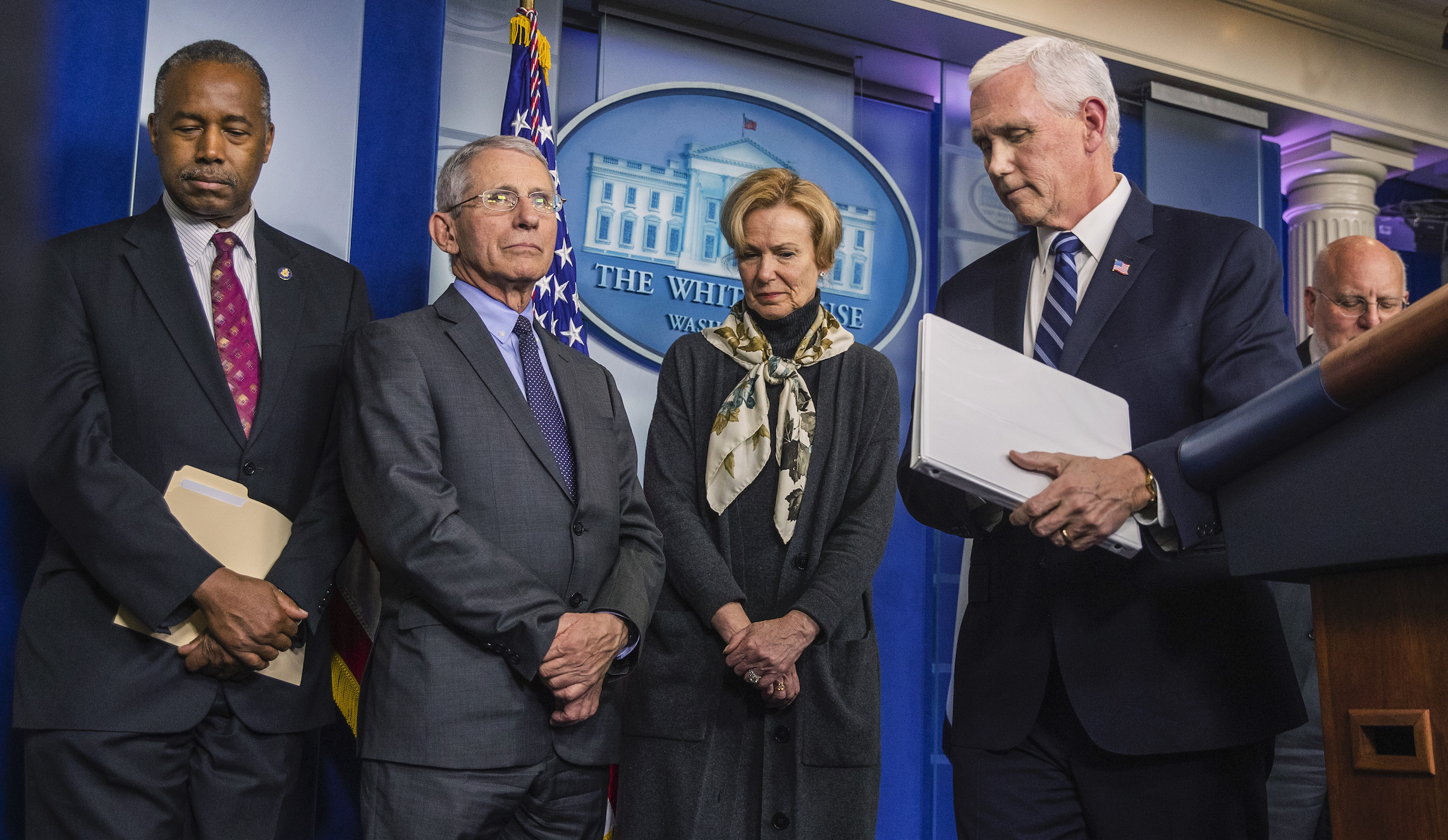
The White House has instituted precautionary measures to contend with the coronavirus pandemic.
In order to protect officials from the illness, White House medical staff are routinely making the rounds with hand-held thermometers to check reporters ahead of daily coronavirus task force briefings. Mandatory temperature checks are also being conducted on anyone who comes in close contact with President Trump and Vice President Mike Pence.
Recommended Stories

“Out of an abundance of caution, temperature checks are now being performed on any individuals who are in close contact with the President and Vice President,” White House deputy press secretary Judd Deere said in a statement Saturday.
One journalist was denied entry into the briefing room on Saturday after being tested three times by the White House Medical Unit over a 15-minute period, each time getting a result registering above the Centers for Disease Control and Prevention’s guideline for what constitutes a fever, 100.4 degrees Fahrenheit, according to Katie Miller, who is a press secretary to Pence.
[Click here for complete coronavirus coverage]
Journalist turned away after temperature screening. His organization appears to be CGTN an English language channel that is Chinese owned. pic.twitter.com/DFvVasbxd5
— Kelly O’Donnell (@KellyO) March 14, 2020
Fever is one of the symptoms of the coronavirus.
There will also be some “social distancing” at play in the White House briefing room.
The White House Correspondents Association issued a temporary seating chart effective Monday that puts journalists one seat apart from each other. Bright orange signs have been placed on the back of chairs that are to remain empty.
The stage may be crowded during those White House virus briefings, but the seats no longer will be. New seating chart via @whca pic.twitter.com/n0ckZ4qWWl
— lori montgomery (@loriamontgomery) March 16, 2020
New #coronavirus safety measures at the White House: mandatory temperature checks for all media entering the WH grounds; spacing out correspondents to every other seat in the briefing room pic.twitter.com/8sjoM1BjrW
— Sara Cook (@saraecook) March 16, 2020
Trump told reporters on Saturday that he took a coronavirus test on Friday night and was awaiting results after two members of the Brazilian delegation he hosted at his Mar-a-Lago resort in South Florida tested positive for the COVID-19 virus.
Sean Conley, the physician to the president, said in a memo released Saturday evening that Trump tested negative for the coronavirus.
The CDC released guidance on Sunday that said gatherings of more than 50 people can contribute to the spread of the coronavirus and recommended they be canceled. The CDC also reports that people may exhibit symptoms of COVID-19 two to 14 days after being infected.
As of Monday morning, there were more than 3,770 confirmed cases of the coronavirus in the United States and 69 deaths, according to the Johns Hopkins University tracker.
