

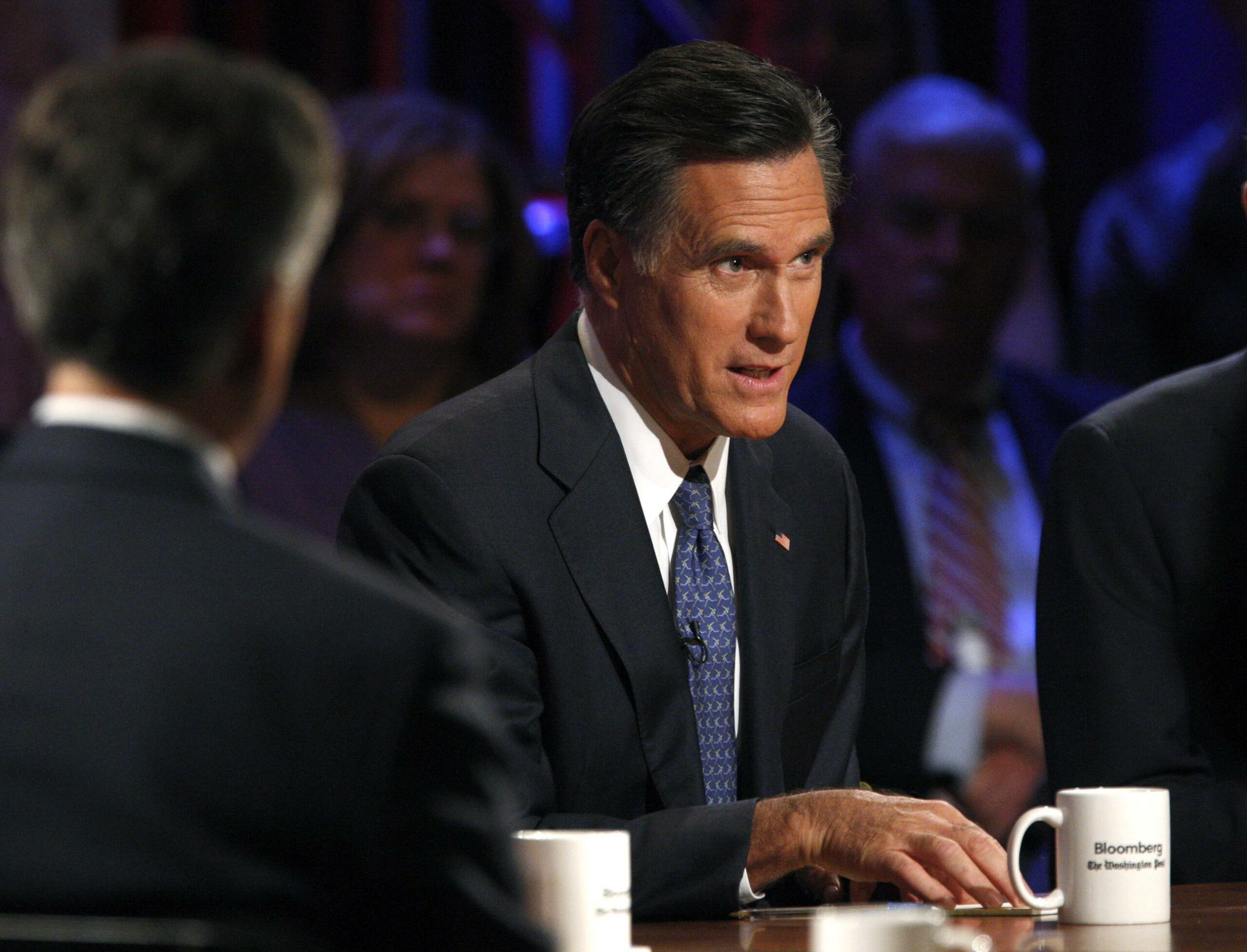
Looking back on the Bloomberg/Washington Post debate at Dartmouth Tuesday night, let’s examine the performance of the frontrunners (in current polling) in alphabetical order.
Herman Cain was just as congenial and likeable as ever and had more chances than in any earlier debate to describe and champion his 9-9-9 tax plan. After a while the constant references to it, from him and from other candidates, became a kind of standing joke. But did Cain make the case that he’s close to being ready to be president? Doubtful. He named one economic adviser and said teasingly that he had chosen two individuals whom he’d like to appoint to head the Federal Reserve, but he won’t tell us their names (has he told either about the other?). Why should we believe the “independent firm” that scored 9-9-9 as revenue neutral? He squandered his question to Mitt Romney by chiding him for not having a simple plan; Romney smoothly said you needed more points to handle a complicated economy. And he was put at least somewhat on the defensive for his support of TARP in 2008 and for his service on the Federal Reserve advisory board in Kansas City. We saw more of what has made Cain popular, but as in the case of candidates who earlier zoomed upward in the polls—Michele Bachmann, Rick Perry—I don’t think we saw enough to make Cain seem plausibly presidential, without which it will be hard to convert his current favorables into the Republican nomination.
Recommended Stories


Rick Perry came into this debate with more in the way of specifics than previously—or, rather, with an assurance that he will present a detailed energy program three days from now. One wonders why it couldn’t have been ready tonight, if not for a detailed presentation in a debate where responses were (supposedly) limited to one minute, then at least on the Perry website to which quick reference could have been made. But even in the absence of a specific plan, Perry could have made a vivid presentation of the startling increases in energy production or potential production in the United States and Canada in recent years, from hydraulic fracturing and lateral drilling—and how the Obama administration has been stifling rather than encouraging these developments. But perhaps because many of these developments are centered outside Texas, we didn’t hear much on the specifics—the Bakken shale in North Dakota, the shale discoveries in Pennsylvania and West Virginia, the Keystone pipeline to bring Alberta tar sands oil to Cushing, Oklahoma. We did hear some uncomfortable segues into talking points—he downplayed the importance of “ways to redo your tax structure or what have you” in his response to Charlie Rose’s first question. He was well prepared to respond to Michele Bachmann’s swipe at Texas’s increase in bonded debt (he said he reduced the state’s indebtedness per capita to the second lowest in the country), he was prepared with facts and figures on the Texas state energy investment program (while Post questioner Karen Tumulty stumbled all over herself to condense a series of questions into one or two) and in the question-for-another-candidate segment he had some specifics for the inevitable question to Romney on Romneycare. But when asked about his own health care program, he talked more as a governor making (good) arguments for more flexibility in Medicaid than like a potential president concerned about health care policy for the whole nation. Overall, Perry put in a better performance than in the three previous debates, but it’s not clear whether it’s enough to elevate his standing in the polls to what it was in the weeks just after he entered the race August 13.
The award for smoothest performance, once again, goes to Mitt Romney. Close observers may be growing tired of his “only 8% were affected” dodge on his Massachusetts health care program and by the way he segues into attacking Barack Obama as ill-prepared and clueless. But I thought he had a truly extraordinary response around the 30-minute mark when Julianna Goldman asked him what he would do if there were financial collapse triggered in Europe comparable to the financial collapse triggered by the bankruptcy of Lehman Brothers in September 2008. Romney appeared astonished that Goldman kept insisting this hypothetical question wasn’t hypothetical, but quickly recovered and embarked on a monologue that, briefly interrupted by another question, seemed to go on considerably longer than the one-minute time limit. In my view he showed a deft ability to make intellectually and politically defensible statements and arguments, and to convey the assurance that he would be a surefooted leader in such a crisis. In contrast, Cain chimed in with a brief statement and Perry, not questioned then, had little to say on the subject. If the goal of a candidate in a debate is to sound presidential, Romney achieved that at Dartmouth.
