

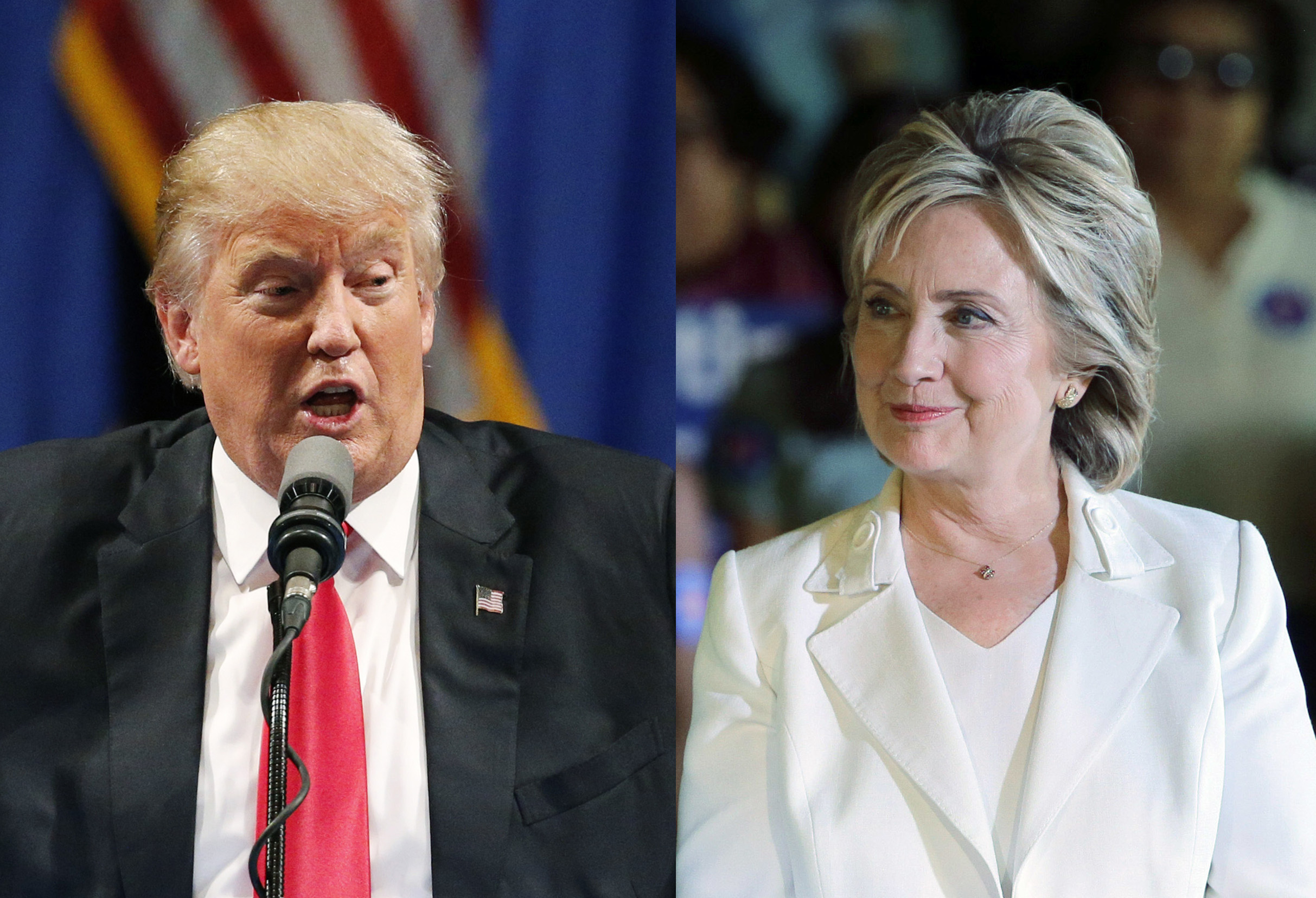
About a dozen pollsters have polled Donald Trump vs. Hillary Clinton in the past two weeks, and the clear picture is Clinton leading as the general election begins.
Large body of data
Recommended Stories


A reminder — Any one poll can be wrong in many ways:
- For one thing, every poll admits to a margin of error of a few points in either direction.
- Also, the margin of error has a margin of error, so to speak: Pollsters admit that there’s a 5 percent chance the “real” result would be outside that margin of error.
- Polls of “registered voters” include many respondents who won’t vote. Trying to discern “likely voters” more than four months out from Election Day is very difficult.
- Polling involves lots of modeling and statistic — creating a predicted turnout model, getting a representative sample. These models are sometimes wrong, and sampling isn’t always easy.
So you should never put too much stake in any one poll. Why are polls useful then? Because if we get a bunch of polls with fairly large sample sizes, and they tell a similar story, that’s a strong indication that we know the current disposition of the electorate.
In the presumptive general election matchup, Clinton leads in all two-way polls, by a significant margin, and sometimes by a large margin. Some of the four-way polls (which include the Green Party’s Jill Stein and Libertarian Party’s Gary Johnson) show a much closer race, but we don’t have enough of these polls to tell us much. So for today’s analysis, let’s stick to the two-way polls. Below are the 11 polls that RealClearPolitics is including in its current polling average.
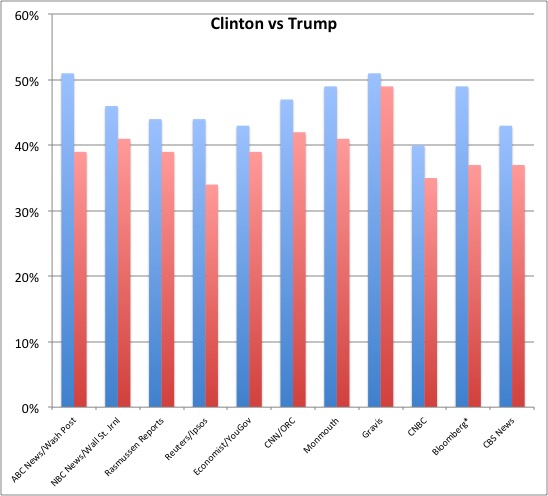
You see Clinton ranges from 40 percent to 51 percent, with a mean of 46.1 percent, while Trump ranges from 39 percent to 49 percent with a mean of 39.4. But his high point, that Gravis poll from 6/16, is the only survey putting him over 42 percent.
Clinton’s average lead is 6.7 points. This represents a major widening in the past three weeks. The chart below, clipped from RCP, is telling.
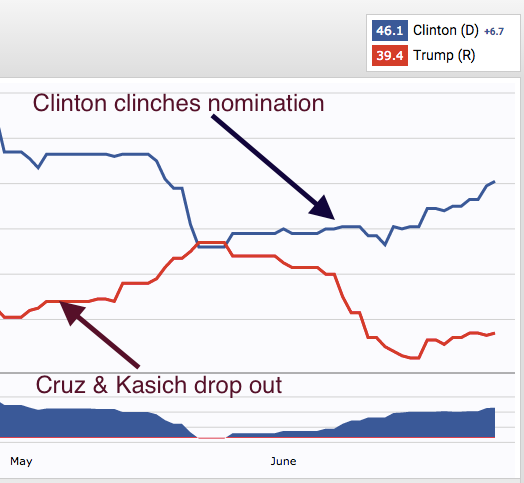
In short, Trump made a surge in the period where Hillary was still wrapping up the Democratic nomination, but Trump had already secured the GOP nod. Then when Hillary clinched the nomination, according to the Associated Press, she surged ahead.
Looking forward
But of course Clinton and Trump aren’t the only candidates on the ballot. As more four-way and three-way polls, we’ll be able to analyze this battle more accurately.
Timothy P. Carney, the Washington Examiner’s senior political columnist, can be contacted at [email protected]. His column appears Tuesday and Thursday nights on washingtonexaminer.com.
