Trump scrambles the politics of the minimum wage

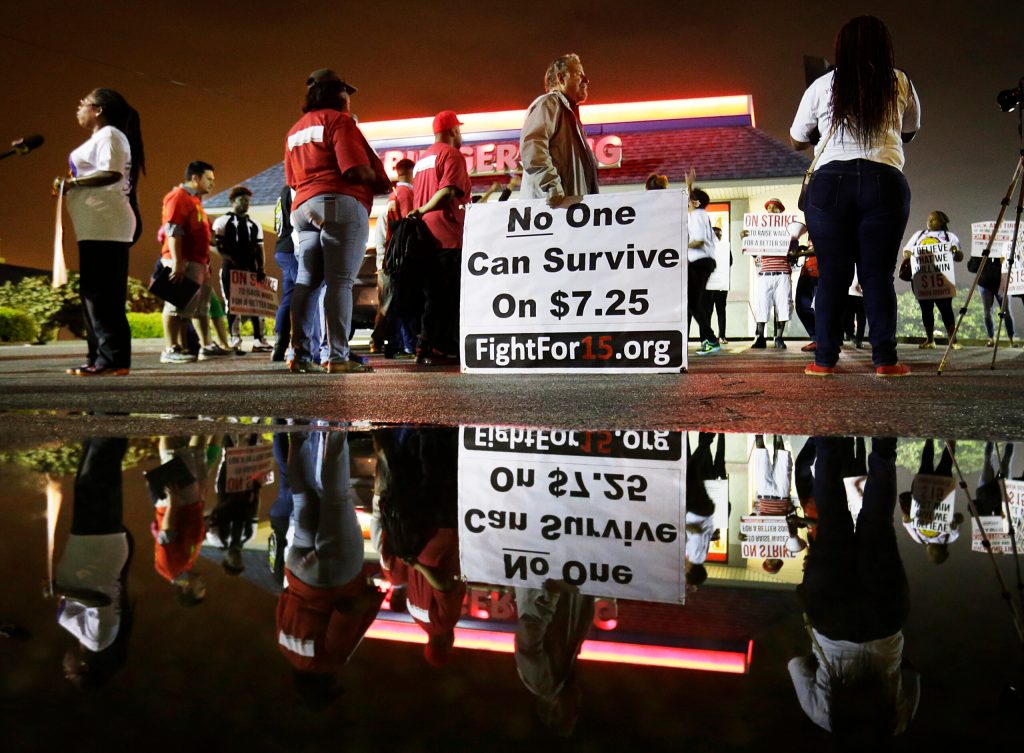
President-elect Trump has baffled friend and foe alike on the question of where he stands on the federal minimum wage, which currently is $7.25 an hour. His position is the political equivalent of a Rorschach inkblot test: He has given so many varying statements that almost anything can be read into it.

“Well, sure it’s a change. I’m allowed to change. You need flexibility,” he told ABC’s George Stephanopoulos in a May interview.

Over the summer, however, he seemed to warm to the idea of a $10 rate as part of a broader deal with Congress. “The minimum wage has to go up. … at least $10, but it has to go up,” he said in a July press conference.

That would open the door to the first real increase since 2009, and also scramble the politics of an issue that has been stuck in partisan gridlock throughout the Obama administration.

“We will continue to push for a boost and to hold our counterparts accountable for their rhetoric on the campaign trail,” said a Democratic committee staffer who requested anonymity. The staffer added that included the next president.

Many business groups are bracing for an increase when Congress returns next year.

“It’s always easier to be for something than against it. Remember, the last time the rate was raised was under a Republican administration,” said Matt Haller, senior vice president for government relations for the International Franchise Association.

That’s assuming that the unpredictable Trump remains open to the idea. Stephen Miller, Trump’s senior policy adviser, told the Washington Examiner in May that “the ideal solution is for the states to choose the wage floor that makes the most sense for their unique economic circumstances.”

That position would remove Washington entirely from the equation. But Miller said that was “the ideal solution” and did not rule out a less-than-ideal one, including federal action. The Trump transition team did not respond to requests for comment.

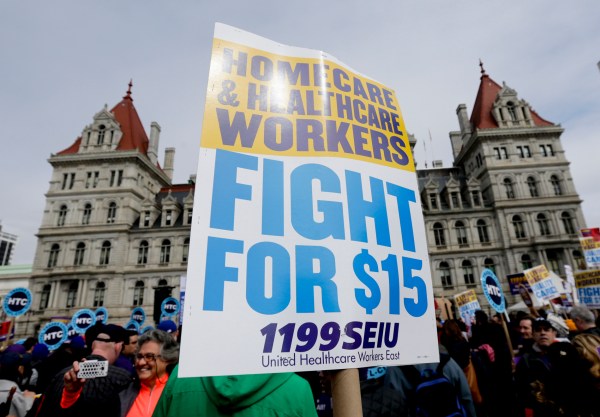
Little happened on the federal minimum wage during President Obama’s administration. Republicans steadfastly opposed any increase, while Democrats steadily ratcheted up their demands, with the official party platform now backing a $15 rate.

A conservative Republican Senate staffer who requested anonymity said Republican sentiment hasn’t changed.

“McConnell is still the Senate majority leader. I don’t see him putting the minimum wage on the agenda,” the Republican said, adding he didn’t think it was on Trump’s front-burner either.

Trump’s victory, which used economically populist rhetoric to win over swing states such as Pennsylvania and Ohio, has some on the Right rethinking the issue, however. An activist with a prominent conservative group in Washington who requested anonymity said a deal that includes “far-reaching reforms” could be worth it.

“Minimum wage is a loser — politically speaking — for our side, at least the way these things have been fought heretofore,” the activist said. “Given the scope of what a GOP Congress and Trump administration can accomplish, I would think very hard if I was in the leadership if I would want to fight and die on the minimum wage bill.”

There’s potential danger for the Democrats, too: Do they deal with Trump and potentially give him an early win on a key issue? Or do they reject him, push for an even higher rate and run the risk that they become the opponents to an increase?

“$10 an hour is what the Democrats were advocating just three years ago,” noted Dan Cooper, an economist with the liberal Economic Policy Institute. He added that a lot depended on how long phasing in a new rate would take. A quick phase-in may be enough to hook Democrats.

Many may be concerned over the economic impact of backing an even higher rate. Even Democratic presidential candidate Hillary Clinton was wary of backing $15 at the federal level, even after the party officially adopted that as part of its platform in July. States and cities have been increasing their minimum wages, some as high as $15.

The Democratic House staffer indicated they would push for $12 an hour and declined to comment on whether they would walk away from a deal for less than that.

The irony is that the federal rate is already beside the point. “Much of the debate is not taking place in D.C. anyway. It is in the states and cities. I don’t think that is going to change,” said the franchise association’s Haller.

In other words, Trump’s “ideal solution” is already playing itself out.

Related Content