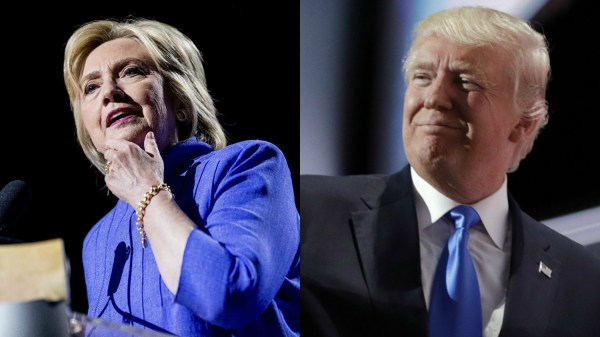
Some Democrats are beginning to openly wonder if identity politics did them in on election day, and left them watching Donald Trump and congressional Republicans win the White House and keep control of Congress.
The soul-searching seems likely to continue for months, possibly right up until the next election. But less than two weeks after their unexpected election day results, some are saying Democrats might be focusing too much on urban minorities and the targeting of various blocs, while ignoring the economic plight of working class votes in rural areas that the GOP overwhelmingly carried to victory.
Recommended Stories

Sen. Bernie Sanders, I-Vt., who nearly clinched the Democratic nomination himself, expressed this idea openly over the weekend, and seemed to pin the blame directly on Hillary Clinton for ignoring millions of potential voters who might be willing to call the Democratic Party home, despite declining to mention her by name.
“It is not good enough for somebody to say, ‘I’m a woman, vote for me.’ That is not good enough,” Sanders said in what seemed to be a clear reference to Clinton. Throughout the campaign, Clinton leaned heavily on the idea that her victory as a woman would be historic, but Sanders indicated that her theme wasn’t substantive enough, and may not have mattered to millions of people with more immediate concerns related to their jobs and their families.
“What we need is a woman who has the guts to stand up to Wall Street, to the insurance companies, to the drug companies, to the fossil fuel industries,” he said.
Sanders’ comments were echoed Monday by Rep. Tim Ryan, D-Ohio, who made waves last week by announcing a challenge to House Minority Leader Nancy Pelosi’s leadership position, citing the party’s need to modernize and reach out to working class places.
Places like Trumbull County, Ohio, which Ryan represents, are front and center in the discussion. A far cry from Pelosi’s district, which encompasses much of San Francisco, Trumbull County supported President Obama by 7 points, but saw a 30-point swing on Nov. 8, and ended up going for Trump by 23 points.
“Those people in that county, the average median household income is $57,000 a year, which means a husband and wife with a couple of kids each make less than $30,000 a year, and they think that Democrats don’t care about them, and they went in droves to Donald Trump,” Ryan told CNN Monday. “We need to speak to their economic interests, that we get it, that we understand, that we talk about those things and we try to fight hard for those things.”
“We need to talk to working class people. We don’t talk to everybody anymore. We slice and dice and we talk to subgroups and interest groups,” Ryan lamented. “We don’t have a unifying message that we can talk about in every room.”
Some Democrats pushed back against that characterization of the party’s focus, and say Democrats are still able to speak to both working class voters while keeping their eye on minorities and other voting blocs.
“Democrats are trying to say that we spend too much time talking to Hispanics and African-Americans than we do white working class voters. That isn’t true,” said Lis Smith, a former top aide to former Maryland Gov. Martin O’Malley’s presidential campaign and rapid response director for Obama in 2012.
“A lot of Democrats are taking the wrong lessons from this election,” Smith said. “Democrats have shown for years that they can walk and chew gum at the same time, and we do not face an either/or change between speaking to the diverse nature of our party and to the white working class.”
Still, the idea is now out there publicly — that Democrats at least need to do more to court rural voters, and may have already become painted as the party that cares mostly about certain slices of people, but not the broad band of middle class workers that clearly tipped to Trump on Nov. 8.
Former President Bill Clinton himself seemed to be aware that his wife’s campaign was vulnerable, and made a concerted effort to win areas of the Rust Belt that went to Trump. Stories that came out after the results were known indicated that Clinton’s advice went unheeded, and that Hillary Clinton’s much younger campaign staff wanted to focus on expanding the minority vote.
And over the weekend, it was reported that President Obama’s own secretary of agriculture saw the problems Clinton had in his home state of Iowa.
“People in my party don’t know how to talk to folks in rural areas,” said Sec. Tom Vilsack, who has served as Obama’s agriculture secretary since 2009. “It’s hard for us to articulate a message that crosses the different silos of a diverse party.”
“We’ve got a message for this group, and that group, and this group,” he said, adding, “But if you’re not a part of that group, asking what’s in it for me, you don’t quite get it.”