
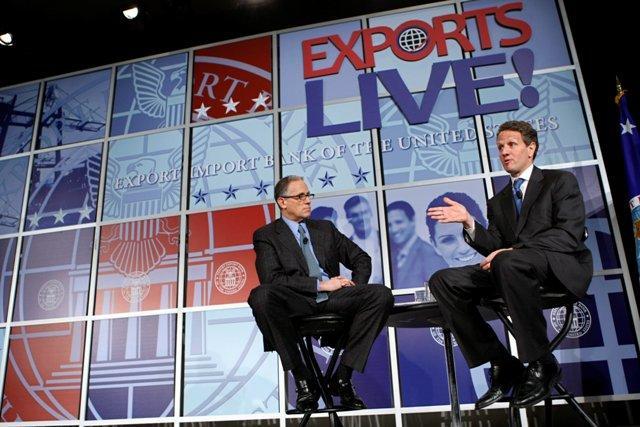
The Export-Import Bank is a federal agency that exists to subsidize U.S. exporters at taxpayer risk, with most of the money subsidizing one company, Boeing. I’ve been criticizing Ex-Im in print since 2001, and every time the agency comes up for renewal, a handful of conservative lawmakers vote to kill it.
Ex-Im is up for renewal again this year, and many free-market types are calling for its abolition, including Sallie James at Cato, and the Club for Growth. Defenders of Ex-Im are almost entirely industry lobbies like the Chamber of Commerce and the National Association of Manufacturers, rather than conservatives.
So conservative radio host and columnist Hugh Hewitt has stepped into the breach, penning a defense of Ex-Im that exhorts the Right to support its reauthorization. I disagree with much of Hewitt’s substantive case for Ex-Im, but I wanted to focus on his political case for its reauthorization:
Ex-Im is a success, one which conservatives can support proudly and from which they can draw lessons on the right functioning of the federal power with which to argue against the abuses and distortions of that power.
I see this exactly the opposite way. If conservatives, arguing against Obama’s interventions in government, want to strengthen their credibility, the best course of action is oppose Obama’s corporate welfare as well as anti-business measures.
Many liberals portray free-market arguments as being apologies for Big Business. Much of the media mostly buy this. If conservatives cry “Free Markets! And subsidies too!” that confirms the liberal line.
Alternatively, imagine conservatives wage war on Obama’s beloved Ex-Im. Picture an election year fight in which President Obama is on the side of the Chamber of Commerce, Boeing, and GE, while simultaneously trying to attack Republicans as shills for Big Business. Not only would this depress Obama’s liberal base, but it would expose, at last, what fluff his scourge-of-the-special-interests talk has been.
