

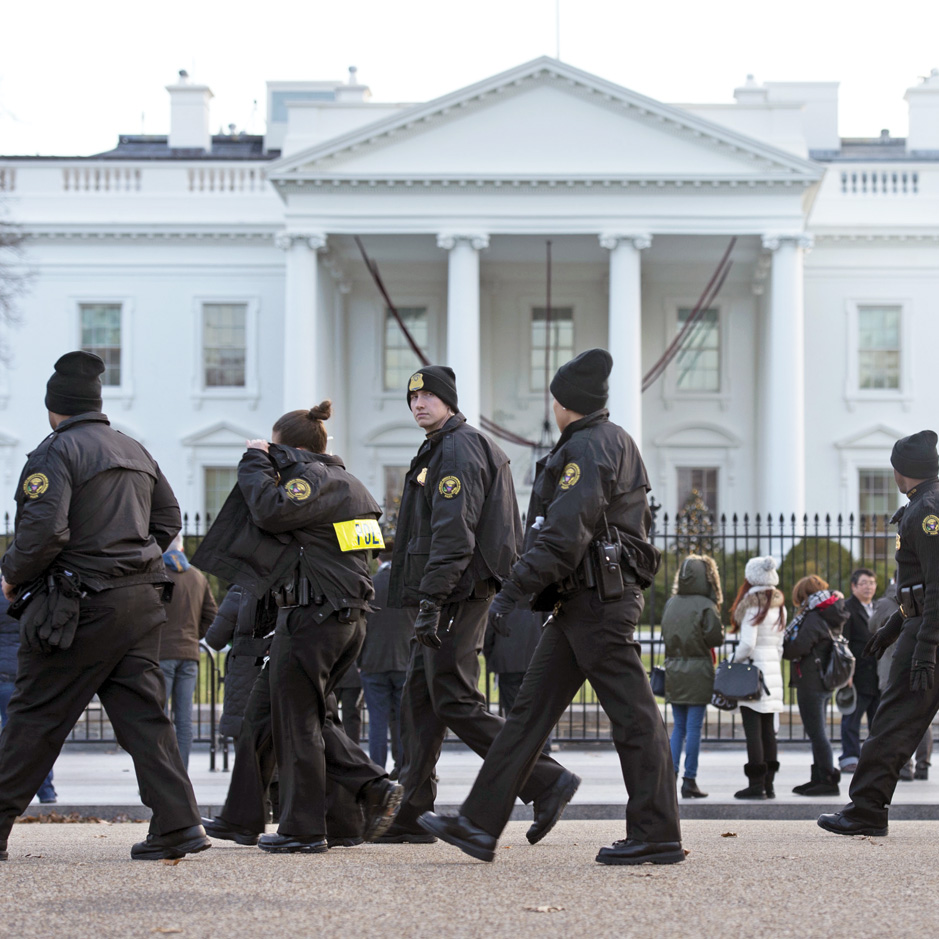
The Scrapbook was recently witness to a harmonic convergence. It began the other evening as we set out, on foot, from The Weekly Standard offices to dinner at a restaurant two blocks east of the White House. It was a cold night and, wrapped securely against the wind in overcoat, scarf, gloves, and tweed cap, The Scrapbook strode confidently across the infamous K Street, along nearby Farragut Square, and then turned left at H Street to cut through Lafayette Park.
Just as we passed the 34-year-old antinuclear encampment across from the White House, we proceeded to step onto Pennsylvania Avenue (closed to automobile traffic since 1995) toward the Treasury Department. At that moment, distant voices could be heard bellowing in our direction and, turning around, we realized that two angry uniformed Secret Service guards (fully armed) were screaming at The Scrapbook! Pedestrians, it would seem, had been banned for the evening from setting foot on the asphalt.
Stay informed.Stay ahead.
Join Washington Examiner for unlimited access to the news, analysis, and commentary that matter most.
Already a member? Log in
As we quickly retreated onto the sidewalk, and headed for the restaurant, we were greeted by yet another armed guard at the corner of Madison Place and Pennsylvania Avenue: “You can’t go there!” he exclaimed. This was especially discouraging to The Scrapbook: We were already late, and with the nearby Treasury building bathed in light, and Pennsylvania Avenue desolate and deserted, we could see our object—the Old Ebbitt Grill—shimmering in the distance.
But now we retraced our steps, trudged the three extra blocks to 15th and G streets—and noticed that (apart from the aforementioned guards) the entire vicinity of the Treasury and White House was devoid of human activity: No tourists, no automobiles, no reporters, no deliverymen. What was going on? The Treasury building seemed empty, nearby traffic was light, and no evidence could be seen of the usual cause for downtown lockdowns: an Obama fundraiser. Still, The Scrapbook thought it wise not to trouble the uniformed guards with our questions.
The next morning, as we reflected on the evening’s adventure, we turned to the front page of the Washington Post (Jan. 15) and saw this headline—“Secret Service to remove four senior leaders”—and read this sentence: “The departures of six out of the agency’s eight assistant directors follows a scathing report last month by a [Department of Homeland Security] appointed panel that concluded the agency is suffering from low morale among the rank-and-file and is ‘starved for leadership.’ ”
Of course, The Scrapbook cannot say whether the rank-and-file of the Secret Service suffers from low morale—it was difficult to gauge the mood of those bellowing guards—but it is fair to say that the nation’s capital has been suffering low morale at the hands of the Secret Service. “Security” now guarantees that pedestrians cannot walk from one place to another without being barred, at some point, from proceeding; and downtown traffic is daily paralyzed by banana republic-sized motorcades and widespread lockdowns. The lives of working Washingtonians, official and unofficial, are routinely disrupted—held hostage in traffic or rudely corralled—so that Joe Biden or Valerie Jarrett gets to lunch on time.
Will this latest housecleaning make any difference, or cause the Secret Service to reflect on the balance it must strike between safety for the president and dignity for citizens? Probably not. We take some comfort, however, in one minor detail in that Post story: According to the acting director, if the four senior leaders “do not resign or retire, they can report for a new assignment with the Secret Service or its parent agency.” A permanent assignment to the Plains, Georgia, field office sounds about right.
