

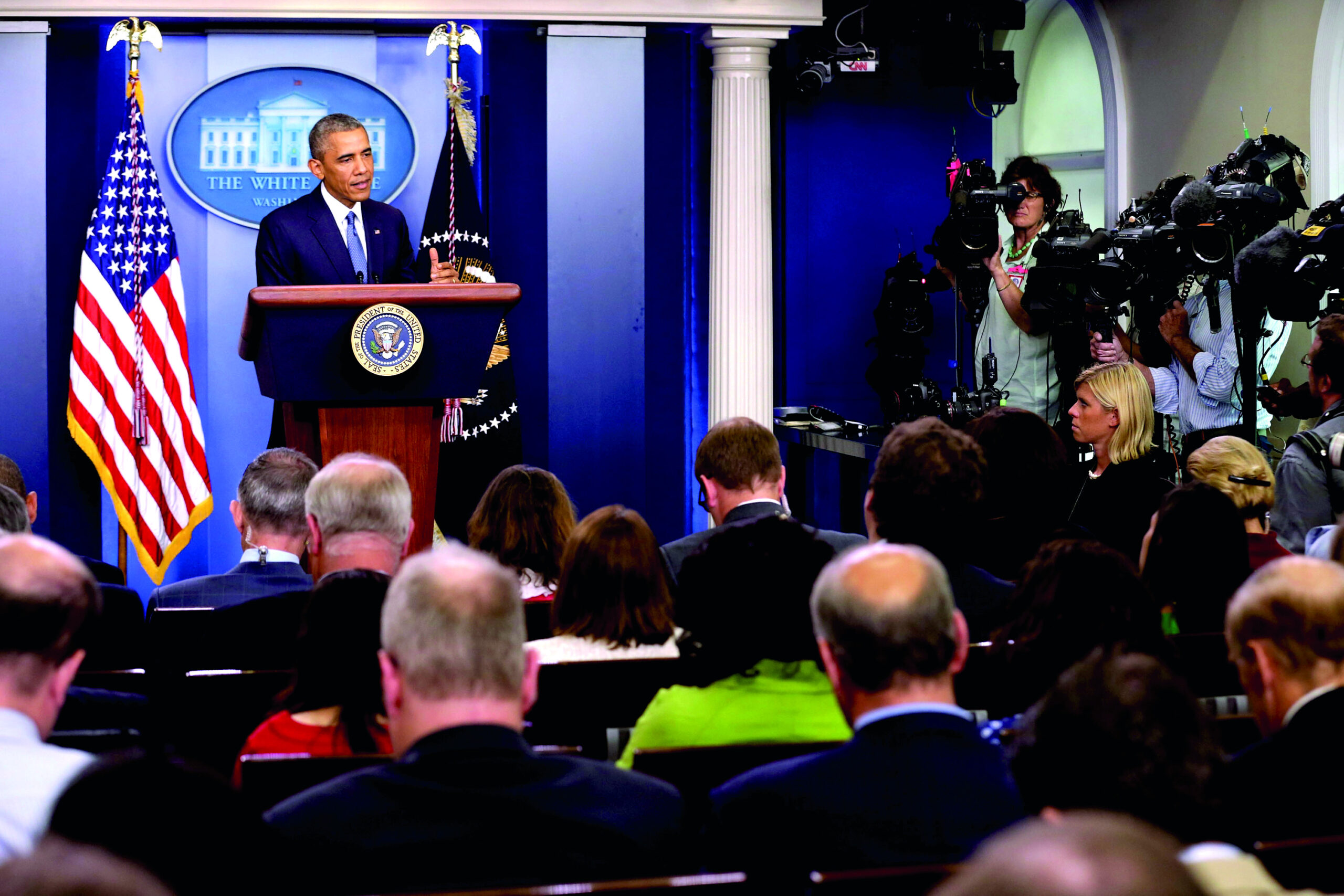
President Obama will likely never run for office again, but for many in Congress, his name might as well be on the top of the ballot this fall.
After an abbreviated session, members of Congress hit the campaign trail with a list of talking points that will often be more about the president than anything the legislative branch has done.
Recommended Stories



“I think the real question is ‘who’ candidates will be talking about rather than ‘what,’ ” a top Senate Republican aide told the Washington Examiner. “Obama may not be on the ballot, but his low popularity argues for talking a lot about him and tying one’s opponent to him and his policies.”
For Senate Republicans and Democrats, the stakes couldn’t be higher as the majority hangs in the balance. The GOP is slightly favored to take over the chamber from Democrats, who are fighting to protect more vulnerable incumbents in states from North Carolina to Alaska. The GOP needs to net only six seats to win control of the gavel.
For Democrats hoping to change the subject from Obama, recent events haven’t helped.
Foreign policy issues have only raised the president’s profile. With growing concerns over the terrorist group known as the Islamic State of Iraq and Syria, polls show likely voters have grown increasingly skeptical of Obama’s handling of world affairs.
“Foreign policy is now a dominant issue,” Rep. Tom Cole, R-Okla., told the Examiner, arguing that it could depress Democratic turnout.
In many of the states where Senate Democrats are in peril, including North Carolina, West Virginia, Arkansas and Louisiana, Obama is particularly unpopular, polls show. In one survey of likely voters taken this summer, the president’s approval numbers in a dozen key battleground states sunk to 38 percent.
Many Congressional Democrats running for re-election in those states have already ducked appearances with Obama.
Democratic party operatives in both chambers tell the Examiner they hope to address the problem by talking more about jobs and the economy, subjects they say resonate more with voters who are seeking solutions and not negative attacks.
“A middle class jumpstart has been our agenda and continues to be our push,” Drew Hammill, a top aide to House Minority Leader Nancy Pelosi, D-Calif., told the Examiner.
In the House, Republicans are expected to keep control of the majority and could even pick up a few seats, pollsters predict. But House Democrats are nonetheless vying for a takeover, however unlikely.
Rep. Steve Israel, D-N.Y., who is head of the House campaign arm, said polls this year show a volatility that suggests Democrats could come out ahead, despite Obama’s unpopularity.
Indeed many polls in swing districts show Republican and Democratic candidates separated by just a few points.
“The president’s numbers may not be where the president wants, but House Republicans’ are a fraction of that,” Israel said.
A recent Gallup poll found, however, that approval ratings for both parties are low, hovering around 40 percent, while Obama’s approval rating is about 43 percent.
Democrats in the House and Senate, meanwhile, have coordinated a Congressional agenda they plan to bring on the campaign trail in order to excite their base.
It’s aimed at contrasting the Democratic Party with Republicans by portraying the GOP as the party that doesn’t care as much about lower-income workers and issues concerning women.
“This election is going to be a referendum on whether or not you want Republicans to continue to stand up for special interests or Democrats who stand up for the middle class,” Israel said.
Both House and Senate Democrats have attempted to pass legislation this year that would aim to ensure equal pay for women, lower student loan interest rates, a higher minimum wage and fewer tax breaks for U.S. corporations that move jobs overseas. Republicans have blocked those measures in both chambers.
It’s not the president that matters to voters, Rep. Jim McGovern, D-Mass., argued. “It’s the bread-and-butter issues.”
University of Virginia political science professor Larry Sabato said congressional Democrats will also dodge Obama by focusing their campaigns on local issues and mentioning the president only if they plan to criticize his policies.
“Some will survive this way, others won’t,” Sabato said. “But it’s the rational thing to do. It’s up to the Republican opponents to nationalize the contests, to make Democrats in red states pay a price for Obama’s unpopularity.”
