

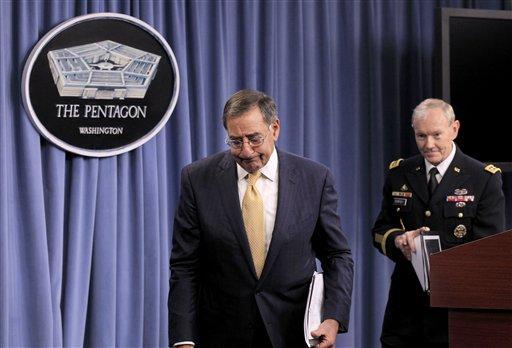
President Obama’s new defense strategy which slashes tens of thousands of troops from the Army and Marine Corps and cuts about half a trillion dollars from the Pentagon’s budget over the next decade exposes the U.S. to “acceptable risk,” according to Defense Secretary Leon Panetta, who said that was necessary in the face of new budget realities. But critics charged Thursday that the president cut too much muscle along with the fat, and has left the United States vulnerable.
Obama, who made a rare appearance at the Pentagon to unveil his strategy, said the doctrine requiring the U.S. military to be prepared to win two major wars will be scaled back to one that allows the U.S. to win one war and disrupt enemies in other parts of the world.
Recommended Stories


Panetta said we “will no longer need to be sized to support the kind of large-scale, long-term military operations ” of recent decades. He said the decision comes with “some level of additional but acceptable risk.”
But retired Army Maj. Gen. Timothy Haake, who served with the Special Forces, said the shift in doctrine is a “dangerous strategy dictated by poverty.”
Haake said announcing such a shift in strategy will only embolden enemies and potential adversaries such as Iran, North Korea and China.
“It makes it a much more dangerous world when you declare that you can only handle one war at a time,” Haake said. “If you’re going to reduce your deficit it shouldn’t be on the back of the military.”
Others saw the president’s strategy as a thoughtful response to the modern world. Michael O’Hanlon, defense expert with the Brookings Institution, said the new strategy allows the Navy and Air Force to be strengthened without piling up deficit spending.
O’Hanlon said the strategy focuses on threats like terrorism and cyber-warfare and counters Chinese and Iranian air and sea power.
However, the doctrine includes significant cuts to both Army and Marine Corps ground forces. Defense officials said the Army will go from 570,000 to 490,000 over the next decade. The Marine Corps is expected to be cut from 200,000 to roughly 180,000 active duty members.
Jeffrey F. Addicott, a former special forces lawyer who is now a terrorism law expert in San Antonio, said the cuts fit a dangerous pattern in American history. “After World War I we decimated our military while our enemies were building theirs,”he said. “Before World War II we were practicing with broomsticks and plywood cutouts.”
Sara A. Carter is The Washington Examiner’s national security correspondent. She can be reached at [email protected].
