
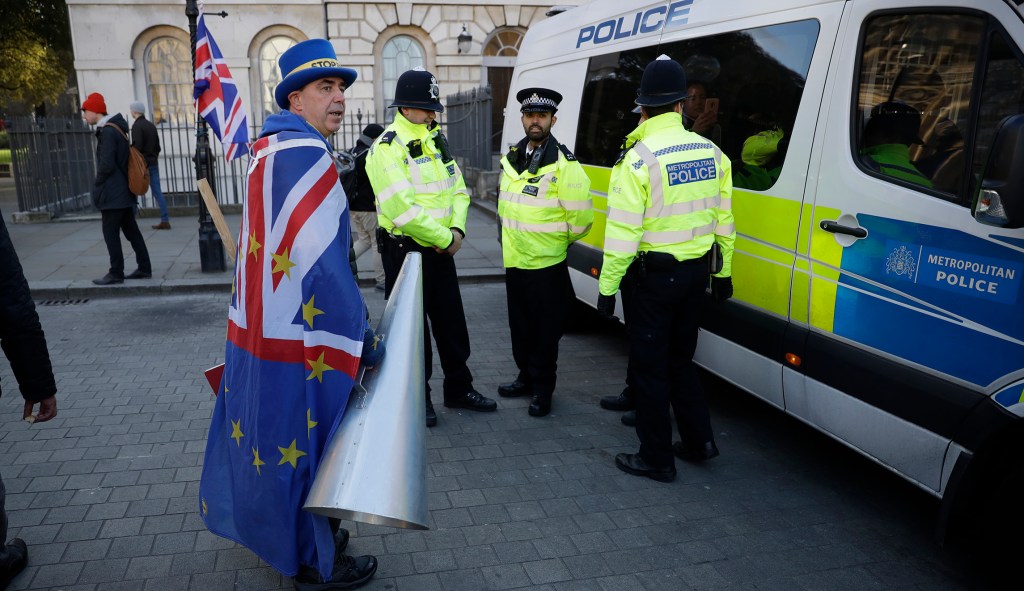
The U.S. could teach Britain a lot when it comes to protecting politicians and the free speech rights of others. The most important lesson is that politicians must accept vigorous public challenge alongside visible, competent protection.
It’s an operative concern in that British members of parliament and a number of opinion journalists have become enraged this week at being confronted by protesters outside of the Houses of Parliament. The fury was sparked by the experience of Conservative MP Anna Soubry as she walked from a BBC interview back to Parliament. Video below shows Soubry surrounded by a shouting crowd.
Following this, a group of MPs wrote to the Commissioner of the Metropolitan Police demanding that protesters involved in these kind of incidents be arrested for harassment and other public order offenses. They say that such aggressive protesting is incompatible with healthy democracy.
I disagree. It isn’t pleasant for those like Soubry and protester targets, but at the margin of the right to an easy walk and the right to protest, the right to protest must come first.
Of course, no politician should be in fear of their safety as they walk in public. That brings us to the better U.S. example.
Every day on Capitol Hill, protesters chase members of Congress, often aggressively petitioning them for a redress of their perceived grievances. During Justice Brett Kavanaugh’s nomination hearings we saw repeated incidents of this. In recent months we have seen numerous Trump administration officials confronted at dinner. Yet these protesters are rarely arrested. They are not arrested because our constitutional tradition rightly recognizes that the legal exercise of free speech, even where uncomfortable and unpleasant, is more important than the comfort of one individual in one moment.
This is most certainly not a tradition that is recognized in Britain.
Still, that is not the end of the story here. Because when it comes to protecting politicians in and around parliament, there is also a lot the Metropolitan Police in London can learn from the U.S. Capitol Police. In specific terms, this should involve ensuring that there are enough police officers in proximity to Parliament so that MPs at risk of being confronted can be given an escort.
This is a standard Capitol Hill tactic and it ensures deterrence against criminality. But it also offers means of ensuring that law-abiding citizens, whether politician or protester, can go about their business. The problem around parliament is that most police officers are assigned to protecting the parliamentary estate rather than protecting the immediate area around it. This leaves too many British officials feeling outnumbered and threatened where the presence of a few police officers would insulate against it.
There is hope, however. Fortunately it seems that the Metropolitan police are beginning to recognize this concern. Consider the video below by left-wing journalist, Owen Jones. Confronted by protesters, Jones recorded himself walking around Westminster. But note in the background of Jones’ video the presence of police officers quietly escorting him. They would have intervened had the protesters broken the law.
Just met some lovely Tommy Robinson fans and I’d love for you to get to know them too pic.twitter.com/iRom8GavNy
— Owen Jones? (@OwenJones84) January 7, 2019
Ultimately though, the real issue here is the expectation of what constitutes legitimate free speech. While some MPs such as Jacob Rees-Mogg recognize that “it’s very encouraging that in a free country we have such spirited political debate,” too many other MPs believe their right to an easy stroll outweighs the right of others to challenge them. The key, then, is that the police ensure that politicians and protesters are protected in equal measure.
