

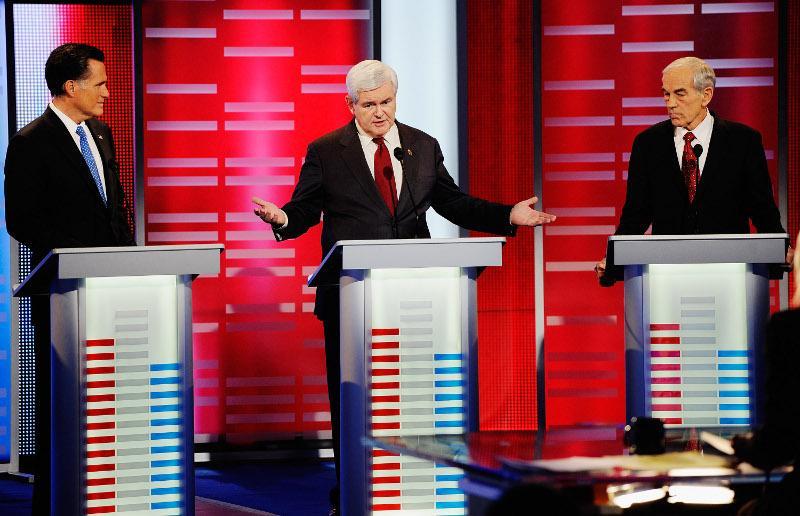
DES MOINES, IOWA — Newt Gingrich’s front-runner status in the Republican nomination is like a house of cards. Lacking a foundation or even a reliable infrastructure, one blow to the former speaker could demolish his chances.
Gingrich’s support is fairly broad – averaging about 30 percent in the last two Iowa polls – but notably shallow. A minority of his supporters, it seems, are enthusiastic – or even concerned – about his record or policies. Many of his Iowa backers favor him not because of who he is, but because of the two men he isn’t: Mitt Romney and Obama.
One retiree in Newton who wouldn’t give me her name (she even hid her driver’s license and credit card from my view as she bought a cup of coffee at Uncle Nancy’s Cafe) told me she simply wouldn’t vote for Romney, because he is Mormon.
As Rick Santorum prepared to address the Republican crowd at Uncle Nancy’s, the anonymous retiree (conservatively, in her 70s) told me she would “probably” back Gingrich in the January caucuses. Her only reason: “He can beat Romney.” After Santorum’s event, though, she told me “I might switch.” Then she begged me for my assessment of Santorum’s chances, “can this guy win?”
Gingrich’s 30 percent is less pro-Gingrich and more anti-Romney. It’s almost inaccurate to use the word “supporter” for the 30 percent who say they back Gingrich. The retiree in Newton, for instance, eventually confided in me: “I don’t really like Gingrich. I was just told he’s the guy to beat Mitt.”
But what if he ceases being that guy? If Gingrich makes a misstep (an intemperate outburst or ill-considered proposal from the former speaker is not hard to imagine) or if his corporate-welfare lobbying and serial adultery starts to sink in with voters, his poll numbers will start to drop. If his numbers drop far enough that he’s no longer the clear alternative to Romney, then his support is apt to collapse.
We’ve already seen this pattern three times. Michele Bachmann, Rick Perry and Herman Cain were popular in part because they were popular. That is, many voters were simply looking for whichever candidate was most likely to beat Romney. They were unconcerned with the anti-Romney’s policy positions or record. Once those favored alternatives fell in the polls, their supporters fled.
Ron Paul’s base of support provides the clearest contrast. At Paul’s town hall in Marshalltown Saturday, probably 75 of the 100 attendees were dedicated Paulistas – a fact evident in the loud ovations for his dovish foreign-policy declarations and his arcane monetary-policy prescriptions. By comparison, a majority at most Iowa candidate events are undecideds. [Disclosure: Paul wrote the forward to my 2009 book, Obamanomics and wrote a blurb on the jacket of my 2006 book, The Big Ripoff.]
The unique makeup of Paul’s crowds reflects both strength and weakness: Paul has firmer, more enthusiastic support than other candidates, but he also isn’t reaching as many potential converts.
The preaching-to-the-converted dynamic leads pundits (those who don’t simply ignore him) to declare Paul’s 17 percent in recent polls a “ceiling.” But given the nature of the caucuses, polls don’t predict results in Iowa as neatly as in other states.
In Des Moines, the average low temperature for January 3rd is 12 degrees. And unlike a regular election, when a voter can choose the most convenient time to vote, caucuses involve going to your local middle school or community center at 7 p.m. on a Tuesday night. It takes over an hour. You can bet $10,000 that Ron Paul’s supporters will turn out in far higher proportion than other candidates’ backers.
Gingrich, given the shallowness of his support, might be the biggest under performer on caucus night.
If Gingrich-leaners’ turnout is low, this could trigger a chain reaction within any number caucus rooms. The caucuses aren’t in-and-out secret ballots. They are full of speeches, negotiation, vote-switching, and finally, publicly standing for your candidate. It’s hard to imagine a worse format for a candidate with shallow support contingent on his being a front-runner.
And the other candidates, not just Paul, will be equipped to pick off Gingrich backers. They already have Iowa ground games, with precinct captains exhorting supporters to turn out and devising pitches to win over wavering voters.
Gingrich, on the other hand, barely has a real campaign. His Iowa headquarters just got its phone lines last week. The Gingrich volunteer at the front desk Saturday morning tried to rope a supporter into being a precinct captain, but since the volunteer was from Indiana, she couldn’t find the supporter’s precinct on a map.
If Gingrich makes no missteps and anti-Romney sentiment continues to climb, of course Newt could carry Iowa. But a small gust could blow over his house of cards. Don’t be surprised, when the dust clears, if Ron Paul is the one standing tallest.
Timothy P.Carney, The Examiner’s senior political columnist, can be contacted at [email protected]. His column appears Monday and Thursday, and his stories and blog posts appear on ExaminerPolitics.com.
