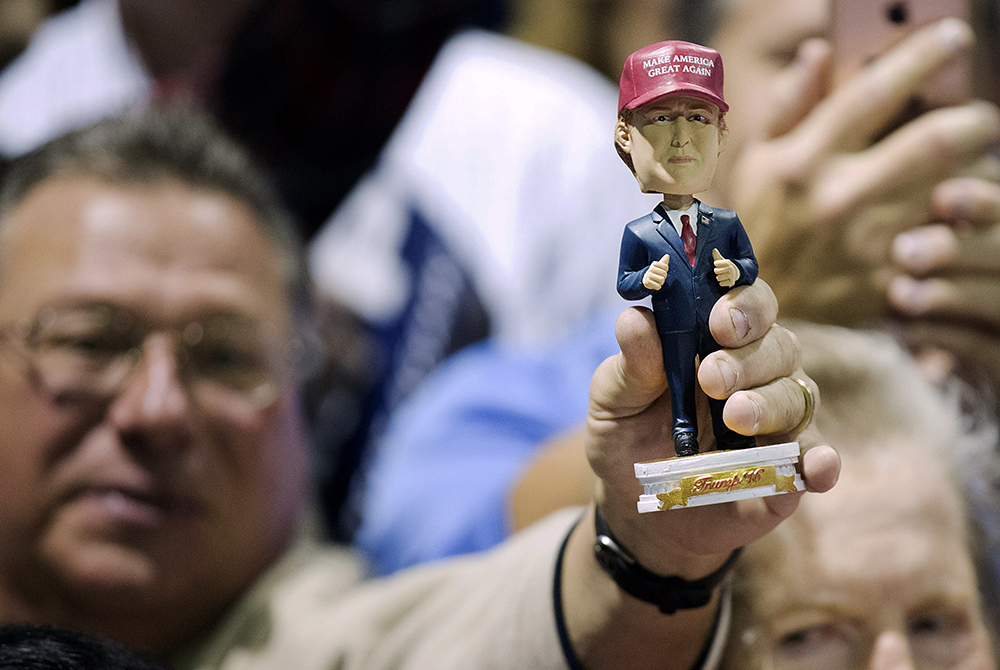
Donald Trump — caveat emptor

Why do people support Donald Trump for president?

Many believe America is in decline and they’re angry about it. They have a point. On the domestic front, they feel the pain of the sluggish Obama economy, wage stagnation and lack of jobs. On the international side, they see America being played for a sap by its enemies and losing respect. On the border, they see a country that has lost control of its immigration policy.

They are tempted to turn to Trump because they look at other, more statesmanlike GOP leaders’ responses to these problems and they take the lack of foaming anger as a token of indifference or incompetence, or both. They hate the political correctness with which so much discourse and policy are infected. As David Gelernter wrote in our sister publication, The Weekly Standard, this week, “we see, for the first time, political correctness powering an administration and a federal bureaucracy the way a big V-8 powers a sports car.” The Trump phenomenon is just one angry reaction to this reality.

Yet, for all that, it is important for Trump’s supporters to realize that he is not really the answer to the very real problems that are stoking their rage. Is Donald Trump really the best vessel for his supporters’ point of view? No he is not.

Perhaps most importantly, those joining him on the Trump express need to realize that although the ride is exciting it is also likely to be short. Many Trump fans believe he is electable, and even choose him for this reason, talking of their “silent majority.” But it’s neither silent nor a majority. It’s a nice narrative, but it’s fiction. If Trump isn’t beaten this summer by his Republican rivals, he is very likely to be beaten in November by Clinton. Which is a shame, because other Republicans could crush her.

Trump is the weakest Republican candidate for the general election, the only one of the three serious contenders who has trailed her consistently in the polls since this election cycle began.

Clinton is a deeply flawed candidate. She has trailed Marco Rubio (and John Kasich) in polling averages by significant margins since the beginning of this year. She has not led Ted Cruz since New Year’s Day. Trump is the only Republican who loses to her. He is the only one perceived by the general electorate as being as dishonest as she is, and the only one with negative ratings that approach hers.

But let’s go along for a while with the hypothesis that Trump can win the presidency. Then what? Would he be different from others who have broken their promises? No, again. We already know that because Trump hasn’t promised anything that he could actually do.

He usually avoids specifics, but the few things he has discussed in any detail fall apart upon inspection. He promised to save $300 billion a year by negotiating the price of drugs — more than all the money our country spends on drugs every year. He promised to fix Social Security’s finances by removing dead people from the rolls, as though there were millions of them rather than a few thousand. He has promised to establish a mandatory death penalty for cop-killers, which is not within a president’s constitutional powers. Then there’s his 40-foot wall at the Mexican border, which he says will be financed by punitive tariffs on Mexican imports. This would be illegal under international treaty that he would not be able to change.

Finally, let’s go back to that idea that Trump is somehow the right candidate because he is more prepared to break the taboos of political correctness. It has strong appeal. But he is not the only candidate who is speaking plainly. He is just ruder and brasher.

Both Sens. Marco Rubio and Ted Cruz, the only other plausible GOP nominees, are just as straightforward as the bombastic billionaire in talking about, for example, radical Islamic terrorism. They don’t make policy off the cuff and promise to keep Muslims out of America. But that does not suggest they are unwilling to tell the truth plainly. It just shows that they think before they speak, and that they know the constitutional limits on presidential power. Those are recommendations, not faults.

Related Content
