

President Obama introduced another housing bailout plan today, this time adding a program to ease the pain of speculators who tried to make a quick buck flipping properties during the run-up to the housing bubble. The common theme running through all of Obama’s bailout plans is the same: avoid the pain of foreclosure at all cost.
Recommended Stories



But as an article in this Saturday’s Washington Post shows, while hidden, delaying foreclosures has a real cost:
In 2007, as thousands of Marylanders began losing their homes at an alarming pace, Gov. Martin O’Malley (D) vowed to end what he called the “fast track to foreclosure.”
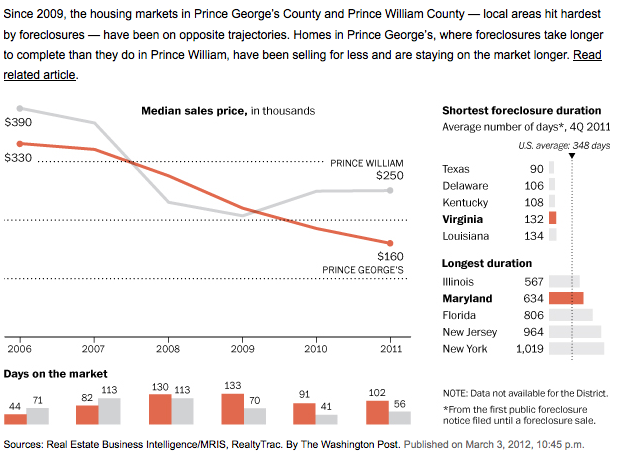
Starting in 2008, state lawmakers passed a series of measures designed to give homeowners — some the victims of predatory lending, others hurt by the recession — more time to find a way to stay in their homes. The changes included forcing lenders to wait longer to file foreclosures, giving homeowners more access to housing counseling, and requiring lenders to participate in mediation. … The result: Maryland has gone from having one of the country’s fastest foreclosure systems to having one of the slowest.
Foreclosure activity in the Free State fell by 16 percent in the three months after the 2008 changes took effect and by 58 percent in the three months after a mediation law took effect in 2010, according to a state report. But sales activity and prices fell as well.
…
Some economists and housing experts contend that Maryland’s efforts to protect distressed homeowners are stifling a recovery in the very communities they are trying to help.
They point to Virginia, where lenders can foreclose without going through the courts, and where the housing market has rebounded more quickly. In 2011, median home sale prices in Virginia rose 0.8 percent, real estate research firm CoreLogic reported, while in Maryland they fell by 3.8 percent.
“The real issue is the length of time of the process. If you just keep pushing back foreclosures that would happen anyway, it just delays the inevitable,” said Thomas A. Lawler, whose firm, Lawler Economic & Housing Consulting, provides market data, analysis and forecasts. “I am not saying therefore everyone should have a fast process that is not fair, but a fair process should not leave a house in foreclosure for multiple years.
Starting in 2008, state lawmakers passed a series of measures designed to give homeowners — some the victims of predatory lending, others hurt by the recession — more time to find a way to stay in their homes. The changes included forcing lenders to wait longer to file foreclosures, giving homeowners more access to housing counseling, and requiring lenders to participate in mediation. … The result: Maryland has gone from having one of the country’s fastest foreclosure systems to having one of the slowest.
Foreclosure activity in the Free State fell by 16 percent in the three months after the 2008 changes took effect and by 58 percent in the three months after a mediation law took effect in 2010, according to a state report. But sales activity and prices fell as well.
…
Some economists and housing experts contend that Maryland’s efforts to protect distressed homeowners are stifling a recovery in the very communities they are trying to help.
They point to Virginia, where lenders can foreclose without going through the courts, and where the housing market has rebounded more quickly. In 2011, median home sale prices in Virginia rose 0.8 percent, real estate research firm CoreLogic reported, while in Maryland they fell by 3.8 percent.
“The real issue is the length of time of the process. If you just keep pushing back foreclosures that would happen anyway, it just delays the inevitable,” said Thomas A. Lawler, whose firm, Lawler Economic & Housing Consulting, provides market data, analysis and forecasts. “I am not saying therefore everyone should have a fast process that is not fair, but a fair process should not leave a house in foreclosure for multiple years.
Nobody wants to see any family kicked out of their home. Its a painful process. But their are other ways underwater families can be helped than delaying foreclosures. Ways that won’t drive down everyone else’s home prices, thus driving more families underwater.
