

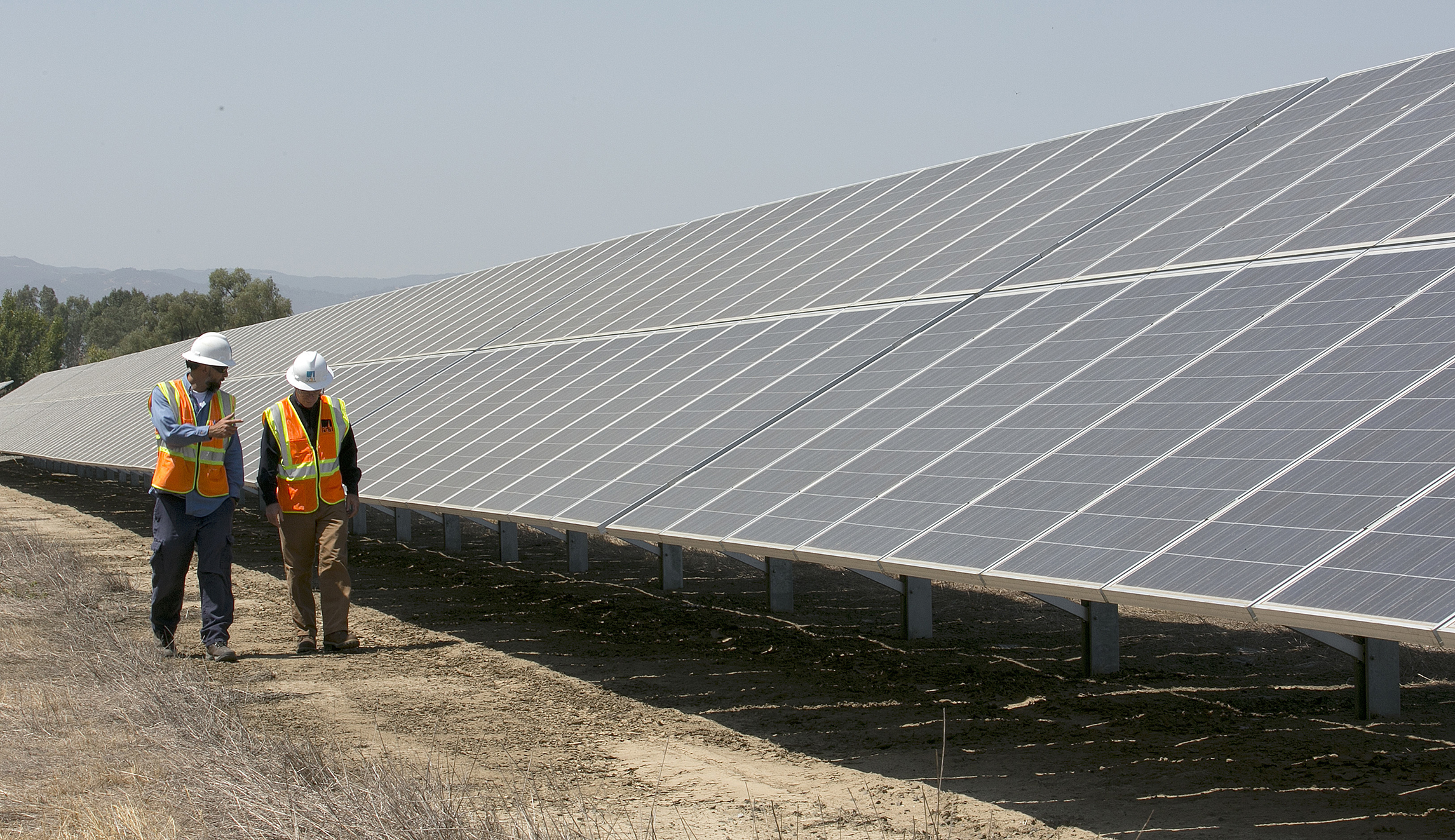
The Trump administration on Monday announced new tariffs on imported solar panels.
The tariffs, to be levied over four years, are for 30 percent in the first year, 25 percent in the second, 20 percent in the third, and 15 percent in the fourth year.
Recommended Stories


The first 2.5 gigawatts of imported solar cells will be exempt from the tariffs.
The International Trade Commission had urged President Trump to apply tariffs, ruling U.S. solar panel manufacturers are being harmed by cheap imports from China and Southeast Asia. It had recommended in October a tariff of on solar cells of about 30 percent and a tariff on solar panels between 10 percent and 35 percent.
About 95 percent of the solar cells and panels sold in the U.S. are made abroad, with most coming from China, Malaysia, and the Philippines, according to SPV Market Research.
The decision facing Trump over whether to impose tariffs presented a major test of the president’s “America First” trade agenda and how it fits with his pledge to support U.S. “energy dominance.”
“We consider this decision more severe than what the solar industry hoped, but less severe than what President Trump’s America First tough-on-trade policy platform suggested,” Timothy Fox, an analyst with ClearView Energy Partners, told the Washington Examiner.
Trump’s decision comes as the wider solar industry is booming in recent years, providing momentum for the transition away from fossil fuels to renewable energy sources.
Solar power makes up about 1 percent of electricity generation in the U.S. But solar costs have fallen by about 70 percent since 2010, and the domestic industry now employs more than 260,000 people, according to the Solar Foundation.
While the broader U.S. solar energy opposes tariffs, two U.S. companies asked the Trump administration to act.
In April, solar panel manufacturer Suniva, later joined by SolarWorld, petitioned the International Trade Commission for tariffs on solar cells and a price floor on modules for imports coming from anywhere in the world, arguing that cheap foreign products are harming the domestic panel industry.
Both companies are bankrupt and foreign-owned (Suniva is based in Georgia but is majority-owned by a Chinese company), though they primarily manufacture in the U.S.
“SolarWorld Americas appreciates the hard work of President Trump, the U.S. trade representative, and this administration in reaching today’s decision, and the president’s recognition of the importance of solar manufacturing to America’s economic and national security,” said Juergen Stein, president of SolarWorld. “We are still reviewing these remedies, and are hopeful they will be enough to address the import surge and to rebuild solar manufacturing in the United States.”
But other companies across the solar energy industry warn that tariffs could harm the industry’s progress by increasing their costs and would force them to raise prices for consumers.
Most the jobs in the U.S. solar industry are people installing solar-power systems on roofs, not manufacturing panels. The Solar Energy Industries Association (SEIA), the main trade group for the U.S. solar industry, estimates 88,000 U.S jobs could be lost from a tariff, representing one-third of the $19 billion industry’s workforce, mostly in installer jobs.
“While tariffs in this case will not create adequate cell or module manufacturing to meet U.S. demand, or keep foreign-owned Suniva and SolarWorld afloat, they will create a crisis in a part of our economy that has been thriving, which will ultimately cost tens of thousands of hard-working, blue-collar Americans their jobs,” said Abigail Ross Hopper, SEIA’s president and CEO.
