
The Hurt Locker
Real journalism.Trusted by millions.
Unlimited access to in-depth reporting, expert analysis, and the stories that shape our country.
Already a member? Log in
Directed by Kathryn Bigelow
The Hurt Locker appears to be on its way to an Academy Award for best picture on March 7. If it happens, this episodic account of a three-man squad tasked with disabling improvised explosive devices in 2004 Iraq will be the least financially successful film ever to win the Oscar (box-office gross: $12.6 million). And it will do so by besting Avatar, the most successful movie ever made ($691 million and counting). Back in September, nobody thought it had a whisper of a chance, and its fans only hoped it might hang on to score a hopeless Best Picture nomination to give it some help with DVD sales and rentals.
As it happens, The Hurt Locker is just out on DVD and available on-demand through most cable and satellite TV systems, so it is a fortuitous moment for it to be seeking votes from Academy members—and for the vast majority of moviegoers who missed it to catch up. What are the reasons for this obscure war movie’s awards surge? First is the simple matter of its quality: The Hurt Locker has several sequences of staggering power and intensity. The movie shows, as none before it has, the variety of terrifying dangers facing American soldiers in the early phase of the Iraq war—a showdown with a possibly booby-trapped car on a Baghdad street, a sniper attack on the city’s outskirts, the discovery of a spider-web-like bomb hidden in the sandy dirt covering a street, an insurgent locked in a suicide belt who has changed his mind.
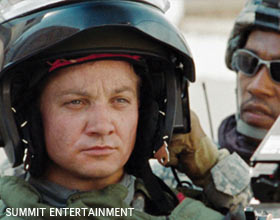
The film’s director, Kathryn Bigelow, and its writer, Mark Boal, make sure we never get comfortable, are never sure what might happen at any moment, and in doing so, create stretches of nearly unbearable tension. They aided themselves immeasurably by casting three unknown actors, led by the brilliantly stalwart Jeremy Renner, whose very obscurity means we can have no confidence they will survive for another minute. What Renner conveys, that few war movies have in the modern era, is the character of the warrior—the man for whom fighting for his country is a calling, a means of achieving glory, and a way of feeling charged and alive.
But while there are stretches in which The Hurt Locker really is amazing, it has no plot to speak of, and movies with no plot always begin to sputter at their midpoint. We are just counting down the days until our squad gets to go home, during which time we are left only to wonder whether these men and the people they encounter are going to live or die. And oddly enough, that is not enough drama, even for a war movie. The futility of the squad’s efforts renders The Hurt Locker oddly inert.
In an effort to create something like a storyline, the movie bothers itself with the fate of a kid who sells DVDs to American soldiers who becomes an obsession of Renner’s. But it’s not clear why the kid obsesses him, and why he places his squadmates in danger attempting to find out his fate—unless the kid is intended to serve as a metaphor for everything the United States got wrong in Iraq. And if that is the case, he is one overused symbol, as he serves to represent the nonexistent WMD, the wrecked city, the shadowy Sunnis, the conniving Shiites, the whereabouts of Saddam Hussein, and God knows what else. This turns Renner’s character into a metaphor for America, and The Hurt Locker into a gigantic allegory—and like all allegories, is reductive in ways that tax everyone’s patience.
But it is precisely this unsatisfying quality that has set The Hurt Locker on its path to the Kodak Theater in Los Angeles. The movie succeeds where no Iraq film has before it because its inscrutable purpose and unintelligible politics set it a bit outside the vicious debates about the war. By focusing on the overwhelming peril in which brave and resourceful American military personnel found themselves in the days before the surge, and the parlous circumstances under which they had to act, The Hurt Locker occupies the only patch of common ground there is about the war: Soldiers good.
Will that be enough? There’s some thought that Inglourious Basterds, Quentin Tarantino’s crazily audacious rewriting of 20th century history, might sneak in between The Hurt Locker and Avatar—which has little chance of winning because actors, who make up the plurality of Academy voters, are unlikely to celebrate the film that bids fair to destroy their livelihoods. World War II retold with a happier ending, or the Iraq War retold without meaning: a perfect snapshot of what constitutes prestige in Hollywood circa 2010.
John Podhoretz, editor of Commentary, is The Weekly Standard’s movie critic.