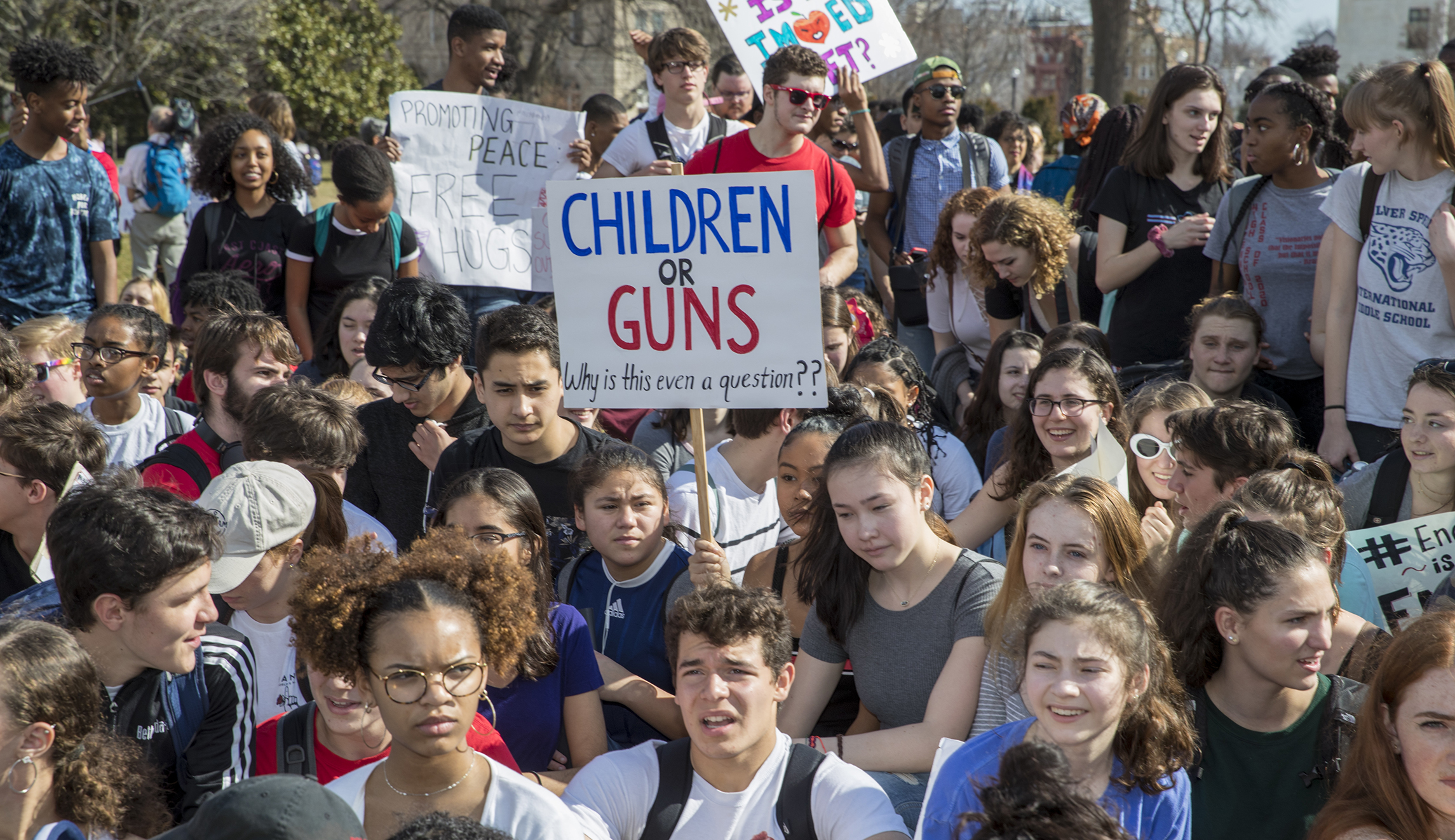
The shooting of 17 students at Marjory Stoneman Douglas High School has reignited the debate over how to stop such tragedies from occurring, with outspoken student survivors giving the issue even more emotional force by demanding swift action from lawmakers.
There is no reason for students to have to worry about getting gunned down at school, and it is undeniable that the frequency of mass shootings is a bigger problem in the United States than in other countries.
After witnessing these scenes all too often, it is natural for people to demand public policy responses to these massacres. It’s hard to grapple with a world in which something like this can happen, and so it can be psychologically comforting to try and reassert control by searching for easy answers. This impulse leads people to assert that there are simple solutions to end this plague of violence. These include ideas such as increasing background checks, banning some guns, increasing funding for mental health problems, or increasing security at schools.
In the face of this festering anger, nobody wants to throw their hands up in despair, and say, “Sorry, this is a tragedy, but there’s nothing we can do about it.” But what if it turns out if there’s no easy way to stop mass shootings in America?
A closer look at a lot of the proposed remedies reveals a haunting paradox: Solutions that would be theoretically (though not necessarily) effective would be some combination of draconian, illegal, costly, and a threat to civil liberties, whereas more modest solutions aren’t likely to be effective.
To start with, let’s talk about guns. While it’s true that people kill people, it’s also undeniable that guns make it a lot easier for a novice to kill more people more quickly. However, any attempt to control guns has to be balanced against gun rights that are enshrined in our Constitution and recognized by our highest court; and the reality of the large number of existing guns in circulation.
Some of the ideas that have been batted around in recent years include banning “bump stocks,” increasing the age to purchase guns, background checks, or even banning AR-15s.
The two least likely to face resistance are the bump stock ban and increasing the age of purchase. By making it easier for semi-automatic guns to approximate automatic fire, bump stocks likely helped the Las Vegas shooter inflict more carnage. However, outside of that very specific attack, which a ban wouldn’t have prevented, it isn’t going to make a difference as other mass shooters did not use the item. An age limit, which won’t be bitterly fought, is also unlikely to make much of a difference. Shooters over 21 wouldn’t have a problem getting guns, and as we saw with Sandy Hook, where a 20-year old murderer stole his mom’s guns, underage assailants can obtain weapons by other means.
As for other measures, looking at recent mass shootings, many of the shooters had no prior criminal record, allowing them to pass background checks, and in several cases where there was a problematic background, human error allowed shooters to pass the screening process. This was the case, for instance, with the Texas church shooter, who had a domestic violence conviction while in the Air Force, but the Air Force didn’t enter that information into federal databases, so he was able to pass a background check, allowing him to legally purchase a gun that he used to kill 26 people.
As for banning AR-15s, there are many other guns that can be just as deadly that would remain legal — and a ban on all semi-automatic weapons would affect about half of the guns already in circulation. This raises another issue: even if all new purchases of semi-automatic weapons were banned, there would still be over 300 million privately-owned guns in the U.S.
Unlike politicians and special interests who try to talk about modest “common sense” steps to control guns that will save lives, honest opponents of guns are willing to admit what it would really take to limit access to guns — mass confiscation. This step, however, would be unconstitutional, requiring repealing the Second Amendment by two-thirds of Congress and/or 38 states.
Though supporters like to tout Australia as an example, which instituted a mandatory buyback program and stricter gun regulations after a mass shooting, there is wide debate over how effective it was in reducing gun violence in general, and at the minimum, the evidence is inconclusive that it prevented mass shootings. Regardless, the comparison with Australia, which confiscated 650,000 guns, doesn’t offer guidance as to how a similar policy would be implemented in America, which has roughly 500 times that amount of guns and a tradition of gun ownership that was part of our nation’s founding.
Joe Hockey, the current Australian ambassador to the U.S. who served in parliament when the mandatory buyback program passed in the 1990s, observed the cultural differences. “Australia and the United States are completely different situations, and it goes back to each of our foundings,” Hockey told CityLab. “America was born from a culture of self-defense. Australia was born from a culture of ‘the government will protect me.’”
As Jamie Kirchick once put it, “it is no exaggeration to suggest that civil war could erupt on American soil were the U.S. government to attempt anything remotely resembling what was done in Australia.”
Gun rights advocates, under pressure to come up with a response in the face of outrage after mass shootings, have promoted other ideas that don’t involve gun control, but all of them carry their own problems.
More money for mental health? Whatever the merits of improving mental health policy, it’s not an easy fix, either, as Bill Gardner concisely spells out. Among the issues: many mass shooters are not mentally ill; increased access doesn’t mean that potential shooters will seek psychiatric care or that it would be effective if sought; forcing any high-school student who seems odd or anti-social into mental health treatment would create massive civil liberties issues, and most of those being treated wouldn’t have turned into mass shooters anyway.
How about more security at the schools? That is an idea that NRA executive vice president Wayne LaPierre touted at CPAC, and also one embraced by the father of a shooting victim, who demanded airport-style security at schools in a forum with President Trump, calling it “simple.”
The problem with this seeming no-brainer of a solution is that that it’s costs would be massive and it’s unclear that it would be effective.
Marjory Stoneman Douglas High School had an armed guard, but he was at a different part of the campus at the time of the shooting. Installing airport-style security at every school would impose massive costs on a school system that is already strained. The budget of the TSA is around $8 billion and there are about 500 commercial service airports in the U.S. There are, in contrast, about 100,000 public schools, a very small number of which will ever see a shooting. This doesn’t even speak to the change in culture that would result in maintaining such a massive security state in schools, or the potential for civil liberties violations. Even if you were to completely secure the school building itself with metal detectors, and armed guards at all entrances, it’s easy to see mass shooters adapting — say, shooting up soccer games that aren’t within the secured area of the building.
As for Trump’s push for having trained teachers conceal-carry weapons, it’s easy to see a host of issues that it brings up. It’s a lot to assume that staff who are focused on teaching kids will be able to carry out a dual role, able to respond quickly and calmly when confronted with active shooters. At the same time, it would create more openings for potential accidents at schools involving guns.
Now, this may sound defeatist and fatalistic. I hope I’m wrong and there is an effective public policy response that can stop these recurring slaughters. But the current menu of ideas are either unworkable or wouldn’t work.
