

Exeter, N.H.
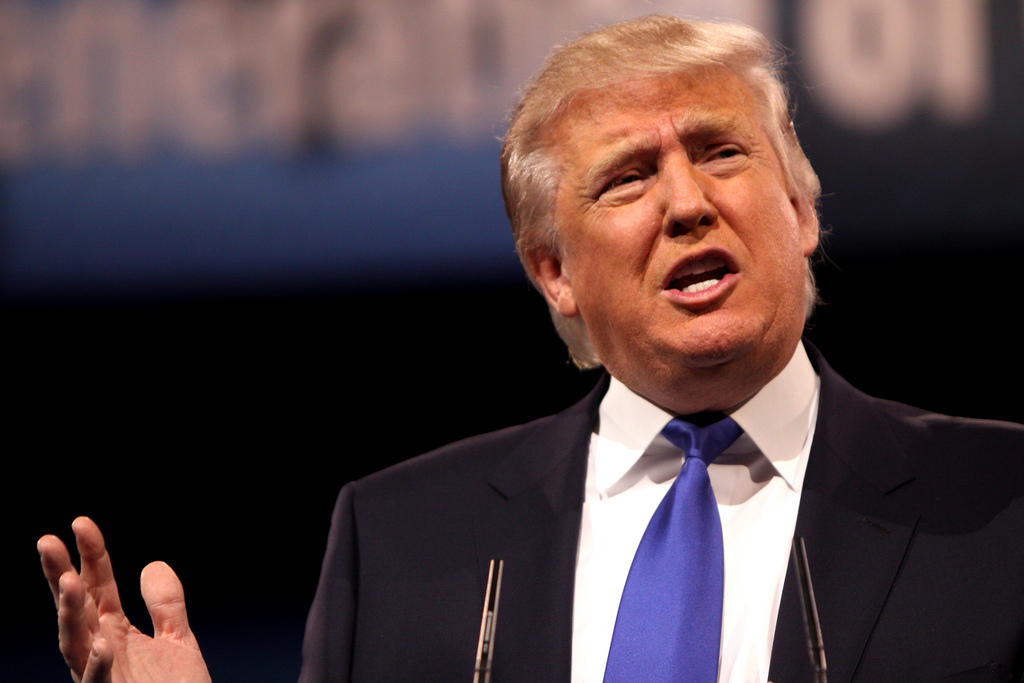
According to the fire marshal I talked to, about 450 people were packed into Exeter’s charming, historic—and very tiny—town hall this morning to see the Trump show. To judge by the crowd’s reactions, they weren’t disappointed. They laughed, they cheered, they shouted. What they didn’t seem to notice was a brief, five-second sequence, in which their candidate admitted that he might not be the Republican nominee.
“If I win—and I have a good chance!” Trump said, “If I win—and I don’t know that I’m going to win, but I have a good chance.”
Maybe he’s expressed that sort of self-doubt before; if so, I haven’t seen it. “Good chances” are for losers.
The rest of the event was vintage Trump. He brought the house down with his promise to build a wall. When someone in the crowd requested a wall on the Canadian border, too, he was in on the joke. He spoke in the third person. (“That won’t happen with Trump. Believe me, that won’t happen with Trump.” “Trump is leading with Hispanics.” “Do the vets like Trump?”)
As Mark Steyn observed a few weeks back, Trump doesn’t have a stump speech; he simply talks about whatever strikes his fancy. And the result is that his events are more like a night at the improv than a traditional political rally. This is not necessarily a bad thing. Sometimes, it’s very, very good. One of the consequences is that Trump can go on for an hour, or ninety minutes. Or not. In Exeter, he spoke for 17 minutes, then took questions for another 13 minutes, and then blew the popsicle stand.
We’re past—long past—the point where anyone expects policy coherence, let alone details, from Donald Trump. But one moment from the rally stood out nonetheless. Asked “what is your plan to update” Social Security,” Trump answered:
So there you have it.
Yet for this—a 30 minute event in which nothing of consequence was said—there were hundreds of people lined up down the block hours in advance. There we protestors chanting. There were police and security out the wazzoo. The only primary campaign I’ve seen which approached the Trump operation in terms of the size of the security force and the militancy of access control to the venue was the Obama ’08.
There’s something strange in this dichotomy: On the one hand, Trump is running an unconventional race where the candidate is the campaign and everything, from policy to speeches, is unscripted and improvised. On the other hand, Trump’s organization is running a security apparatus around him like he’s an especially paranoid head of state.
It’s an odd combination. And probably a bit revealing, too. The Trump show isn’t entirely what it seems.
