

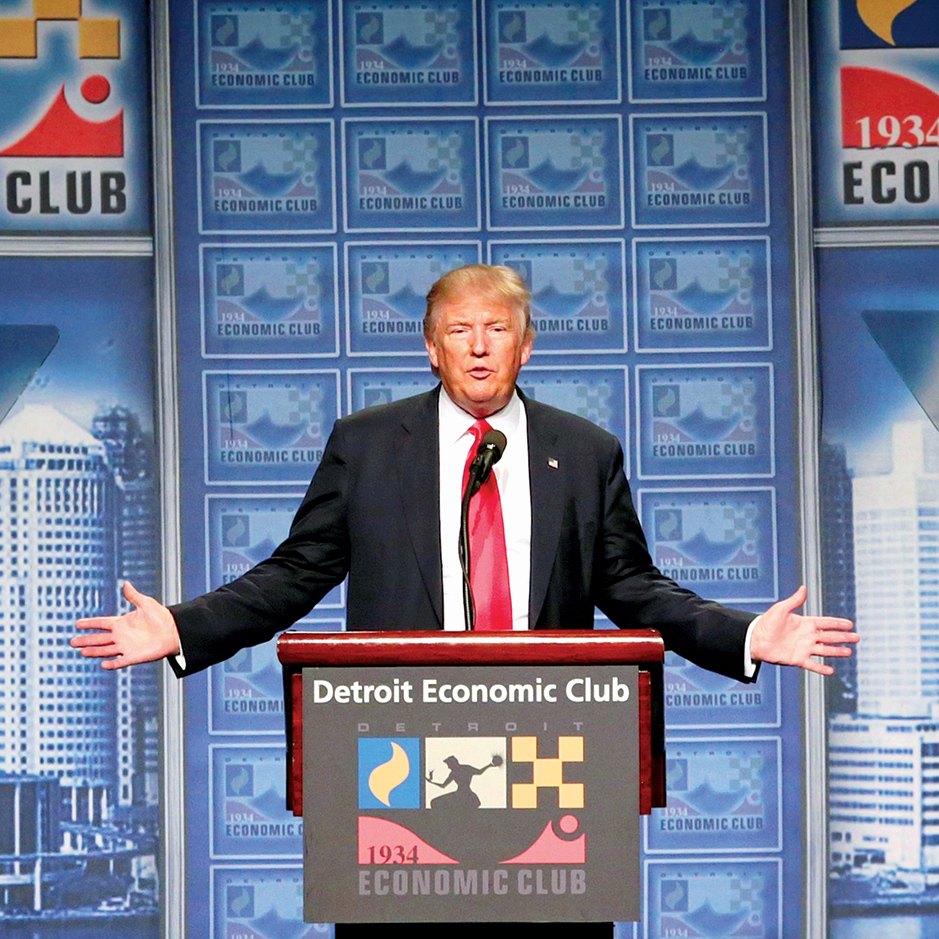
As Trump speeches go, his address to the Detroit Economic Club was a good one. Donald Trump cleared the low bar of actually staying focused on what is mostly a pro-growth economic policy. But for a speech on economics, it was also remarkable for what it didn’t say. There was absolutely nothing about America’s most pressing fiscal issue: runaway spending on Medicare and Social Security. And even if Trump had mentioned the issue of entitlements in his economic speech, chances are he would have—as he has elsewhere on the campaign trail—ruled out changes to the programs.
Anyone who would cut federal spending has to face the daunting fact that more than two-thirds of the federal budget is spent automatically on Medicare, Social Security, and other entitlement programs, such as Medicaid and unemployment insurance. Some 17 percent of the budget goes to defense, while interest on the federal debt eats up another 6.5 percent. The little that is left for discretionary spending—the 6.5 percent of the budget Congress uses to pay for disaster relief, research, education, and less salutary items such as pork—could easily be crowded out. Economist Milton Ezrati warned in City Journal last year that, in the likely event the interest-rate on federal debt doubles, interest payments would eat up all non-defense discretionary spending. Even the liberal think tank the Urban Institute says that, absent reforms, mandatory spending on entitlements will swallow 98.3 percent of the budget a decade from now, leaving just 1.7 percent for all discretionary spending—and that 1.7 percent includes defense.
Stay informed.Stay ahead.
Join Washington Examiner for unlimited access to the news, analysis, and commentary that matter most.
Already a member? Log in
