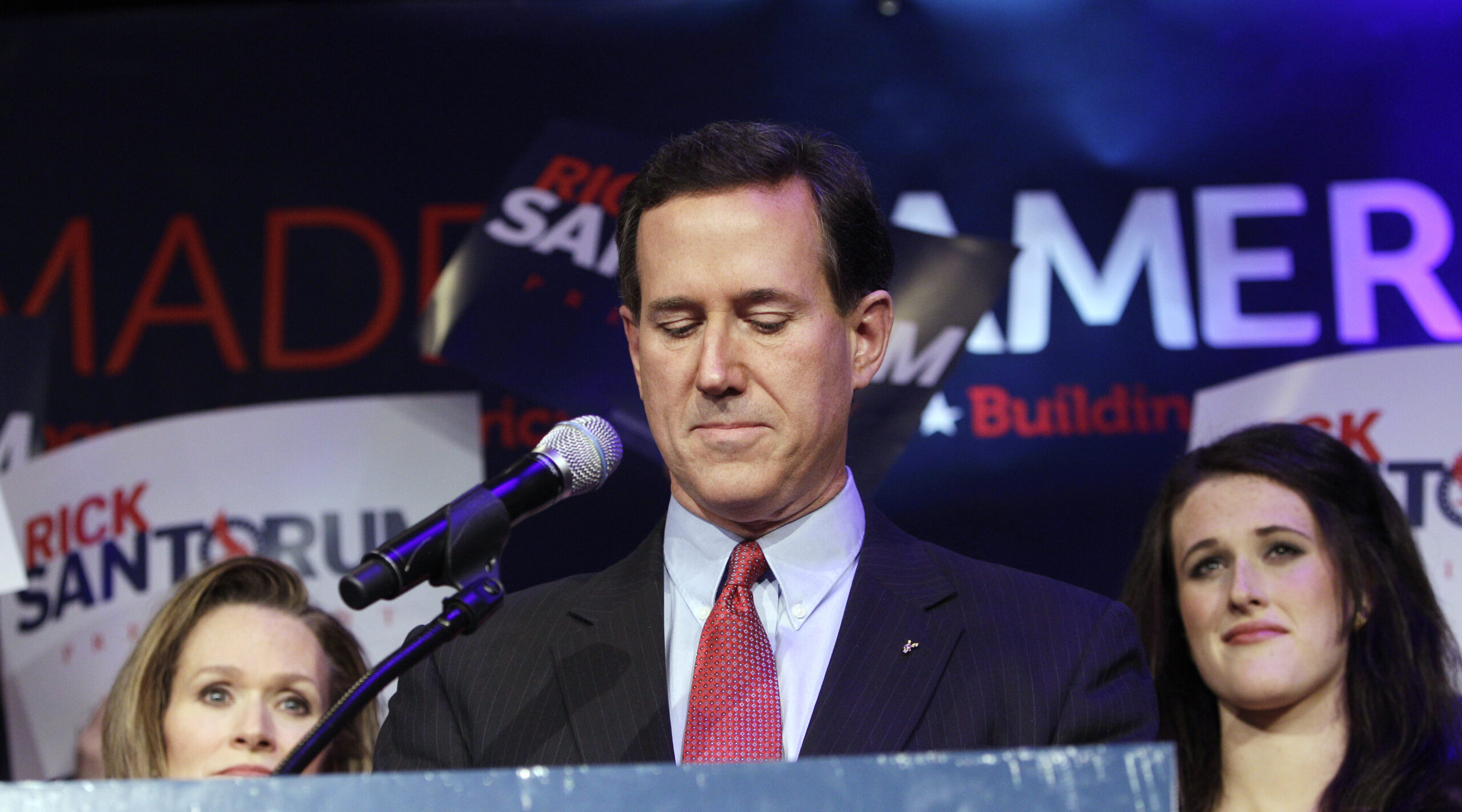
There couldn’t be a greater contrast between two campaigns than the Michigan election-eve rallies of Rick Santorum and Mitt Romney.
Santorum’s was held in a gymnasium at Heritage Christian Academy in Kalamazoo. It began with a prayer from Rev. Paul Davis of Calvary Baptist Church, who asked God to “give us a president who would defend the voiceless and the unborn” and prayed that “if You have found [Santorum] faithful, we pray that You would make him the next president of the United States.” The bare-bones event featured no fanfare and no music, although at Santorum’s rally earlier in the day, at a hotel in Lansing, the crowd broke into a spontaneous and touching version of “God Bless America.”
Romney’s election-eve rally was held in a music hall in Royal Oak, a well-off suburb of Detroit. The high-energy production featured a live mini-concert by a secret “special musical guest” who turned out to be Kid Rock, the Michigan-born singer known for drunken brawls, scrapes with the law, a stormy and brief marriage to Pamela Anderson, and a notorious group sex tape. Rock, whose real name is Bob Ritchie, is unusual in the music business because he’ll let a Republican play his songs; nearly every Romney entrance at rallies is accompanied by Rock’s “Born Free.” A few nights earlier, Romney went to Ritchie’s home to ask that he sing at the election-night rally; after extracting Romney promises to help Detroit and Michigan if elected president, Ritchie agreed. It was a good show; still, for a candidate who has never had even a hint of scandal about his life, it was an odd contrast.
As each candidate appeared at those last rallies, the Michigan race seemed almost dead even. Santorum had dashed into the lead after big wins in Minnesota, Colorado, and Missouri. But Romney poured money into Michigan and began to come back; by Friday and Saturday, Romney seemed firmly in command. But on Sunday and Monday, there was a feeling around the state that Santorum was coming back; the morning of election day, there were a lot of observers who thought he might pull off an upset. Then Romney pulled ahead right at the line — exit polls showed he won among voters who made their decision virtually as they walked into the polls — and won, 41 percent to 38 percent.
In the end, the election was about the economy, and voters bought Romney’s economic message more than Santorum’s. According to the exit polls, 55 percent of voters said the economy was the top issue, and Romney beat Santorum among them, 47 percent to 30 percent. In perhaps a more telling indicator, among the 31 percent of voters who said that someone in their household had been laid off in the last three years, Romney won 42 percent to 36 percent: the people who are most anxious about jobs chose Romney. Finally, when voters were asked which experience, in government or in business, best prepared someone to be president, they chose business 57 percent to 31 percent. That is the core of Romney’s pitch to voters, and they bought it.
Romney’s appeal was concentrated in the better-off parts of the income scale, but he did better among low-income voters than Santorum did among high-income voters. Among people who make less than $50,000 per year, Santorum won 41 percent to 36 percent. Among people who make between $50,000 and $100,000, Santorum won 40 percent to 37 percent. Among people who make between $100,000 and $200,000, Romney won 46 percent to 37 percent. And among people who make more than $200,000, Romney crushed Santorum 55 percent to 28 percent. Of course, there are more people in the lower-income groups than the higher-income groups; Romney won by staying close to Santorum in the lower category and blowing it out in the higher category.
Santorum campaigned hard for lower-income votes. Despite having made, according to his tax returns, $923,000 in 2010 and $1.1 million in 2009, Santorum portrayed himself as the little guy against an opponent who made $20 million in 2010 and committed rich guy gaffes like admitting that his wife drove two Cadillacs and that he was friends with NASCAR owners but not fans. (Romney held his election-night party at the Suburban Collection, a giant car dealership outside Detroit, whose CEO, David Fischer, is a friend of Romney’s and introduced him at Romney’s ill-fated economic speech at a nearly-deserted Ford Field the previous Friday.) In the end, though, Santorum, the self-styled if prosperous little guy, just didn’t connect enough with lower-income voters to overcome Romney’s advantage with the better-off.
As far as issues were concerned, Santorum did best among voters who said abortion was the most important issue — he beat Romney 77 percent to 13 percent. But those abortion voters were a small part — 14 percent — of the electorate. They were passionate — at one Santorum event, the man who led the Pledge of Allegiance ended it by saying, “with liberty and justice for all, born and unborn” — but there weren’t nearly enough of them to carry Santorum to victory.
Santorum was betting on several factors that didn’t quite pan out. The first was that most economic conservatives are social conservatives, too, and while they say it’s essential that a candidate have a solid economic plan, they don’t forget about the social issues when they vote. If Santorum could meet their threshold on the economy, the thinking went, those voters might give him the edge for his long-held positions on issues like life, marriage, and the role of faith in government. The problem was, in the end Santorum could not match Romney’s strength on the economy.
The second thing Santorum counted on is the fact that just 25 percent of adults in Michigan have a bachelor’s degree or higher. What some observers heard as Santorum’s off-the-wall criticism of going to college — his calling Barack Obama a “snob” for proposing college for all — they heard as reassurance that Santorum hasn’t forgotten about them. In the end, Santorum won among that group, but by just a little. And the even bigger problem for him was that lower-educated Michiganders didn’t vote as much as their higher-educated fellow citizens. The 25 percent who have a bachelor’s degree made up about 50 percent of the electorate on Tuesday. Santorum might have had the blue-collar world on his side, but he couldn’t get enough of them to the polls.
Santorum also expected to do well among Catholics, who made up 30 percent of Tuesday’s electorate. Santorum, after all, has never been shy about discussing his Catholic faith, and when, for example, he needed to stage an event quickly, as he did last Friday night, he turned to the nearest Knights of Columbus hall — and greeted the crowd as “a fellow Knight.” But on election day, Catholics chose Romney over Santorum, 44 percent to 37 percent.
Perhaps the reason was as simple as Catholics are just as concerned about the economy as everyone else. Or perhaps Santorum hurt himself with his much-publicized observation that reading John F. Kennedy’s 1960 speech on Catholicism and politics made him “want to throw up.” Maybe conservative Catholics got Santorum’s point, but it was a rough thing to say about the nation’s first, and only, Catholic president. On election day, Santorum told radio host Laura Ingraham, “I wish that I had that particular line back.” It was one of his few publicly-expressed regrets about the campaign.
Santorum did, on the other hand, win the Protestant vote, 42 percent to Romney’s 40 percent. Throughout the campaign, Santorum has often expressed amusement at the fact that he was once chosen as one of the nation’s most influential evangelicals. On Tuesday, they accepted him more than Catholics.
For all Santorum’s problems, the race was close. And it’s hard to say how big a role Romney’s native-state advantage played in the results. Certainly Romney and wife Ann, who also grew up in Michigan, played up their connection to the state at every opportunity. (“I like to tell people, if you cut us open and we bleed, we bleed Vernors,” Ann Romney told crowds, referring to the popular Michigan-brewed ginger ale.) In Ohio, shaping up as the next big test on Super Tuesday, Romney won’t have that advantage. And Santorum has a solid lead in the polls.
So the Santorum campaign still has life in it. But Michigan’s results have to hurt. As much as Team Santorum said that just being competitive was a huge win in Romney’s native state, the fact is, they were really hoping for an upset in Michigan that might derail Romney’s entire campaign. What has to be disheartening for Santorum is that more voters were more concerned about the economy than anything else, and they chose Romney. That’s a big obstacle for Santorum to overcome.
