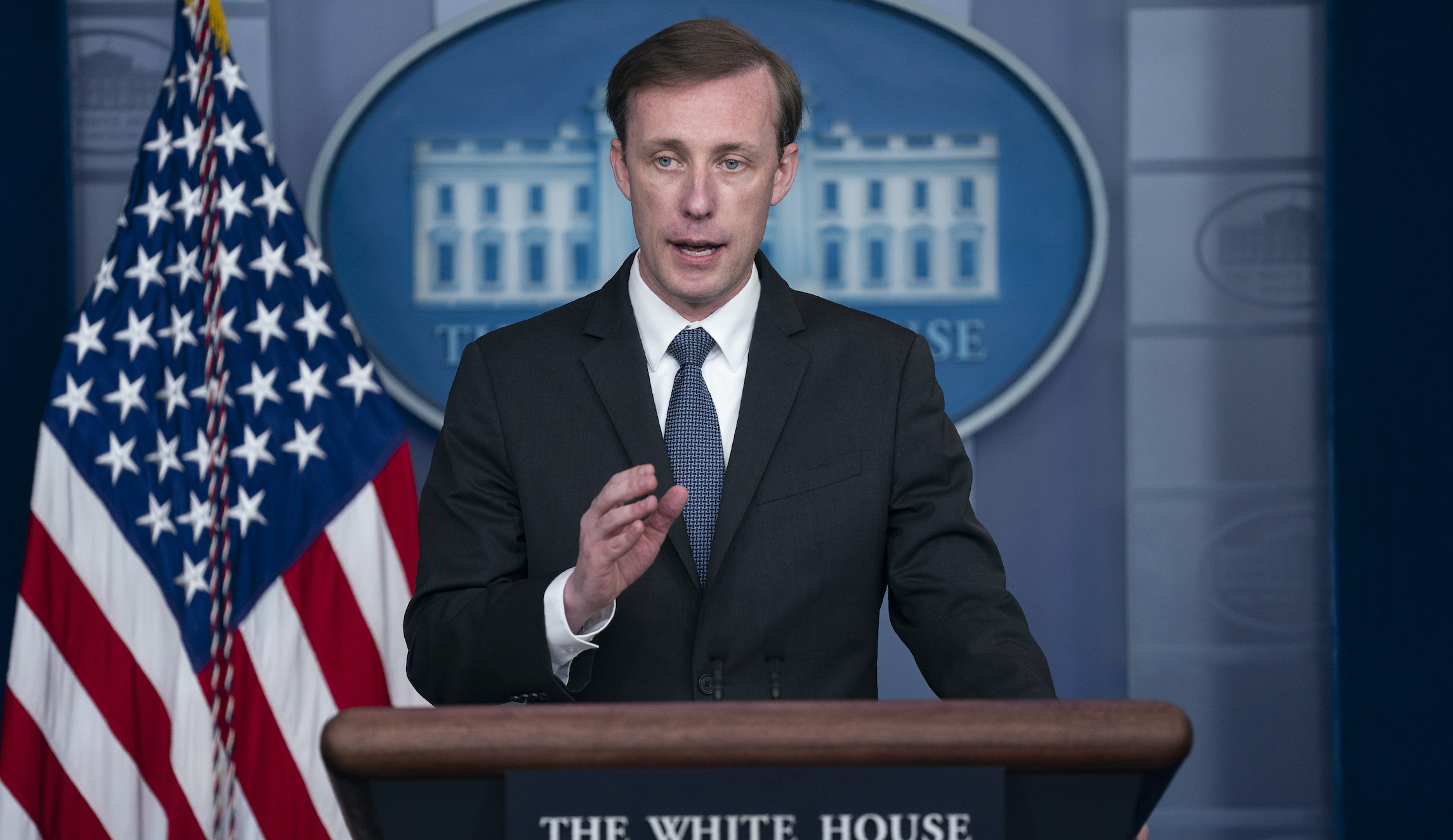
A top U.S. official warned the Chinese government there would be “consequences” if Beijing helps the Kremlin evade sanctions and said he believes China had at least some insight into Russia’s invasion of Ukraine before its launch.
Jake Sullivan, the national security adviser for President Joe Biden, said on two Sunday shows that the United States would not just allow Beijing to undermine U.S. and international sanctions against Russia.
Recommended Stories
While the Pentagon criticizes China for its “at least tacit approval” of Russia’s invasion, China has repeatedly sought to lay blame at the feet of the U.S., calling it one of the “culprits of the crisis.”
“We have made it clear not just to Beijing but to every country in the world that if they think that they can basically bail Russia out, they can give Russia a workaround to the sanctions that we’ve imposed, they should have another thing coming, because we will ensure that neither China nor anyone else can compensate Russia for these losses,” Sullivan told NBC’s Meet the Press. “I’m not going to lay all of that out in public, but we will communicate that privately to China as we have already done and will continue to do.”
PENTAGON OUTS RECENT NORTH KOREAN UNDISCLOSED BALLISTIC MISSILE TESTS
Sullivan was asked about consequences for China again.
“We also are watching closely to see the extent to which China actually does provide any form of support, material support or economic support, to Russia,” Sullivan said on CNN’s State of the Union, adding, “I’m not going to sit here publicly and brandish threats, but what I will tell you is that we are communicating directly, privately to Beijing that there will absolutely be consequences for large-scale sanctions evasion efforts or support to Russia to backfill them.”
Sullivan also said, “We will not allow that to go forward and allow there to be a lifeline to Russia from these economic sanctions from any country.”
When asked if he considers Chinese leader Xi Jinping a co-conspirator with Russian leader Vladimir Putin, Sullivan replied, “We believe that China in fact was aware before the invasion took place that Vladimir Putin was planning something. They may not have understood the full extent of it, because it’s very possible that Putin lied to them the same way that he lied to Europeans and others.”
CIA Director William Burns said last week that China was likely “unsettled” by Russia’s flawed invasion of Ukraine thus far.
Putin and Xi met at the start of the Olympics in February to announce a broad strategic partnership “without limits” amid Russia’s military buildup on Ukraine’s border. Since the full-scale invasion was launched, China has carefully avoided condemning Russia, has placed blame on the U.S., and has joined the Kremlin in spreading what the U.S. says is misinformation about the U.S. working on biological weapons in Ukraine.
Chinese Foreign Ministry spokesman Zhao Lijian said Sunday that Yang Jiechi, director of the Office of the Central Commission for Foreign Affairs, will meet with Sullivan in Rome on Monday as a follow-up on President Joe Biden’s virtual summit with Xi in November.
“They will exchange views on China-US relations and international and regional issues of common concern,” Zhao said.
Zhao has already weighed in on the Biden administration’s claims that China would be punished if it helps Russia skirt sanctions.
National Security Council spokeswoman Emily Horne said the Sullivan-Yang meeting will be “part of our ongoing efforts to maintain open lines of communication” and that “the two sides will discuss ongoing efforts to manage the competition between our two countries and discuss the impact of Russia’s war against Ukraine on regional and global security.”
A Biden administration official told the Washington Examiner the meeting had been in the works for a while but that it is “taking place in the context of Russia’s unjustified and brutal war against Ukraine, and as China has aligned itself with Russia to advance their own vision of the world order.” The official said that “you can expect us to raise that very clearly.”
CLICK HERE FOR MORE FROM THE WASHINGTON EXAMINER
“China firmly opposes any form of unilateral sanctions or long-arm jurisdiction by the U.S. When dealing with the Ukraine issue and the relationship with Russia, the U.S. should take seriously China’s concerns and not undermine China’s rights and interests in any way,” Zhao said last week. “China will take all necessary measures to resolutely safeguard the legitimate rights and interests of Chinese companies and individuals.”
The U.S. intelligence community pushed back against Russian claims that the U.S. is running bioweapons labs in Ukraine, calling them part of a Kremlin disinformation campaign.
The Russian government and media outlets have ramped up claims in recent weeks that the U.S. operates bioweapons research facilities in Ukraine, with Chinese diplomats and propaganda outlets amplifying the story. The U.S. and Ukraine have consistently denied the claims, and Russia has never provided any proof.
The U.S. and Ukraine signed an agreement in 2005 for the Defense Department to assist Ukraine in the “prevention of proliferation of technology, pathogens, and expertise that could be used in the development of biological weapons.”
Zhao said Tuesday that “Russia has found during its military operations that the U.S. uses these facilities to conduct bio-military plans.” And he said Thursday that “the international community has had grave concerns about U.S. bio-military activities.” Zhao said to “never forget that there are three fingers pointing back to you when you point fingers at others.”
Last week, he repeatedly pointed to Fort Detrick in Maryland. Russia and China have spread COVID-19 disinformation baselessly claiming that the virus originated with the U.S. military there.
The U.S. has condemned China for its false claims about the origins of SARS-CoV-2. At least one U.S. spy agency believes a Chinese government lab in Wuhan is the most likely origin for the pandemic.
The heads of the intelligence community and of the CIA both agreed last week that Putin’s invasion of Ukraine may give China pause when considering invading Taiwan.
Director of National Intelligence Avril Haines said last week that the Chinese Communist Party remains the “absolutely unparalleled” long-term priority for the U.S. intelligence community.
