

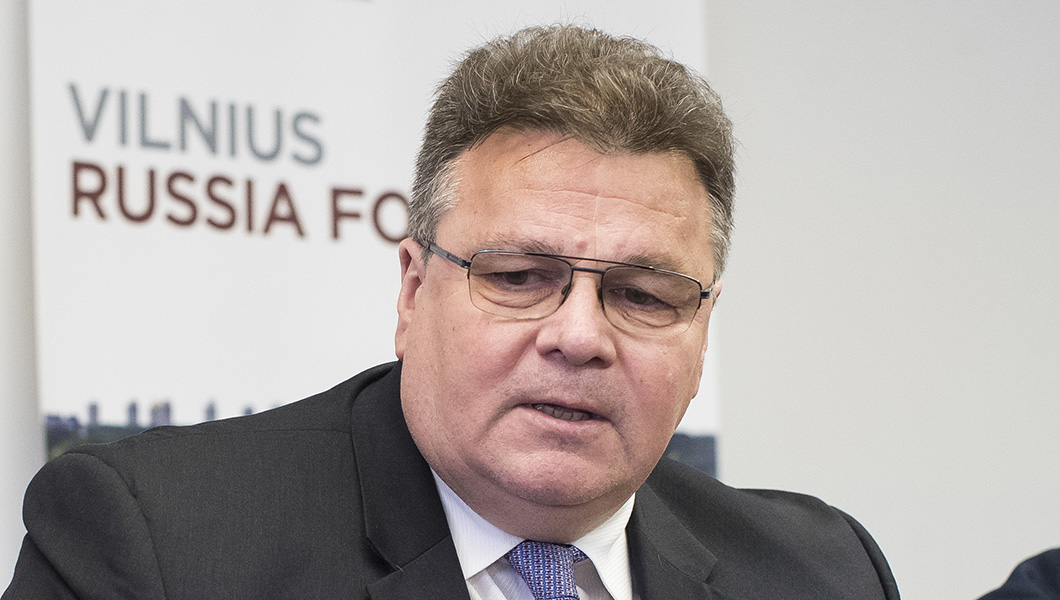
European talk of establishing a continental army independent of the United States is serving to undermine political stability within NATO, according to a top Baltic diplomat.
“We are experiencing now a period which is testing our strength and unity, by all means — boats rocked from both sides,” Lithuanian foreign minister Linas Linkevicius told the Washington Examiner.
Recommended Stories


Linkevicius believes the credibility of the transatlantic alliance has come into question thanks to controversies swirling around President Trump’s posture toward it, dating back to his presidential campaign and stoked by perennial rumors he’ll seek to withdraw the United States from the union. But European leaders aren’t guiltless, he said.
“So this mobilizes some skeptics in the European Union saying that we have to do that autonomously, we have to develop our own projects,” Linkevicius said. “Ideas about European armies — which nobody knows what that means, nor are we going to implement, frankly. But it’s discussed, creates quite [a bit of] ambiguity and suspicion from the U.S. side. So, all in all, we’re really rocking the boat and testing, is it really viable enough?”
Russia maintains that it is not. Foreign Minister Sergey Lavrov argues that with a lack of “a reason for its existence,” NATO is “doomed to failure,” as he put it in 2017. “NATO has destabilized and continues to destabilize the security structure in Europe,” he said. But Russia’s annexation of Crimea and invasion of eastern Ukraine serve as a vivid reminder, for former Soviet satellite states, of the value of NATO in an era when U.S. and major European leaders seem at odds with each other and internally conflicted about the proper Western view of Russia.
“So on the ground militarily, I would say NATO has been strengthened in the last couple of years,” former NATO secretary general Anders Fogh Rasmussen told the Washington Examiner in December. “But having said that, it is a matter of concern that NATO, at the same time, has been politically weakened because of the statements by the president that could be interpreted as a lack of commitment to NATO Article V,” which establishes that “an attack against one Ally is considered as an attack against all Allies.”
Secretary of State Mike Pompeo and other administration officials have sought to reassure allies of American dedication to NATO. Linkevicius argued that their remarks should be taken seriously even if Trump fails to echo them because the president believes NATO members are taking advantage of U.S. defense spending and failing to carry enough of the security burden themselves. He stressed that Trump is “right” to insist on spending increases.
“But when it comes to all other aspects and details, I believe he maybe has not sufficient insight or no practice,” the diplomat told the Washington Examiner, noting that Trump is a first-time politician. “[I]n reality, he cannot be expert on all those details.”
Trump’s praise of Russian President Vladimir Putin and his hesitance to rebuke the Kremlin leader at their high-profile summit in Finland fostered additional European unease about the president’s commitment to NATO. Linkevicius thinks Pompeo speaks for a bipartisan foreign policy establishment, and he touted the recent deployment of additional NATO forces in Europe as physical evidence of a commitment that trumps any doubts caused by the president’s comments.
“Are we concerned about these statements? Yes, we [are], but let’s look into how things are developing on the ground,” he said. “We can see tangible footprints.”
But Linkevicius also pointed a finger at business interests in Germany and other Western European countries that support the construction of a controversial natural gas pipeline from Russia that would increase European reliance on Russian energy.
“It contradicts our agreed [upon] European policy and is still, still moving ahead,” Linkevicius said. “Sometimes these interests prevail, but it should not be the rule.”
