

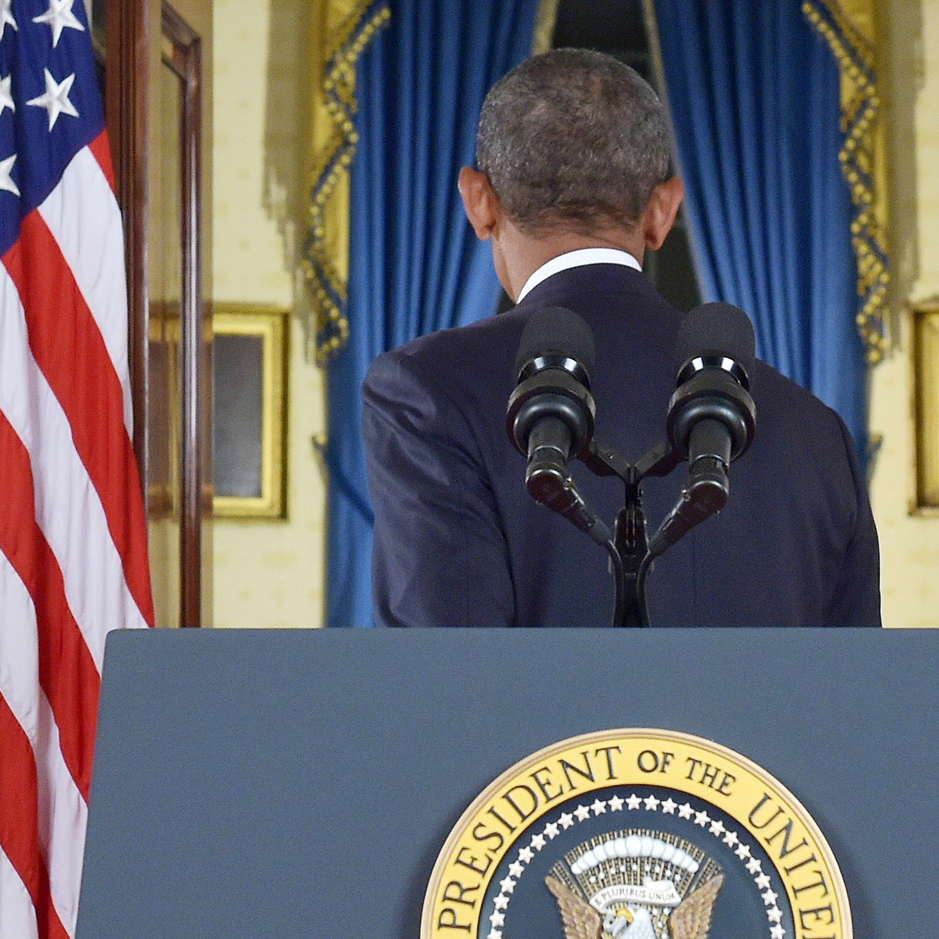
On September 10, President Barack Obama announced in a prime-time television address that the United States would be going to war—sort of. He explained that terrorists in Iraq and Syria threatened the United States—sort of. He proclaimed that the United States would do everything in its power to eliminate that threat—except deploy the “modest contingent” of ground troops recommended by his generals. The president declared an ambitious objective—destroying the Islamic State—and laid out a strategy that almost certainly will not achieve it. And in so doing Obama assumed the mantle of war president—sort of.
America needed to hear from the president himself an acknowledgment that his approach to the global war on terror hasn’t worked, that the reason he was delivering the speech at all is that he had misunderstood the threat. We needed to hear that he was committed to changing course and that, while we were not yet safer, we would be if we followed this new path.
Recommended Stories


Instead, we heard a president committed to selling failure as success, weakness as strength. It was the kind of speech a president would give if the White House discussions and debates preceding it had focused less on threats and war than on polls and politics. Before he even finished reading the second paragraph on the teleprompter in front of him—a brief recounting of “successes” in the overseas contingency operations he’d been conducting—Obama made clear that he is still not serious about winning the long war.
“We took out Osama bin Laden and much of al Qaeda’s leadership in Afghanistan and Pakistan. We’ve targeted al Qaeda’s affiliate in Yemen and recently eliminated the top commander of its affiliate in Somalia. We’ve done so while bringing more than 140,000 American troops home from Iraq, and drawing down our forces in Afghanistan, where our combat mission will end later this year. Thanks to our military and counterterrorism professionals, America is safer.”
It is a passage almost breathtaking in its delusion.
America is not safer—not safer than a year ago, or six years ago, or a decade ago. That’s an assessment shared by Obama critics and many supporters alike.
Senator Dianne Feinstein, chairman of the Senate Select Committee on Intelligence, acknowledged that reality last year. CNN’s Candy Crowley put the question to her directly. “The big question that’s always asked: Are we safer now than we were a year ago, two years ago? In general?”
Feinstein, a Democrat, was unambiguous: “I don’t think so. I think terror is up worldwide, the statistics indicate that. The numbers are way up. . . . There are more groups than ever and there’s huge malevolence out there.”
She updated her assessment after gaveling in the annual “Worldwide Threats” hearing on January 23, 2014. Feinstein worried about the “popular misconception that the threat has diminished,” and declared, “It has not.” Feinstein continued: “The presence of terrorist groups, including those formally affiliated with al Qaeda and others, has spread over the past year. While the threat emanating from Pakistan’s tribal areas has diminished due to persistent counterterrorism operations, the threat from other areas has increased. In fact, terrorism is at an all-time high worldwide.”
Director of National Intelligence James Clapper, the nation’s top intelligence official and one who was appointed by Obama, put it this way: “Looking back over my more than half a century in intelligence, I have not experienced a time when we have been beset by more crises and threats around the globe.” Among particularly acute threats: a more “globally dispersed” array of jihadist terror groups and the conflict in Syria, a “growing center of radical extremism, and the potential threat this poses to the homeland.”
Clapper was correct. The threat is greater today than it was just a few years ago.
Does Obama reject the assessment of his top intelligence adviser? Does he think we are in a better position than we were in January, when these two Obama supporters offered their assessments and when he himself dismissed the group we are now at war with—sort of—as junior varsity?
Equally troubling, Obama began a speech announcing America’s return to war in Iraq by celebrating his withdrawal of combat troops from that country. Would he have us believe that the two events are unrelated?
If he believes this is a mere coincidence, he has little company. And it’s a change from last month, when he attempted to deflect blame for the chaos by claiming it hadn’t been his choice to remove troops from Iraq. Asked directly if he had “any second thoughts about pulling all ground troops out of Iraq,” Obama disclaimed responsibility for the outcome. “As if this was my decision,” he huffed.
Finally, can this president truly believe that removing troops from an Afghanistan teetering on a return to chaos will make us safer? Has he not learned the lessons of Iraq?
The day before the president’s speech, The Weekly Standard asked a senior official in the Afghan government what will happen if the United States follows through on Obama’s promise to end the combat mission there. He was blunt: “It will be a disaster.”
It may be comforting for the president to see these things as distinct and unrelated to one another, to imagine that the threats emanating from Iraq and Syria are new and unique, to pretend that his decisions have made us safer. But it shouldn’t be comforting to the rest of us.
Ambivalence won’t win this war. And self-delusion could lose it.
