

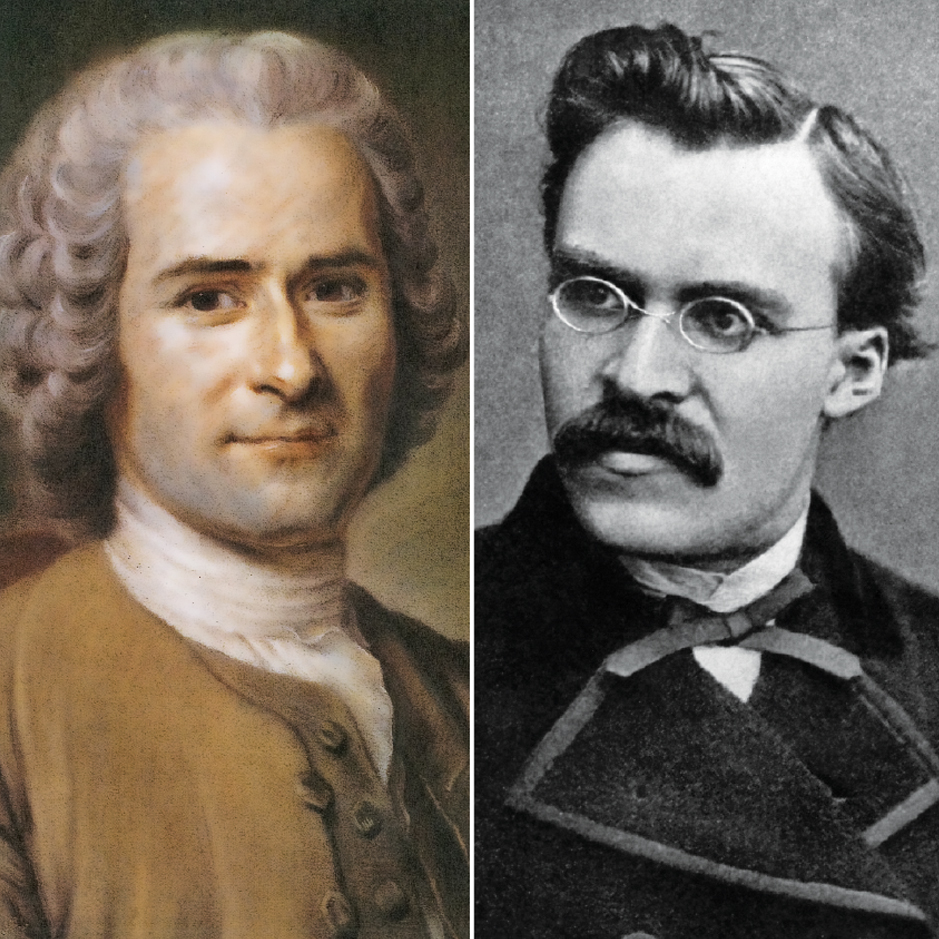
The extremely fertile period of European intellectual history that runs from about 1749 (Rousseau becomes famous) to 1889 (Nietzsche goes mad just as he’s becoming famous) spawned nearly every idea that has bewitched and bedeviled us since. It also spawned a new social class entirely devoted to coming up with ideas—the thinking class, the theory class, the class consisting of the imperious, all-explaining persons who became known, sometime around the middle of the 19th century, as intellectuals.
In Frank M. Turner’s view, Rousseau, who shed conventional clothing along with conventional manners and morals, was the original of all the estranged, visionary, badly dressed intellectuals who came after him:
Stay informed.Stay ahead.
Join Washington Examiner for unlimited access to the news, analysis, and commentary that matter most.
Already a member? Log in
He made intellectuals different from simply being influential writers. He made the social role or social function of the intellectual to be that of a critic who found himself alienated from his or her society while at the same time actually living a life deeply embedded in that society. . . . It was Rousseau who made the hatred of one’s own culture the stance of the cultivated person.
Of course, alienation from conventional or sophisticated society wasn’t new—think of Diogenes the Cynic or the desert saints or the Chinese Taoists—and some measure of it can be found in thoughtful people of any era. But if Rousseau was something new, it’s because he was reacting to something new. He broke with his fellow philosophes because he thought that their newly minted ideal of rational progress was deforming and diminishing modern humanity instead of improving it.
Most of the writers Turner surveys here either turned against progress or declared it wasn’t nearly enough and had to be accelerated into a mad dash to utopia. It’s really a study of a new kind of sour grapes: For these writers, the grapes were sour precisely because they were within reach, and they all went off feverishly pursuing something out of reach.
Frank Turner, who died in 2010, was an Ohio-born historian and specialist in eminent Victorians who had a long career at Yale and first presented this material in lecture form for a popular course there. In 15 chapters, corresponding to the original lectures, he negotiates his way through the Ozymandias-caliber ruins of every once-mighty theory and moonstruck utopia of the period with infinite tact, avoiding summary judgments and any theoretical posturing of his own. Each chapter contains acute, often against-the-grain insights into individual thinkers or movements.
In his chapter on nationalism, for instance, he notes that despite its later populist manifestations, it was originally a top-down movement. He traces the respective roles of university professors and students, schoolteachers, newspapers, and the emerging scholarly field of philology in forging (in both senses of the word) distinct national identities out of the blurred European reality of multi-ethnic states, regional loyalties, wary peasants, and the Babel of local dialects. And in “Race and Anti-Semitism,” he deals not only with the usual suspects (Arthur de Gobineau and Houston Stewart Chamberlain, whose dueling Aryan theories form a study in delusional contrasts) but with the way scientific achievements like the theory of evolution, advances in public hygiene, and the germ theory inadvertently contributed to new obsessions with ethnic purity and eugenic measures.
Turner’s sympathies are clear. He likes the less presumptuous intellectuals, writers of a moderate reformist bent or an empirical, scientific temper: Alexis de Tocqueville, John Stuart Mill, Charles Darwin, Adam Smith, and the pioneering feminist Mary Wollstonecraft. He offers interesting angles on all of them, such as Darwin’s eventually repudiated debt to William Paley’s Natural Theology (1802) and the way Mill’s entanglement with the married Harriet Taylor affected his conceptions of liberty, genius, and progress. Like Isaiah Berlin, Turner takes a complex and cautionary view of 19th-century liberalism, and he sees its inherent disadvantages in competition with other philosophies and movements of the time that resembled heavenly visions and fighting faiths.
In fact, most of the figures Turner contemplates were not interested in gradual reform or patient scientific inquiry. They were engaged in a far-flung quest for lost authenticity—or wholeness, or purity, or organic unity, or something equally inspiring and vague and lost. Much of this looks, in retrospect, like a search for new bottles into which the old wine of religious feelings could be poured. So Turner’s intellectual history becomes, in large part, a history of intellectuals trying to make a religion out of something that can’t actually be one—nature, art, the inner self, primitivism, progress, the distant past, the radiant future, nation, culture, even science—and in the process turning each of them into a myth.
This, of course, doesn’t always invalidate their criticisms of contemporary society, which could be devastatingly accurate—e.g., Thomas Carlyle and John Ruskin on the degrading monotony of modern work. Even while chasing their mirages, they could discover real things, like the beauty of Gothic cathedrals, which Ruskin’s evangelism turned into the 19th-century architectural juggernaut known as the Gothic Revival.
Turner devotes one of his best chapters to medievalism. The fascination with medieval legends and lore, with knights errant and damsels in distress and sacred quests, emerged from Romanticism and quickly became a vital part of Western popular culture. For its admirers, it was an age of pure, naïve passions, heroism, and wholehearted faith, or else an age of inspired craftsmanship and organic social forms—one that, in any case, served as the polar opposite of the new utilitarian age. The Middle Ages, much more than the ancient world, formed the childhood of Western civilization, offering the wonder, enchantments, and archetypal figures that childhood retains but that rational, businesslike, bureaucratic modernity seemed to have lost.
Yet Turner overlooks this enduring aspect of Romanticism in Rousseau, William Blake, and William Wordsworth—a longing for an idealized childhood and a sense of childhood as a separate, significant realm. He also overlooks the momentous change in 18th-century sensibility demonstrated by the new penchant for the sublime—soaring mountains, storms, wilderness, and melancholy ruins—that was reflected in the works of Rousseau and Edmund Burke and consummated in Romantic art. Burke, in fact, hardly appears in the book. But in “The Turn to Subjectivity” and “The Cult of the Artist,” Turner seizes on the lasting importance of another aesthetic development.
German idealist philosophy took a plunge into the inner self and emerged cradling a new conception of art and the artist. Art, sometimes along with nature, was seen as an expression of profound inner realities: the unique, autonomous, creative genius of the artist or of some pantheistic or transcendent inner spiritual essence. Art was given a metaphysical status and sacred aura: It was now understood as inherently expressive, with an emphasis on the artist’s personality and on radical originality instead of the faithful, self-effacing imitation of nature—or an edifying version of it—found in classical aesthetics. But once sacred mysteries were expected of the artist, mystification often followed, and Turner considers just one form of it in a separate, mordant chapter on Richard Wagner.
Friedrich Nietzsche picked up the cult of the artist and ran with it. His cloudy, lofty, suspiciously godlike Superman may be a super-artist who turns life itself into a work of art. At the very least, the artist gives form and meaning to human life in a formless, meaningless, godless universe: “We have art lest we perish of the truth.” Human beings need illusions, and the artist provides them at their best.
Rousseau, despite his own literary and musical gifts, was almost as hostile to the arts as Plato. His ideal was the artless austerity of ancient Sparta. But Turner, bringing his survey full-circle, focuses instead on the contrasting ethical and historical visions of Rousseau and Nietzsche. They make ideal bookends for this shelf of modern writers, being twinned opposites. They had in common not only their nomadic, ailing lives, their Swiss affiliations, and their devotion to music and long, solitary Alpine walks, but also a tendency to see history in terms of a decisive wrong turn, a fall from grace.
For Rousseau, it occurred with the advent of organized society itself, when private property and inequalities of wealth and power eclipsed a primordial state of nature, where equality had prevailed and natural human sympathy prevented violent rivalries. For Nietzsche, the fall came when a robust pagan aristocratic-warrior ethic succumbed, first, to the ethical and metaphysical rationalism of Socrates and Plato, and then to the life-denying ascetic morality of Christianity (“Platonism for the masses”). His saga of leveling “resentment” disguised as morality continued with the French Revolution and its offspring, democracy and socialism, both aiming, in his view, at a herdlike mediocrity and conformity: life with all the risk, adventure, and high aspiration ironed out of it.
Both Nietzsche and Rousseau thus saw in modernity a dismal sequel to the original fall. Rousseau thought modern “progress” was just leading to more inequality and conflict; Nietzsche thought it was leading to not enough of either. Both recommended if not a return to nature a closer approach to it. But Rousseau’s nature is pastoral and peaceful, like the imaginary Arcadia of the ancient pagan world. Nietzsche’s nature is a sublimely heroic, strenuously life-affirming version of the ancient pagan world itself, and is equally imaginary.
Both writers had great critical gifts, Rousseau’s tending toward earnest complaint and Nietzsche’s toward astringent irony. But both went trolling in the distant past for myths of authenticity and offered them up as a basis for wiping the slate of modern civilization clean so that something more resilient and redemptive could take its place. And with some honorable exceptions, that is the story of the intellectuals in this book. Some of their myths were harmless; others, like Marxism and militant nationalism, were essentially bombs with long fuses that finally exploded during the 20th century. Nietzsche may or may not have been right about human beings needing illusions, but it’s clear that most intellectuals can’t live without them.
Lawrence Klepp is a writer in New York.
