

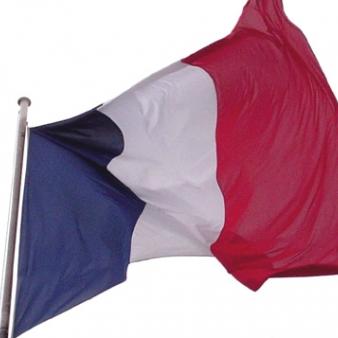
Bernard-Henri Lévy has written an intelligent and forceful, if somewhat grandiloquent, piece on Paris and its implications. Highlights:
So it’s war.
A new kind of war. A war with and without borders, with and without states, a war doubly new because it blends the non-territorial model of al-Qaeda with the old territorial paradigm to which Islamic State has returned.
But a war all the same.
And, faced with this war unwanted by the United States, Egypt, Lebanon, Turkey, and now France, only one question is worth asking: What should we do? How, when a war like this is forced upon you, do you respond and win?
Principle number 1: Do not play with words. Call things by their right names. Dare to utter the terrible word “war,” a word that the democracies try to push out of the range of hearing, beyond the bounds of their imagination, their symbolic system, and their reality….
Principle number 2: The enemy. To utter the word “war” is to evoke an enemy. As Carl Schmitt taught, we must deal with the enemy as enemy, viewing him as someone to be tricked, outmanoeuvred, tangled up in negotiations, or struck silently, depending on the tactics adopted, but in no case appeased. But, following Saint Augustine, Saint Thomas Aquinas and every other theoretician of just war, we must also call the enemy by his true name.
That name is not “terrorism.” It is not a dispersed collection of “lone wolves” or “lunatics.”
Better: fascislamists.
Better: the product of the grafting that Paul Claudel saw coming when he noted in his journal for May 21, 1935, in one of those insights that occur only to the truly great: “Hitler’s speech? A kind of Islamism is being created at the centre of Europe.”
What is the advantage of naming things accurately? To place the cursor right where it belongs. To remind us that against such an adversary, war must be waged without truce or mercy. And to require each of us, everywhere, in the Arab-Muslim world as on the rest of the planet, to say why we are fighting, alongside whom, and against whom….
But that implies two things, or rather three.
First, an understanding that the Islamic lands are the only parts of the world that never underwent the work of remembrance and grieving done by the Germans, French, other Europeans, and Japanese, because in much of the Islamic world, the myth has persisted that the fascist storm of the 1930s was contained within the perimeter of Europe.
Next, the need to emphasize even more clearly the critical, primordial opposition between the two visions of Islam, two visions that are locked in a war to the death….
“Not in our name” is a noble cry; a noble gesture. But what is needed now above all else is the simple act, essential in war, of isolating the enemy, cutting his supply lines, and no longer allowing him to swim like a fish in the water of a community of which he is, in fact, the shame.
To speak the word “war” also implies, inevitably, the identification, the marginalization, and, ideally, the neutralization of that part of the enemy camp that is operating at home….
I come now to the heart of the matter. The real source of this flood of horror. And that is the Islamic State, which occupies a good third of Syria and Iraq and provides to the perpetrators of possible future Bataclans the rearguard bases, command centres, crime schools and training camps without which none of this would be possible.
Last week, in Sinjar, Kurdish forces backed by the international coalition won a clear and decisive victory. I could cite many examples over the past six months in which the Kurds – who, for the time being, are the only ones engaging the enemy on the ground – have routed IS’s rabble army without a fight.
This was the situation two decades ago in Sarajevo, when putative experts raised the spectre of the hundreds of thousands of ground troops that would have to be deployed to prevent ethnic cleansing from reaching its grisly apogee. Yet it turned out that a handful of special forces, backed by strikes, was sufficient. I am convinced that the IS hordes are much braver when blowing the heads off defenceless young Parisians than when facing real soldiers of freedom. Similarly, I believe that the international community possesses all of the means necessary to defeat the threat it faces, should it choose to do so.
What holds us back? Why have we been so stinting in assisting our Kurdish allies?
What is it about this war that the America of Barack Obama, at least for the moment, seems not to really want to win? I do not know the answer. But I know where the key lies.
And I know the alternative to using the key: No boots on their ground means more blood on ours.
A new kind of war. A war with and without borders, with and without states, a war doubly new because it blends the non-territorial model of al-Qaeda with the old territorial paradigm to which Islamic State has returned.
But a war all the same.
And, faced with this war unwanted by the United States, Egypt, Lebanon, Turkey, and now France, only one question is worth asking: What should we do? How, when a war like this is forced upon you, do you respond and win?
Principle number 1: Do not play with words. Call things by their right names. Dare to utter the terrible word “war,” a word that the democracies try to push out of the range of hearing, beyond the bounds of their imagination, their symbolic system, and their reality….
Principle number 2: The enemy. To utter the word “war” is to evoke an enemy. As Carl Schmitt taught, we must deal with the enemy as enemy, viewing him as someone to be tricked, outmanoeuvred, tangled up in negotiations, or struck silently, depending on the tactics adopted, but in no case appeased. But, following Saint Augustine, Saint Thomas Aquinas and every other theoretician of just war, we must also call the enemy by his true name.
That name is not “terrorism.” It is not a dispersed collection of “lone wolves” or “lunatics.”
Better: fascislamists.
Better: the product of the grafting that Paul Claudel saw coming when he noted in his journal for May 21, 1935, in one of those insights that occur only to the truly great: “Hitler’s speech? A kind of Islamism is being created at the centre of Europe.”
What is the advantage of naming things accurately? To place the cursor right where it belongs. To remind us that against such an adversary, war must be waged without truce or mercy. And to require each of us, everywhere, in the Arab-Muslim world as on the rest of the planet, to say why we are fighting, alongside whom, and against whom….
But that implies two things, or rather three.
First, an understanding that the Islamic lands are the only parts of the world that never underwent the work of remembrance and grieving done by the Germans, French, other Europeans, and Japanese, because in much of the Islamic world, the myth has persisted that the fascist storm of the 1930s was contained within the perimeter of Europe.
Next, the need to emphasize even more clearly the critical, primordial opposition between the two visions of Islam, two visions that are locked in a war to the death….
“Not in our name” is a noble cry; a noble gesture. But what is needed now above all else is the simple act, essential in war, of isolating the enemy, cutting his supply lines, and no longer allowing him to swim like a fish in the water of a community of which he is, in fact, the shame.
To speak the word “war” also implies, inevitably, the identification, the marginalization, and, ideally, the neutralization of that part of the enemy camp that is operating at home….
I come now to the heart of the matter. The real source of this flood of horror. And that is the Islamic State, which occupies a good third of Syria and Iraq and provides to the perpetrators of possible future Bataclans the rearguard bases, command centres, crime schools and training camps without which none of this would be possible.
Last week, in Sinjar, Kurdish forces backed by the international coalition won a clear and decisive victory. I could cite many examples over the past six months in which the Kurds – who, for the time being, are the only ones engaging the enemy on the ground – have routed IS’s rabble army without a fight.
This was the situation two decades ago in Sarajevo, when putative experts raised the spectre of the hundreds of thousands of ground troops that would have to be deployed to prevent ethnic cleansing from reaching its grisly apogee. Yet it turned out that a handful of special forces, backed by strikes, was sufficient. I am convinced that the IS hordes are much braver when blowing the heads off defenceless young Parisians than when facing real soldiers of freedom. Similarly, I believe that the international community possesses all of the means necessary to defeat the threat it faces, should it choose to do so.
What holds us back? Why have we been so stinting in assisting our Kurdish allies?
What is it about this war that the America of Barack Obama, at least for the moment, seems not to really want to win? I do not know the answer. But I know where the key lies.
And I know the alternative to using the key: No boots on their ground means more blood on ours.
Read the whole thing. You probably won’t agree with all of it. All the more reason to read it.
Stay informed.Stay ahead.
Join Washington Examiner for unlimited access to the news, analysis, and commentary that matter most.
See Options
Already a member? Log in
Print subscriber? Click here to login/register your account
Digital subscriber? Click here to login/register your account.
