Four Republicans are vowing to vote against advancing a bill that would repeal portions of Obamacare if they do not get a guarantee from congressional leadership that they will hash out additional details of a replacement plan during a conference with the House.
Without conferencing the bill, the House could pass legislation on its own and send the watered-down Obamacare repeal bill to President Trump to sign.
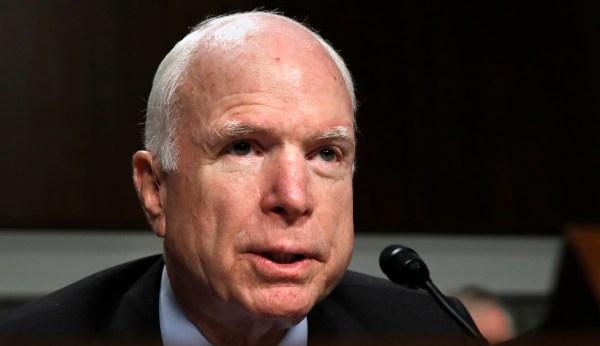
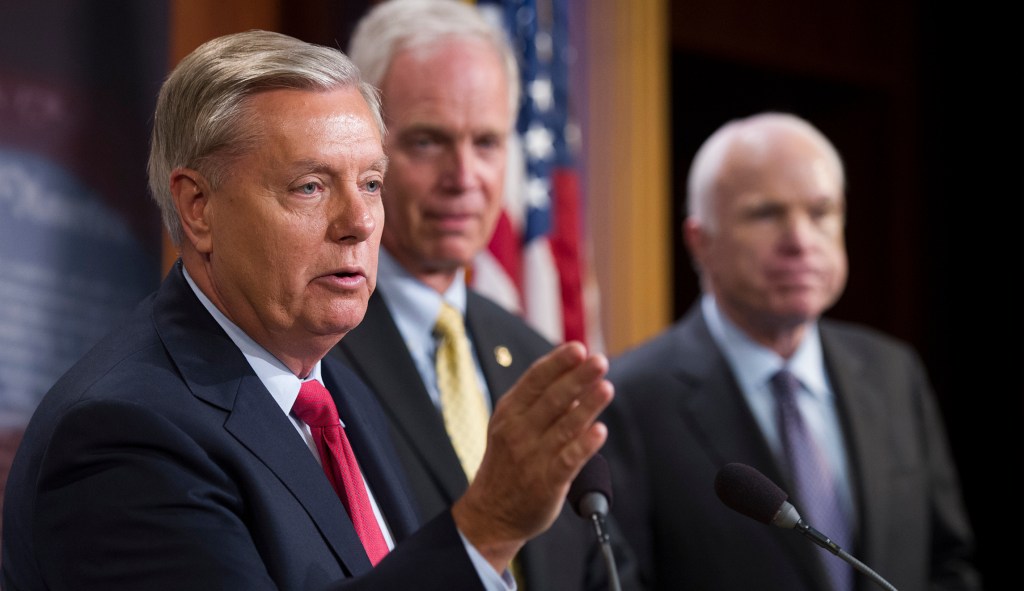
The announcement, made by GOP Sens. Lindsey Graham of South Carolina, John McCain of Arizona, Bill Cassidy of Louisiana and Ron Johnson of Wisconsin, came Thursday as various news reports said that some House members would be open to sending a bill to President Trump without working on additional proposals or waiting for other proposals discussed in recent weeks to be evaluated.
“I am not going to vote for the skinny bill if I am not assured by the House that there will be a conference,” Graham said at a press event. Passing the bill on its own, he said, would politically be “the dumbest thing in history.” House Freedom Caucus Chairman Mark Meadows, R-N.C., has agreed that the bill should go to conference, but other House members say they would be willing to pass a “skinny repeal.”
The vote to send the bill forward is expected to be held Thursday night, and it was not clear what congressional leadership would need to do to win over the holdout senators and pledge that the bill would go to conference.
“We don’t have it,” Graham said. “It’s like pornography: You know when you see it.”
Johnson said that they had been told by Senate leaders that the “skinny repeal” was intended to be a vehicle that would buy lawmakers additional time so that different proposals that have been made in recent months can be scored by the Congressional Budget Office.
The Senate has been working on a watered-down version of Obamacare repeal this week that they said would repeal the individual and employer mandate, defund Planned Parenthood for a year, and suspend the medical device tax for six years. Some senators urged other members to vote for the measure, dubbed the “skinny repeal,” so that a final healthcare bill could be hashed out in conference.
But some senators are worried the pledge won’t be followed and are prepared to abandon efforts at passing a healthcare bill strictly along party lines.
For Cassidy, the concerns go beyond whether the bill will be sent to conference, he said. He would also want additional details about what would happen during those negotiations, including whether a proposal he has been working on with Graham would be considered after it is evaluated by the Congressional Budget Office. The proposal would allow Obamacare funding to go to states so they can craft their own plans.
The senators explained that they are concerned about the House passing the “skinny repeal” bill without a replacement because it would inject additional problems into the exchanges, which were created under Obamacare and allow people to buy tax-subsidized coverage. Repealing the individual mandate, which requires people to purchase coverage or pay a fine, would raise unsubsidized premiums by 20 percent and would cause 16 million more people to become uninsured in 2018, the Congressional Budget Office estimates. “It is not a replacement in and of itself,” Graham said, calling the approach a “disaster” if it were to become law on its own.
The exchanges already are facing troubles: Insurers are exiting different counties and asking for double-digit rate increases on premiums. Republicans have concluded that if they cannot pass a bill on their own, they would have to work with Democrats on a bill that would stabilize the exchanges.
“I’d rather get out of the way and let it collapse than have a half-assed approach where it is now our problem,” Graham said.
Still, the senators signaled that an appropriate guarantee could win their support.
“What I’m afraid of is that this thing dies this week and then sits out there over the August recess,” McCain said.
The “skinny repeal” came to the forefront of GOP healthcare strategy this week after Senate Republicans failed to arrive at a consensus following months of closed-door negotiations, and after they failed to pass two other pieces of legislation on Obamacare this week. One of the bills would have repealed Obamacare and delayed implementation of a new plan for two years, while the other would have immediately replaced the law with other provisions and made long-term changes to the Medicaid program.
Republicans are advancing the legislation through reconciliation, which means they can pass a bill with only 50 votes, but have to abide by strict rules and craft legislation that affects only the federal budget, and must meet certain targets in reducing the deficit. They can afford to lose no more than two GOP votes for their healthcare bill, so the four senators could sink the effort.