
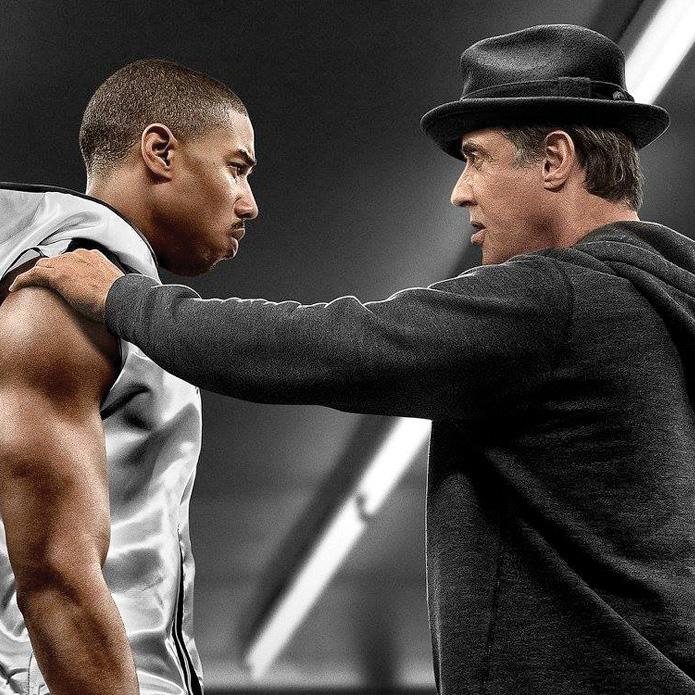
Ryan Coogler, who conceived and directed the new hit film Creed, is up to something very tricky with this effort to update the Rocky films to the 21st century. Creed is not a Cinderella story about a working-class chump who gets an unexpected shot at glory, as the original Rocky was. Instead, it’s a character study of a soul in quiet torment.
Real journalism.Trusted by millions.
Unlimited access to in-depth reporting, expert analysis, and the stories that shape our country.
Already a member? Log in
He is Adonis Johnson (Michael B. Jordan), and he’s the illegitimate son of Apollo Creed, the publicity-mad heavyweight champ who plucked the hangdog mug Rocky Balboa from the streets of Philadelphia to be his opponent in a bicentennial fight back in 1976. Adonis is seeking some kind of deliverance for himself in the sport his father dominated—the father he never knew, the father who was married to a woman other than his mother, the father who died before he was born.
Creed is the most original franchise reboot we’ve yet seen from reboot-mad Hollywood because Coogler comes at what we’re not supposed to call “the Rocky universe” from such an unexpected angle. Everything that was there originally is here: the humble ethnic neighborhoods of Philadelphia, the low-tech training techniques, a low-key love affair, even Rocky himself, embodied once again by Sylvester Stallone, now 69 years of age.
Adonis comes to Philadelphia to find Rocky, whom he has to browbeat into working as his trainer. He doesn’t fit in there because he doesn’t fit in anywhere. He spent a childhood in Los Angeles in extreme privation (group homes and juvenile detention) and his teen years in luxury (with Creed’s widow, who finds him after his mother’s death and takes him in).
We don’t understand what Adonis needs and gets from boxing, and neither does anyone else. His adoptive mother is angry that he is putting himself at risk. Rocky tells him that there’s no reason to box unless you come from nothing and have nothing. He’s angry when anyone refers to his father in his presence. It is not until he speaks a single line of dialogue, just moments before the movie comes to a close, that the reason for the torments Adonis Johnson Creed has put himself through becomes clear.
I can’t tell you what that line of dialogue is, but it’s a killer piece of screenwriting by Coogler and his collaborator Aaron Covington. It’s so good that it comes close to justifying the fact that, for most of the movie’s running time, Adonis is really kind of a pill. Close, but alas, no cigar.
Critics are rhapsodic about Creed, but I can’t join in with them fully, because pretty much every minute the movie focuses on him, I wanted the camera off Michael B. Jordan’s face and back onto Stallone’s beautiful, wrinkled, startlingly transparent face. It’s hard to think of a more sheerly lovable performance than Stallone’s, and I don’t mean this year. I mean in Hollywood history. And it’s impossible to divide the pleasure one takes from Stallone’s indelible work in this movie from his own Hollywood history.
The original Rocky was Stallone’s own Cinderella story. He was a struggling actor who was supporting his family by working part-time tearing tickets at a Manhattan movie theater when he wrote its screenplay—nothing less than a walk-off work of pop-culture genius.
The championship bout between a Muhammad Ali type and a third-rate palooka with heart was a clever stroke. But the genuinely brilliant trick of the screenplay was how Stallone took Paddy Chayefsky’s Marty—that paradigmatic and self-described “sad, lonely little man” from a white ghetto—and put some boxing gloves on him.
Rocky doesn’t have an ounce of killer’s blood running through his veins. All he wants is to date his drunken pal Paulie’s shy kid sister, feed his turtles, and not have to hurt the deadbeat numbers players his gangster boss sends him out to threaten. And when he lands the big fight, all he wants is not to get his face kicked in. Rocky has to find strength and drive just to keep from being humiliated—and then discovers he has much more in him than he ever knew.
This is what made Rocky the most beloved film of the year it was made, and won it the Oscar over All the President’s Men and Network. Stallone took a huge risk after he completed the screenplay; he was offered big money for it and turned it down so he could play the role himself. Which he did beautifully. And then, for the next 39 years, he didn’t do much of anything all that beautifully.
Stallone created a character named Rocky Balboa, but this iteration of him—sweet, tired, disappointed, lonely, rueful, wounded, and offhandedly wise—is Coogler’s work. Which means Stallone is actually acting here, and may wonders never cease. He supplies all the fun and the joy and the heart that people are loving about Creed. And boy, does the movie need him, because it doesn’t get nearly enough from its Creed.
John Podhoretz, editor of Commentary, is The Weekly Standard‘s movie critic.