
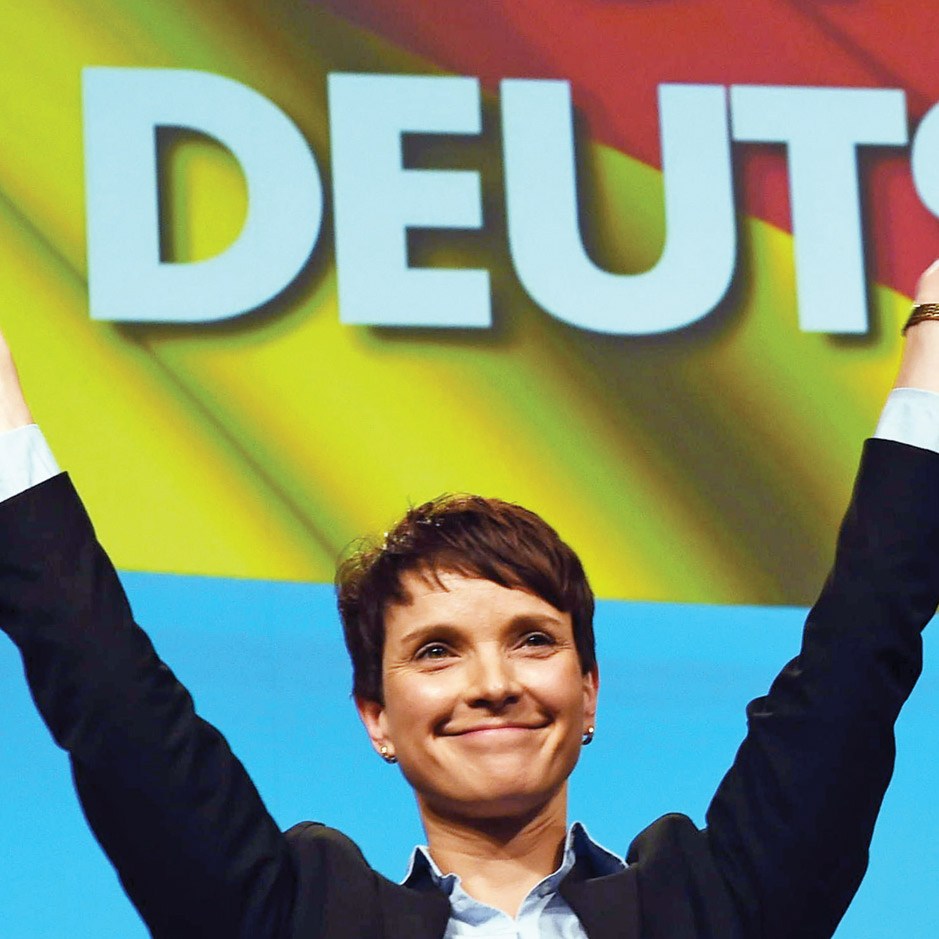
Not many people had heard of Frauke Petry, a pretty and very sassy 40-year-old chemist, until she started talking about how a country without borders is not a country at all and railing against the political establishment. It is natural for Americans to think of Petry as a kind of German version of Donald Trump. Since she took over the small protest party Alternative for Germany (AfD) a year ago, she has shifted its focus from economics to immigration. She, too, lauds her country’s military. She points to a southern border overrun by migrants, suggesting that it needs to be defended—with force, if necessary. She accuses her country’s conservative nabobs of not being conservative at all, of abandoning their most loyal voters to the schemes of various yuppie utopians. She has harvested the scorn of that same establishment, and of the country’s most visible pundits. And she, too, is in the process of creating a political earthquake.
In mid-March, 3 of Germany’s 16 states held their statewide elections. Petry’s Alternative for Germany mostly won. Chancellor Angela Merkel’s Christian Democrats mostly lost. So did Merkel’s Social Democrat coalition partners, the formerly socialist-leaning party of Willy Brandt and Helmut Schmidt, which now rules with Merkel in a semi-permanent establishment coalition. The AfD’s performance in Saxony-Anhalt (home of Martin Luther) was astonishing. In its first race ever, it took about a quarter of the vote (24.2 percent), finishing just behind Merkel to become the state’s second party. The Social Democrats lost more than half their voters from the last election (they seem to have moved to the AfD). Turnout was through the roof. Forty percent of the votes cast for the AfD were by new voters.
Real journalism.Trusted by millions.
Unlimited access to in-depth reporting, expert analysis, and the stories that shape our country.
Already a member? Log in
Right-wing parties occasionally crop up in former East German states like Saxony-Anhalt. They get dismissed as the atavistic protest votes of un-denazified ex-Communists. AfD is tapping into something very different. Look at rich, western Baden-Württemberg, which in some ways resembles California in the Reagan era, during the period when Republican dominance was first being challenged. Baden-Württemberg was a main beneficiary of Germany’s postwar industrial boom, particularly in the cities of Stuttgart and Mannheim. It is sophisticated (Heidelberg is there). Its conservative culture looked unshakable. Merkel’s CDU had been the top party in every state election for half a century. But in March, the environmentalist Greens came out on top, as the CDU lost almost a third of its vote, falling from 39 to 27 percent, a record low. The SPD, as in Saxony-Anhalt, lost half its votes, to the point where it had too few seats to join the government.
As in the United States, immigration policy in Germany is made by the federal government. So the AfD has been vaulted to power at a level where it cannot deliver on its main campaign promises concerning migration. Maybe the AfD’s voters don’t understand politics, but one suspects they do. The higher the stakes of an election get, the higher the AfD’s vote totals may rise.
The AfD would be only a shadow of itself had Merkel not promised to admit 800,000 Syrian refugees late last summer, driving half the country into a frenzy of charitable activity and the other half into an existential panic. In the event, 1.3 million migrants came—most of them economic immigrants, practically all of them Muslims, and only a minority from Syria. There is no workable procedure to sort the humanitarian rescue cases from the opportunists. They will all, eventually, have the right to bring their families. They are still coming in at the rate of more than 3,000 a day. The March vote came, luckily for Merkel, at a time when the stream had fortuitously paused, as migrants sought to adjust to Macedonia’s having closed its border with Greece. This summer the numbers will probably swell.
Merkel reacted with the sangfroid that we have come to expect of presidents in American midterm elections. Like George W. Bush in 2006 and Barack Obama in 2010 and 2014, she very forthrightly said that she had heard the voters’ fury, and now she was ready to redouble her efforts to carry out the very policies that provoked it. “In terms of the basic approach,” Merkel said in a press conference, “I’m just going to continue doing what I’ve been doing over the last few months.” Her strategy seems to be to gamble that voters do not really feel the worries that they express, and that they will now allow party leaders to go back to making policy unmolested. But this strategy seems more foolish because the situation is getting more risky.
Merkel actually has the semblance of a diplomatic strategy. For 20 years, Turkey—massive, fast-growing, Muslim, radicalizing—has sought to become a member in good standing of the multinational European Union. That would give its 75 million citizens the right to work and live in the EU visa-free. Every time a particularly zealous German utopian (such as former foreign minister Joschka Fischer) urges admitting Turkey in the name of the brotherhood of man or a similarly utopian Englishman (such as Prime Minister David Cameron) proposes it in the name of free markets, European voters hit the roof, and parties like AfD thrive. But EU membership requires the unanimous consent of existing members, and politicians, including Merkel, have promised to block Turkey’s accession. Nicolas Sarkozy of France promised he would submit it to a referendum, which would have meant an automatic no. Anyhow, it wasn’t going to happen. Politicians were too worried about an EU in which the largest country would have Islam as its state religion. Now they say, “Islam, Shmizlam.”
Turkey’s leader Recep Tayyip Erdogan is growing more authoritarian by the day. But he is gaining leverage over the EU, too. Most of Germany’s refugees—including a few of the terrorists who blew themselves up in Paris last November—pass through Turkey. Merkel therefore thinks a solution can be negotiated with the Turks, and over the last two months, at various summits, it has begun to take shape. Turkey will take back the unvetted migrants who have lately been stranded in Greece. Turkey will also regularize—not stop but regularize—the flow of new refugees into Europe. In return, Europe will accept from Turkey an equal number of real Syrian refugees in exchange for the camp-dwellers Turkey takes back. This is the so-called 1:1 resettlement scheme. Note that it is not Germany but Europe that is on the hook for the new refugees. Merkel is promising concessions by other countries in order to pay for the damage done by Germany’s overpromising last summer.
On top of that, the European Commission promises to “make the legislative proposal to lift the visa requirements for Turkish citizens at the end of April 2016.” There are a couple of problems. The first is that this is not a treaty in the classic sense but an Obama-style “deal.” It lacks democratic legitimacy. Merkel’s Germany is negotiating it and expecting it to bind other sovereign countries. The second problem is that the deal seems to give Turkey an incentive for increasing the flow of refugees into Europe, or at least threatening to. Donald Trump may have a point when he says in his stump speech that when you send people to the land of the bazaar and the souk, it’s not a bad idea to remember that negotiating is a skill.
Surf the Internet and you will discover on one page that Spiegel‘s longtime correspondent Hasnain Kazim is being kicked out of Turkey. On the next page you’ll see a German member of the European parliament named Elmar Brok trying to bully German elites into backing the deal: “Whoever is against the Turkey treaty is bringing more migrants,” Brok says, adding, “The alternative would be a Europe once again divided by barbed wire.”
This is the kind of rhetoric that circumscribed German refugee policy until the arrival of the AfD. Politicians and pundits were either unwilling or unable to distinguish between the Europe of Adolf Hitler and the Europe of Helmut Kohl. To argue with Merkel’s logic—let alone with her heart—was a sign of Nazi sympathies. Threatening people with the opprobrium their grandparents suffered is a tactic that has outlived its justifiability. In this election there were voters whose grandparents had not been born when World War II ended. Even so, there remains a second-order kind of vigilance against anti-immigrant sentiment that is kept up by Germany’s businessmen, who believe a Germany that tolerates extremism to be bad for business. But a Germany in which immigration is out of control might be worse. The mass sexual molestation of women by bands of North African men next to Cologne’s cathedral on New Year’s Eve has shaken the country. More than a thousand incidents, including outright rapes, have been reported.
One can ask whether all the historical monitions to AfD voters are really meant or even understood, or whether they are pious blather. Is Merkel really protecting Germany against a “return to the horrors of the twentieth century”? Perhaps she aims to, but in showing herself indifferent to the fate of her country, she is increasing the risk of what she claims to fear. People expect a sign—almost any sign—that their leaders care whether Germany survives or not. This sign need not be belligerent—it could be the slightest acknowledgment. But the public is not receiving it. From anyone.
Now, through the AfD, they have begun to insist on it democratically. No one can doubt that Petry is right to call the recent election “a very good day for democracy in Germany.” But that may be precisely the problem, and the problem may be a deeper one than we think. Europe and the United States have built an enormous architecture of international rules on a foundation of democratic nation-states. This architecture consists of international bureaucracies, treaties guiding global corporations and finance, the informal rules of international migration and world “governance.” The problem is that the two are at odds. International organizations require predictability: The Elmar Broks of the world describe this need for predictability as “international law.” Democracies require flexibility: People must have real choices about how they govern themselves. For a while we found a middle way, offering the people fake choices about how they govern themselves. But they have seen through it. Now that they have, one of the two—flexibility or predictability—is going to have to go. Merkel has chosen to keep predictability. We should not be too confident that her compatriots, or ours, will make the same choice.
Christopher Caldwell is a senior editor at The Weekly Standard.