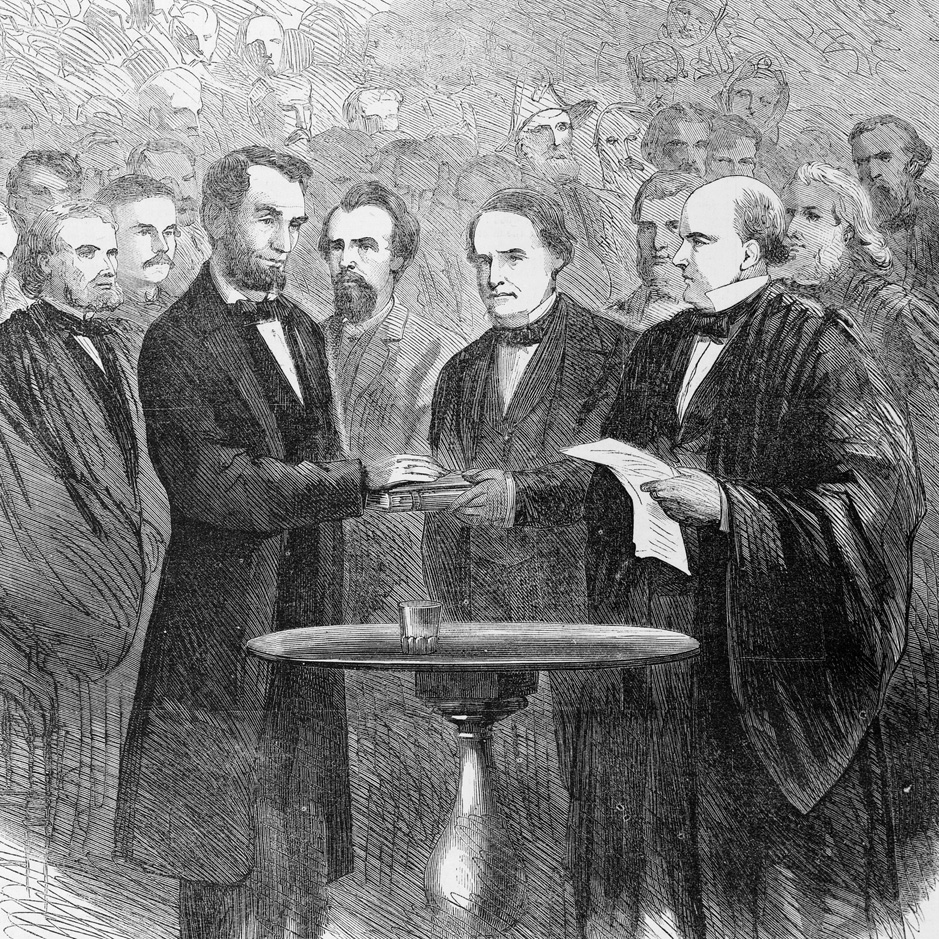
The Weekly Standard looks forward to the 58th swearing-in of a president of the United States on January 20, 2017. The oath-taking is the heart of the occasion. It’s what makes the winner of the presidential election legally and constitutionally able to execute the office of the president. All the rest is ceremony. That’s why Abraham Lincoln, for example, who thought deeply about these things, begins his second Inaugural Address with these words: “At this second appearing to take the oath of the presidential office . . . ”
And where does that oath come from? The Constitution. The president is the only officer of the United States whose oath is specified in the Constitution. To wit: “I do solemnly swear (or affirm) that I will faithfully execute the Office of President of the United States, and will to the best of my ability, preserve, protect and defend the Constitution of the United States.”
As Yale law professor Akhil Amar points out, embedded in the Constitution, “an impersonal legal text setting forth general rules and principles,” lies “a strikingly personal passage revolving around the words ‘I’ and ‘my’—words that appeared nowhere else in the Constitution.”
Now the Constitution requires that the president swear (or affirm, if he is not a believer) two things: That he will “faithfully execute” the office; and that, to the best of his ability, he will “preserve, protect and defend the Constitution of the United States.”
The first task is relatively straightforward. Obviously, any officeholder should faithfully execute his duties. But it’s especially important that the president do this, because his is an especially important office. The Constitution vests the executive power in one and only one person, and thus we rely on him to do all that’s necessary and within constitutional bounds to faithfully execute that office.
The second part of the oath is more striking. Only the president swears to preserve, protect, and defend the Constitution. The presidency, the Founders knew, would have great power. And a president might well have occasion to exercise extraordinary powers. Those powers are to be directed toward protecting the Constitution.
It’s true that “We the People” establish the Constitution. But the Founders went out of their way to reject an understanding whereby the president could exercise power simply by claiming to be defending the People.
One element—a powerful element—of the conservative critique of progressivism over the last century is that progressives have viewed the presidency as a tribune of the people rather than an executor of the office and a defender of the Constitution. Of course presidents have always claimed, and are entitled to claim, that they are acting on behalf of the people. Many of our debates turn on whether the policies they’re advancing really are in the best interest of the people. But a president’s fundamental obligation is to the Constitution.
It was to be expected that, lacking respect for the Constitution, progressives would do damage to it. And so they have. Indeed, Barack Obama has undermined the Constitution in novel and breathtaking ways. Republicans have opposed Obama’s extra-constitutionalism. After all, the Republican party first rose to power in reaction to a Supreme Court decision (Dred Scott) that fundamentally distorted the Constitution. It’s a party reinvigorated in recent years by a popular movement that has sought to restore the Constitution to its deserved place of honor.
When Republicans took control of the House of Representatives in 2011, they opened the first session of the new Congress with a reading of the Constitution. They were much mocked for this by the Constitution’s progressive despisers. Is the GOP now going to select as its presidential candidate someone who has no commitment to constitutional government, who has never shown the least concern about the Constitution, whose campaign seems unacquainted with the Constitution? Will the party of the Constitution abandon its north star?
We doubt it. But Republican voters do need to remember what it is they believe. They may not have sworn an oath. But they ought, to the best of their ability, take their civic responsibility seriously.
As this issue of the magazine goes to press, Donald Trump is sitting out a debate and hosting an event in Iowa ostensibly to benefit military veterans. So perhaps it’s appropriate to recall Abraham Lincoln’s brief remarks to veterans of his day, speaking outside the White House to the 166th Ohio Regiment, on August 22, 1864.
Soldiers—I suppose you are going home to see your families and friends. For the services you have done in this great struggle in which we are engaged, I present you sincere thanks for myself and the country.
I almost always feel inclined, when I say anything to soldiers, to impress upon them, in a few brief remarks, the importance of success in this contest. It is not merely for the day, but for all time to come, that we should perpetuate for our children’s children that great and free government which we have enjoyed all our lives. I beg you to remember this, not merely for my sake, but for yours. I happen, temporarily, to occupy this big White House. I am a living witness that any one of your children may look to come here as my father’s child has. It is in order that each one of you may have, through this free government which we have enjoyed, an open field, and a fair chance for your industry, enterprise, and intelligence; that you may all have equal privileges in the race of life with all its desirable human aspirations—it is for this that the struggle should be maintained, that we may not lose our birthrights—not only for one, but for two or three years, if necessary. The nation is worth fighting for, to secure such an inestimable jewel.
We have no Lincoln among us. Perhaps a nation gets only one Lincoln in its history. But in other respects we are fortunate. Our generation has faced no challenges comparable to those overcome by Lincoln and his successors. We have enjoyed in relative peace and comfort the great and free government they bequeathed us. The Republican candidates among whom we can choose in 2016 are not embarrassingly unworthy of repeating the oath of office that Lincoln took a century and a half ago. Except Donald Trump.
