
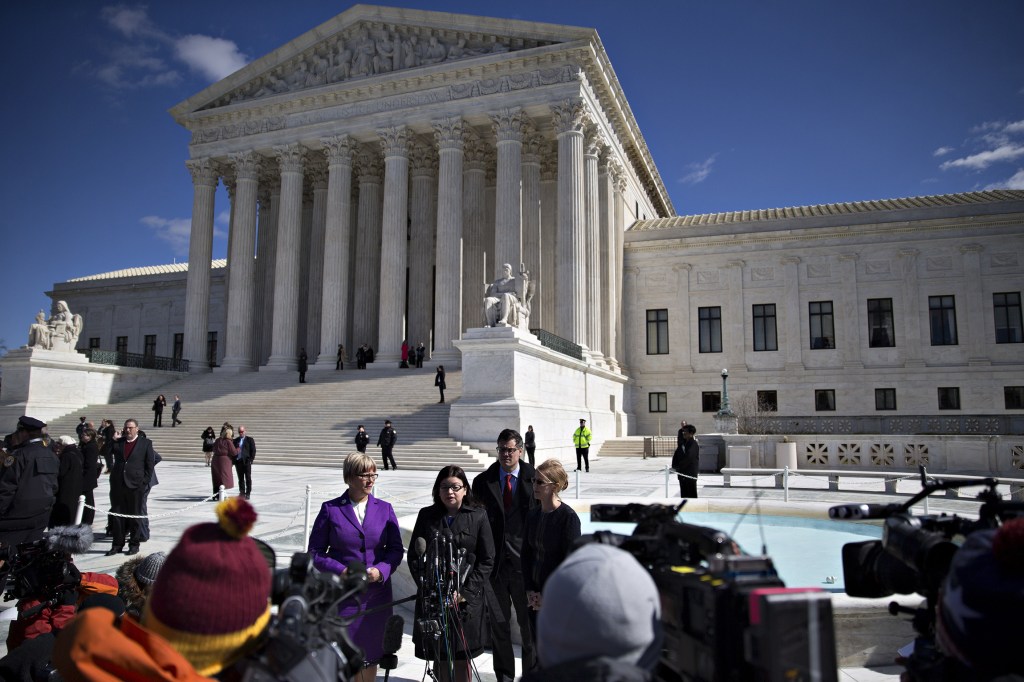
A split decision by a short-handed Supreme Court on Obamacare’s birth control mandate could lead to religious nonprofits in a small pocket of states not providing their workers birth control coverage.
Real journalism.Trusted by millions.
Unlimited access to in-depth reporting, expert analysis, and the stories that shape our country.
Already a member? Log in
The Supreme Court heard oral arguments Wednesday in the case Zubik v. Burwell, in which a group of 37 religious nonprofits such as charities and universities argue a compromise known as an accommodation for Obamacare’s birth control mandate violates their religious beliefs. The eight justices who make up the court, after the death last month of conservative Justice Antonin Scalia, appeared evenly divided during the oral arguments.
A decision is expected in June. A 4-4 split essentially would mean different precedents in different parts of the country, with religious nonprofits in a majority of states having to abide by the accommodation, since a variety of appeals courts have ruled in the case, almost all deciding for the government.
Nine appeals courts have issued rulings, but not all of the plaintiffs in those cases were part of the Supreme Court case, according to an analysis from Kaiser Family Foundation.
Of those nine rulings, eight went for the government and one went for the plaintiffs, Kaiser said.
The Catholic charity Little Sisters of the Poor would be among the nonprofit groups that would have to abide by the accommodation as the 10th Circuit Court of Appeals ruled in favor of the government. Other religious groups affected by the ruling would be Notre Dame and other schools and several archdiocese in various regions.
The one court decision for the nonprofits was in the Eighth Circuit Court of Appeals, which encompasses Iowa, Arkansas, Missouri, Minnesota, North and South Dakota and Nebraska.
That ruling affected the Christian school Dordt College in Iowa and businesses that operate in the planned religious community called Heartland Community in northeast Missouri. The businesses include a country store, ice cream shop and an auto repair shop.
The case focuses on Obamacare’s requirement that all insurers and employers provide birth control. Religious organizations such as churches receive an exemption allowing them to not provide birth control coverage.
Religious nonprofits want the same thing. The organizations currently have to abide by the Obama administration’s accommodation, which allows employees to get birth control coverage but the employer doesn’t have to pay for it.
The organizations argue that the accommodation violates the Religious Freedom Restoration Act of 1993. The law says that government agencies can’t place a substantial burden on a person’s exercise of free religion, unless it has a compelling interest.
The court took up a similar case back in 2014.
It ruled 5-4 in Hobby Lobby v. Burwell that closely held for-profit companies could get the accommodation.
The deciding vote in that case, Justice Anthony Kennedy, didn’t appear to be amenable to the government’s argument in Zubik v. Burwell.
Kennedy said that under the government’s argument it appeared “necessary to hijack” the healthcare plans of the nonprofits.
The nonprofits argued that they are complicit in providing birth control under the accommodation because they have to authorize the coverage through their health plans, even though they don’t have to pay for it.
The court’s liberal wing of Ruth Bader Ginsburg, Sonia Sotomayor, Stephen Beyer and Elena Kagan appeared likely to vote in favor of the government.
Kennedy’s vote will likely be the deciding one again as conservative Justice Samuel Alito and Chief Justice John Roberts asked pointed questions about the government’s argument. Justice Clarence Thomas did not ask any questions but voted in favor of Hobby Lobby in the 2014 case.