Vice President Mike Pence had to travel for work again.
Tuesday afternoon, the vice president hopped in his motorcade, drove 15 minutes to Capitol Hill, and cast the tie-breaking vote to begin debate on healthcare bill in the Senate. Caught up in the drama, most missed a key detail though: Republicans don’t have the votes to pass the legislation.
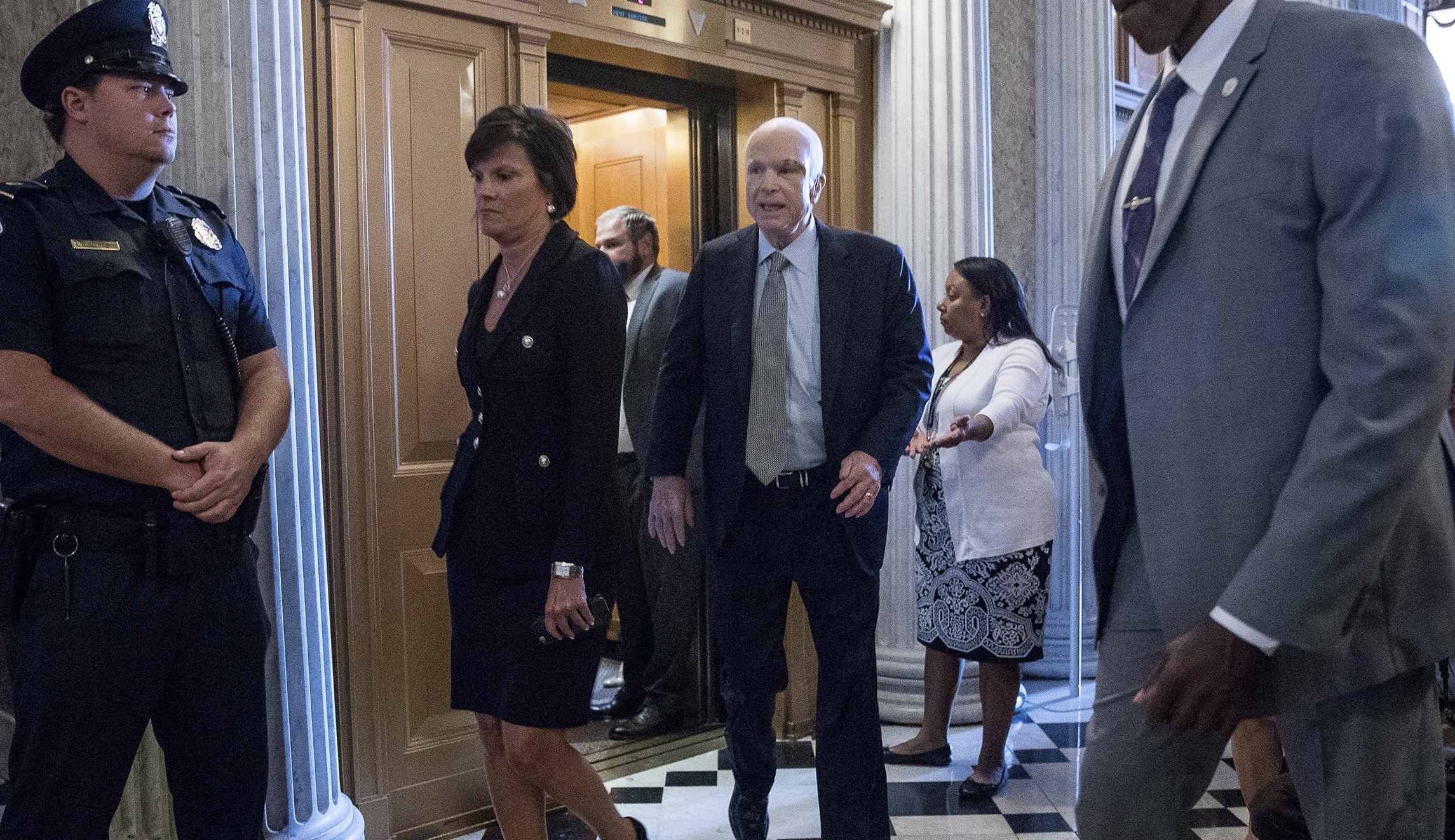
Anyone listening to an equally dramatic Sen. John McCain, R-Ariz., would know this. Returning to the chamber after surgery to remove a malignant tumor, McCain voted to advance the bill. He explicitly did not vote for the bill.
“I voted for the motion to proceed to allow debate to continue and amendments to be offered,” McCain said before continuing with added influence, “I will not vote for the bill as it is today. It’s a shell of a bill right now. We all know that.”
Slamming McCain, then, as many on the Left are doing on Twitter, seems slightly out of order. First, his vote counted just as much as that of the other 49 senators. Second, he voted yes to begin debate but remained opposed to the bill. Tuesday doesn’t mark the beginning of the end. It doesn’t even look like the end of a beginning.
After all, before helping put the bill back on its feet, McCain really rhetorically roughed it up a bit.
He slammed the way Senate Majority Leader Mitch McConnell, R-Ky., tried “coming up with a proposal behind closed doors in consultation with the administration.” He condemned the way the bill was being “sprung on skeptical members.” And he cut down the myth that it was “better than nothing.”
If anything, McCain just freed the bill from its parliamentary prison and then threw it into the partisan lions. Sens. Lisa Murkowski, R-Alaska, and Susan Collins, R-Maine, still think the bill does away with too much of Obamacare, all while Sens. Rand Paul, R-Ky., and Mike Lee, R-Utah, think it keeps too much of Obamacare in place.
No, the Obamacare overhaul hasn’t gone through the regular order. But those four senators, plus McCain, aren’t likely to sign onto the final bill until there are significant changes. That means more debate in the Senate, that means a conference with the House, and that means Vice President Mike Pence will more than likely have to travel back to Capitol Hill and cast another deciding vote.
Philip Wegmann is a commentary writer for the Washington Examiner.

