

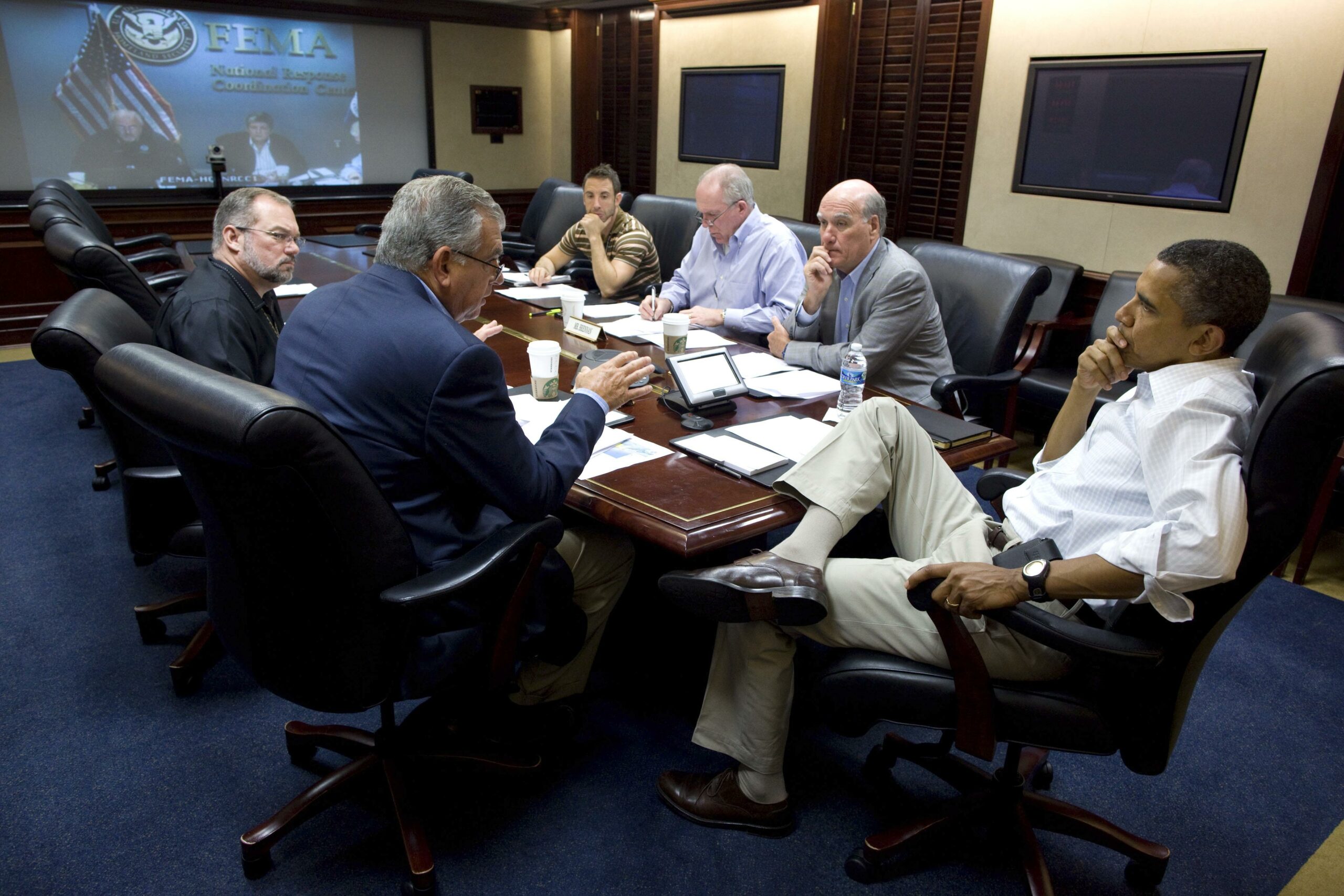
President Obama began preparing for Hurricane Irene long before he was elected president. In the aftermath of Hurricane Katrina, then-Sen. Obama condemned the Federal Emergency Management Agency for being “not just incompetent, but paralyzed and powerless.”
He criticized former President George W. Bush for watching Katrina victims “from the window of an airplane” and for promising government assistance that never arrived.
“If catastrophe comes, the American people must be able to call on a competent government,” candidate Obama said in a February 2008 campaign speech. “When I am president … the director of FEMA will report to me. … I want FEMA to do its job, which is protecting the American people, not protecting a president’s politics.”
Almost exactly six years after Katrina pummeled the Gulf Coast, Obama was so eager to flash his new-and-improved FEMA in the face of Hurricane Irene that some political analysts say he went overboard.
Before Irene touched ground in North Carolina Friday night, there were signs that the storm’s strength had begun to dissipate. The Category 3 hurricane-turned-tropical-storm fizzled into mere rainfall within 24 hours.
The White House took no notice of the weakening threat, firing out emails every hour on what the administration — or rather, the “federal family” — was doing to prepare for the approaching storm. Obama cut short his vacation in Martha’s Vineyard — if only by about 12 hours — and visited FEMA’s headquarters on Saturday, photos of which the White House distributed widely.
Eighteen emergency response teams, or roughly 200 highly trained FEMA officials, camped out along the East Coast for days awaiting the storm. Members of the National Guard were deployed and Obama declared emergencies in eight states and Puerto Rico.
“Given all the kind of theatrics that went behind this — [Obama] going to the FEMA headquarters — and the hype that went around it, I would say this was a bit overblown for what we knew was coming,” said Matt Mayer, a former Department of Homeland Security official.
The risk, he said, is that the public might tune out Obama the next time the U.S. is similarly threatened.
“If you cry wolf, eventually people stop paying attention and that’s the worst that could happen in this type of situation,” he said. “If something big does come down the barrel next time, there could be catastrophic consequences.”
But in the aftermath of Katrina, politicians are wary of underestimating potential risk, said Peter Fenn, a Democratic consultant and political management professor at George Washington University. Though that’s not necessarily a bad thing, he said.
“I would rather have it be overhyped a bit to keep people [safe],” Fenn said. “The fact that people, by and large, did stay in their homes and didn’t go out [during the storm] was in good measure due to the attention given to the storm.”
With less than $1 billion left for federal disaster assistance, FEMA is hoarding its cash for Irene cleanup and temporarily suspending payments to rebuild roads, schools and other structures damaged during the tornadoes that devastated several Southern states in the spring, according to FEMA Director Craig Fugate.
Fugate says he is proud of the FEMA’s preparedness for Hurricane Irene, though he admitted on Monday that accurately estimating a storm’s strength “is an area that … we still need to work on.”
