
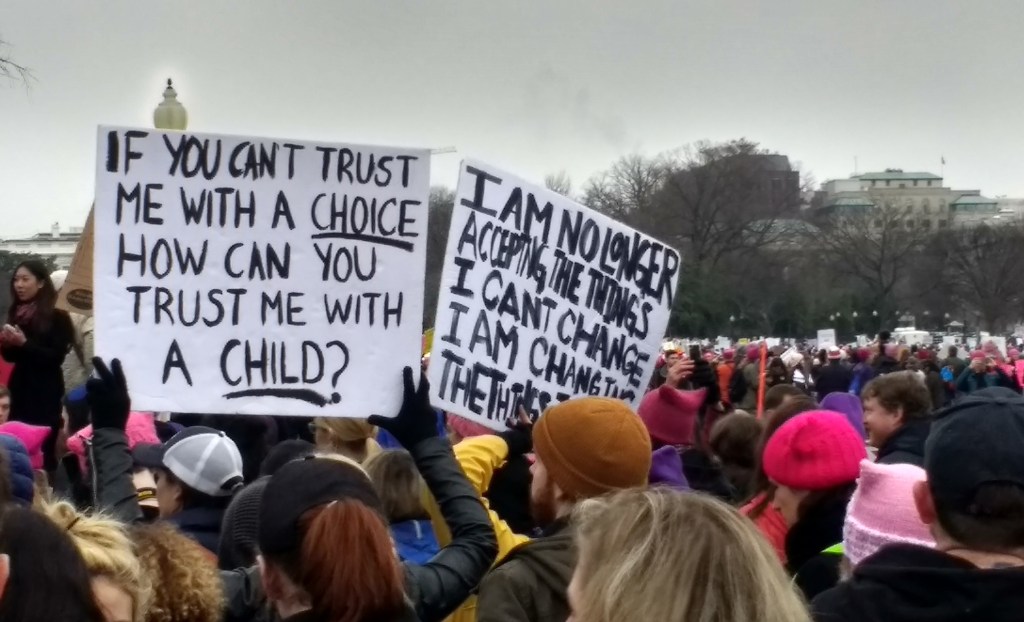
As a popular historian, I’ve spent the last two years researching women’s protest marches. My takeaway? When women march with purpose, the country (purposefully?) forgets them.
Somehow, the story of their heroism seems to be purged from our collective national memory or otherwise whitewashed. In fact, Saturday’s Women’s March on Washington marks at least the eleventh time women have organized a large-scale march on the capital, on issues ranging from war to the right to vote.
In 1970 the Women’s Equality Strike produced a turnout of roughly 20,000 female protesters in Washington D.C., New York, and elsewhere. In 1977 and 1978 the combined marches in support of the Equal Rights Amendment mustered more than 100,000 feminists, including some of the original suffragettes. In April 1989, the March for Women’s Lives, sponsored by the National Organization for Women, attracted a reported 500,000 participants. And who could forget the 1,000,000 moms of the Million Mom March of May 2000?
And yet we’ve forgotten them, or so it seems.
Beyond conspiracy theories, the question persists: Why does our national memory fail us where women’s protest marches are concerned? Were the protests of the past lacking in drama or panache?
Hardly. The march on President Wilson’s inaugural in 1913 saw women dressed in battle gear and mounted on horseback, women dressed as Lady Columbia, and male mob violence that resulted in an 11-day Congressional hearing immediately thereafter.
The tragic headlines in the New York Evening Journal on Inauguration Day 1913 read: “Mob Hurts 300 Suffragists at Capital Parade.” And yet for all that, for a storyline as dramatic as any of the more celebrated civil rights marches of the 1960s, the 1913 women’s march on Washington slipped (or was it swept?) into history’s dustbin within a generation. Surely, our historical amnesia where women marchers are concerned must be something more than garden-variety forgetting.
More than 100 marchers were hospitalized that day in 1913, yet still the transcript of the testimony given to a Senate subcommittee evidences an almost complete disregard for the traumatic memories the women recounted to the senators. In nearly 600 pages of testimony given across 11 days I found the word “violence” used fewer than 20 times in hearings saturated in euphemism, denial and government doublespeak.
Throughout the transcribed pages ordinary women with ordinary names like Mrs. Street recall being spat upon by the mob only to be told by the Washington police, “There would be nothing like this happening if you stayed at home.” Elsewhere in the testimony a Mrs. Hall recounts crowds “surging forward” with a “great deal of violence.” She testifies to being afraid simply to hold hands with her sister protesters for fear of further inciting male mobs.
In a letter to the D.C. commissioner written in advance of the march, women’s right activist Helen Gardener asks the chairman of the commissioners of the District of Columbia for basic crowd control that tragically fails to materialize. Gardener writes, “Would it not be granted to an equally fine, strong, dignified organization of men? Would it not be a matter of course? Does Washington, our beautiful national capital, want it to go forth to the world that such women are not made welcome on the historic avenue, of which all of them know, and which some will see for the first time and pass through with the feeling that it is theirs to help make beautiful and safe and really their national capital as well as that of their brothers?”
More than a century later, as a new generation of women march on Washington to ensure their voices are heard by a new president, they face frighteningly similar obstacles. In light of a denied permit to stage their protest at the Lincoln Memorial, and a march originally planned for Inauguration Day pushed back to the day after, Gardener’s queries from 1913 sound eerily contemporary: “Surely, Mr. Commissioner, Washington will not want to ask these women to take to a side street for this beautiful, patriotic, dignified demonstration?”
More than 100 years later, it’s time for a new history to be written of women’s protests, one that begins with remembering.
Zachary Michael Jack teaches in the Writing and Leadership, Ethics, and Values program at North Central College in Naperville, Ill. He has authored multiple books, most recently, “March of the Suffragettes: Rosalie Gardiner Jones and the March for Voting Rights.” Thinking of submitting an op-ed to the Washington Examiner? Be sure to read our guidelines on submissions.
