

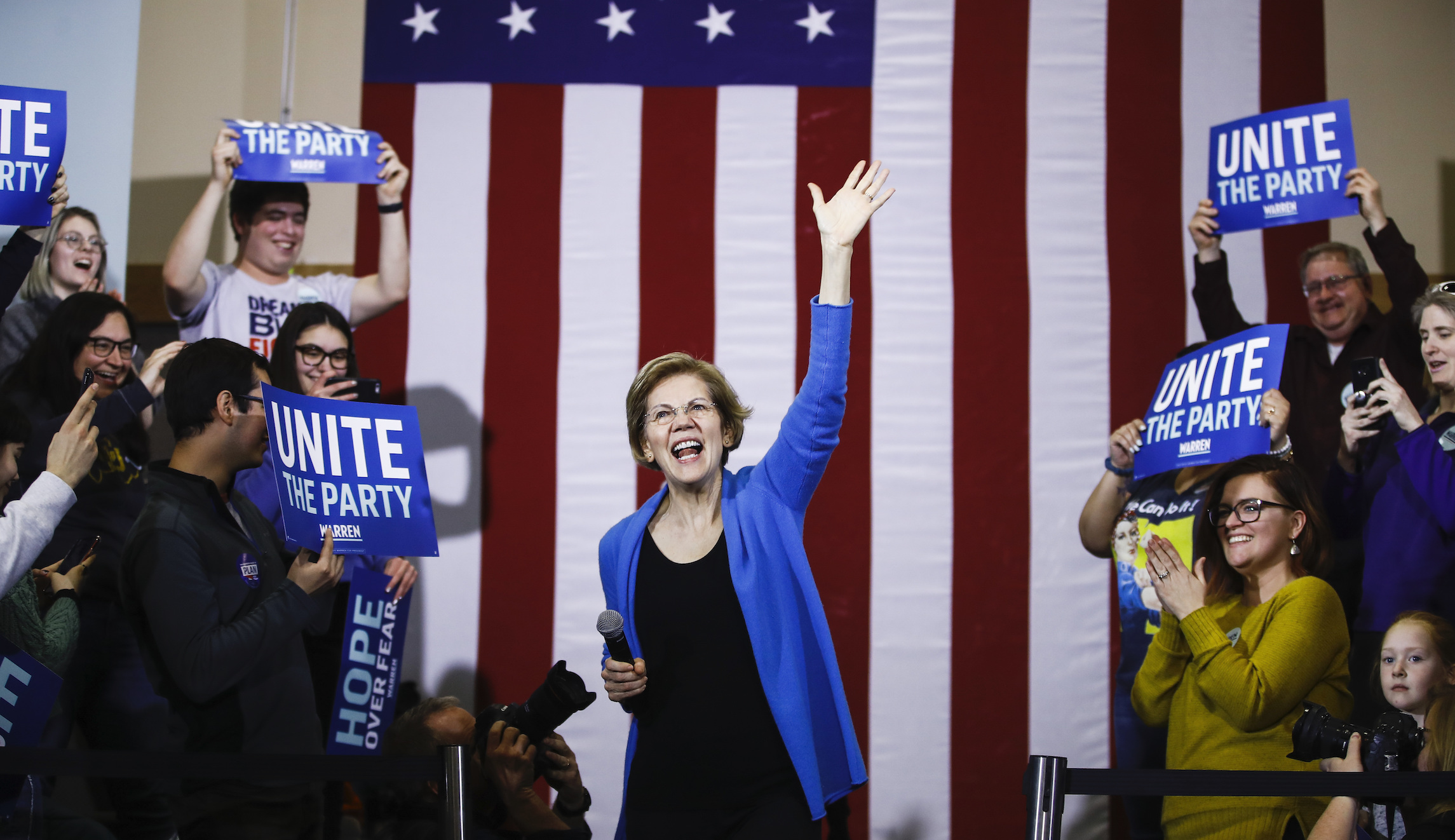
Elizabeth Warren is trying to downplay results in New Hampshire and look toward the future, but her weak finish is bad news for her White House aspirations and a blow for a candidate whom many had high expectations for through much of her campaign.
The Massachusetts senator, 70, was in fourth place with 10% of votes as of about 8:30 p.m. with 30% of precincts reporting, coming in behind Minnesota Sen. Amy Klobuchar, former South Bend, Indiana, Mayor Pete Buttigieg, and Vermont Sen. Bernie Sanders. Warren was in danger of not meeting the 15% threshold to win nominating delegates to the Democratic National Convention.
Recommended Stories


It’s a disappointing finish for Warren, who was expected to perform well because she represents a neighboring state.
Last week, she placed third in the Iowa caucuses, ahead of former Vice President Joe Biden but behind Sanders and Buttigieg. Some analysts believe the lackluster showings in the two states will put the campaign on life support as she pushes forward in the Feb. 22 Nevada caucus and Feb. 29 South Carolina primary.
She gave a speech to New Hampshire supporters early in the night that called for party unity and criticized negative attacks among her rivals.
“Americans in every part of the country are going to make their voices heard. The question for Democrats is whether it will be a long, bitter rehash of the same old divides in our party or whether we can find another way,” Warren said at her New Hampshire primary night party. “The fight between factions in our party has taken a sharp turn in recent weeks, with ads mocking other candidates and with supporters of some candidates shouting curses at other candidates.”
“We can’t afford to squander our collective power. We win when we come together,” she said.
Warren indicated that she does not plan to drop out of the race.
“Since we are here tonight among family and friends, I also want us to be honest with ourselves as Democrats. We might be headed for another one of those long primary fights that lasts for months. We’re two states in with 55 states and territories to go,” Warren said.
On Tuesday afternoon, the campaign distributed a memo that argued she, Biden, and Sanders are the only three candidates well-positioned to win delegates in March 3 Super Tuesday states, pre-spinning a disappointing New Hampshire result.
As she surged in Iowa and national polls last year, even topping polls in Iowa, pundits and analysts largely believed that Warren and her robust field team in the state were the campaign to beat. Her sweeping plans, such as canceling most student debt, implementing a wealth tax, and breaking up big tech companies, drove policy discussions in the field. Glowing news articles gushed over her selfie lines and the hours she spent taking photos with supporters after each campaign event.
The Warren surge quickly faded as fellow left-wing firebrand Sanders regained status as the preferred left-wing candidate after being largely ignored by the press for much of the last year.
The last nail in the coffin, perhaps, was Warren’s “he said, she said” feud with Sanders over whether he told her in a private 2018 meeting that he did not think a woman could win the presidency in 2020. Sanders vehemently denied making the statement. After a January debate in Iowa, Warren declined to shake Sanders’s hand, and a “hot mic” caught her confronting him: “I think you just called me a liar on national TV,” she said.
Early state voters, some of whom had previously been Warren fans, told the Washington Examiner that the exchange and accusation turned them off from supporting her.
Warning signs and Warren’s decline started long before the spat.
For months, Warren dodged questions on whether her vision for a single-payer “Medicare for all” healthcare system would raise taxes on middle-class families even though Sanders conceded that his version of the plan would. She eventually released a plan that claimed it would not raise taxes on the middle class, and it was met with skepticism from analysts and rivals.
In October, the accuracy of a story Warren tells in her stump speech about being fired from her first teaching job at the age of 22 because she was “visibly pregnant” was called into question following the revelation of records that said Warren resigned from her post. The Massachusetts senator stood by her story, but it added to questions about her honesty.
Warren’s past claims to Native American heritage also haunt her. Her 2018 decision to publish a DNA test that found one Native American ancestor six to 10 generations back was widely criticized, and during her campaign, Warren repeatedly apologized for identifying herself as a minority.
In recent weeks, Warren had a jarring shift in messaging. Instead of putting the focus on the “I have a plan for that” sweeping policy changes she hopes to make and insinuating that a wave of energized progressives could carry her to victory, Warren pitched that she is the most electable candidate based in part on an argument that she could appeal to a wide swath of voters.
“We need a Democratic nominee, that our whole party can come together behind and can win on the same set of issues,” Warren said in a tele-town hall just before the Iowa caucuses, adding that “women candidates in competitive races have been outperforming men candidates.” In another supporter call, Warren argued that her platform could be “really appealing to a lot of Republicans around the country.”
