

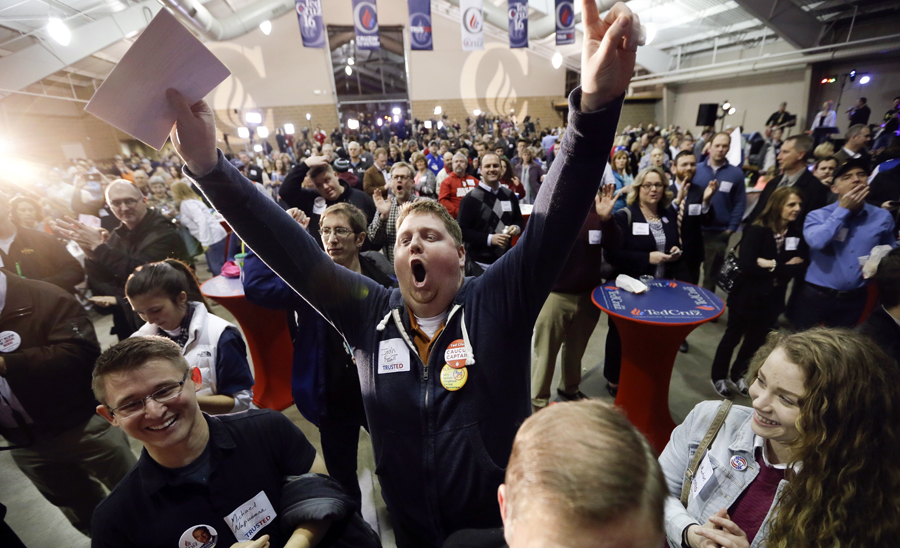
1) Republican turnout appears to have been about 188,000, more than 50 percent more than the 122,000 in 2012 and 119,000 in 2008. This is good news for the Republican brand. In 2008 Democrats got similar good news, as about 240,000 Iowans participated in their caucuses (Iowa Democrats measure results not by actual turnout, but by “state convention delegate equivalents”). This was evidence of the enthusiasm that enabled Barack Obama to win in November in Iowa and nationwide by the largest majority for either party since 1988. The Republican turnout this year in Iowa, taken together with the record-breaking viewership of the Republican debates, each of which with perhaps one exception seems to have drawn more viewers than any Republican debate ever before, suggests that Republicans have an enthusiasm edge this year.
2) It was widely speculated that Donald Trump would bring new people into the caucuses, and he apparently did. The entrance poll showed he carried first-time caucusgoers. But it was also widely speculated that bringing new people in would reduce the percentage of evangelical Protestants among caucusgoers. In 2012 that percentage was 57 percent, the highest in any Republican primary or caucus outside the South that year. But this speculation was wrong. Evangelical Protestants clocked in at 64 percent of turnout in the entrance poll. This tends to substantiate the claims of Ted Cruz and his campaign that he could increase turnout among conservatives, particularly religious conservatives.
Stay informed.Stay ahead.
Join Washington Examiner for unlimited access to the news, analysis, and commentary that matter most.
Already a member? Log in
