
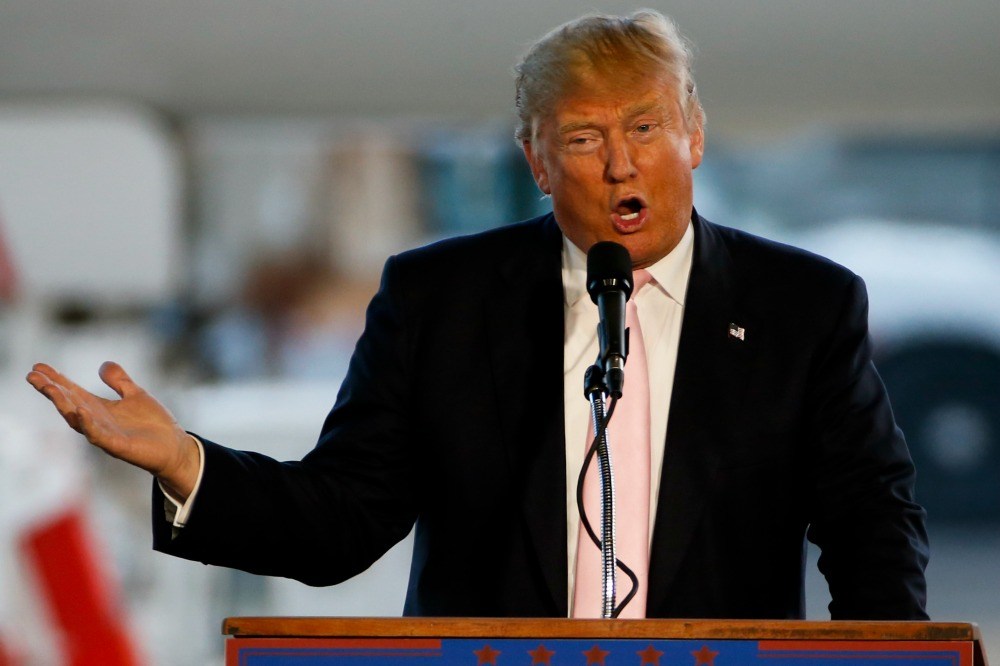
Donald Trump might actually need more than 1,237 delegates, as allotted by each state and territory, to secure the Republican presidential nomination and avoid a contested convention.
That’s because 54 of Pennsylvania’s 71 delegates to Cleveland are unbound on first ballot, according to state GOP rules. The popular vote winner of the commonwealth’s April 26 Republican primary is only guaranteed to walk away with 14 delegates that would be bound to vote for him on the first ballot on the floor of a contested nominating convention. Most states require delegates to vote for the winner of their primary on first ballot.
Real journalism.Trusted by millions.
Unlimited access to in-depth reporting, expert analysis, and the stories that shape our country.
Already a member? Log in
“Pennsylvania looms very large if this turns out to be a contested convention,” said Charlie Gerow, a veteran Republican consultant in Harrisburg who also is a candidate for delegate. “There is not any state that will have the number of uncommitted delegates that we do.”
Pennsylvania’s delegates, if they wanted to band together in opposition to Trump, could deliver a trove of votes to Sen. Ted Cruz of Texas or Ohio Gov. John Kasich on the first ballot, possibly forcing a contested convention. This story was first reported by the Pittsburgh Tribune-Review’s Salena Zito.
Technically, Sen. Marco Rubio of Florida could still emerge with the most delegates in the April 26 delegate elections.
It’s not clear whom these delegates would support with Rubio out of the race. The senator suspended his campaign on Tuesday after losing his home-state primary to Trump, and there is nothing binding them to the candidate they pledged to support when they filed their candidacies. But Republican insiders in the Keystone State say that Rubio was the most organized at fielding delegate candidates inclined to support him in Cleveland.
Mike Devanney, Rubio’s finance chairman in southwestern Pennsylvania and a delegate candidate loyal to the Floridian, said he expects the slate of Rubio delegate candidates to do well in the elections next month. Devanney demurred when the Washington Examiner asked him if they would act as a bloc in the event of a contested convention, and specifically, if they would move to block Trump, whom Rubio has been adamant about defeating.
“These are smart, savvy Republicans. They’re going to want to play a significant role in who our nominee is,” he said. “I, along with a number of folks, are going to be looking at what is best for the party.”
Trump, the New York celebrity businessman, leads the field with 673 delegates, followed by Cruz, with 411, and Kasich, a western Pennsylvania native, with 143. Rubio exited the race with 168 delegates, although most of those will now be unbound and available to be scooped up by the remaining candidates given that he has suspended his campaign.
The limited, and now since dated, polling available for the GOP race in Pennsylvania showed Trump leading; Rubio had been running second.
Gerow, running as an uncommitted delegate, was active 40 years ago — the last time the Republicans held a contested convention, on behalf of Ronald Reagan. That year, and in 1980, Gerow saw firsthand how Pennsylvania’s unique rules can help swing a nomination.
In 1976, President Gerald Ford’s hold on Pennsylvania’s delegates helped him fend off a challenge from Reagan at the convention in Kansas City. Four years later, Reagan lost the commonwealth’s GOP primary election to George H.W. Bush by about 100,000 votes. But the former California governor secured the support of Pennsylvania’s unbound delegates, positioning him to win the nomination when they voted on the convention floor in Detroit.
Four years ago, Gerow was chairman of Newt Gingrich’s presidential campaign in Pennsylvania. He succeeded in electing several delegates loyal to the former House speaker, and he said they might have swung the nomination away from eventual standard bearer Mitt Romney had the convention in Tampa, Fla., been contested.
“If you don’t look at the unusual rules in Pennsylvania, you’re missing something,” Gerow said.