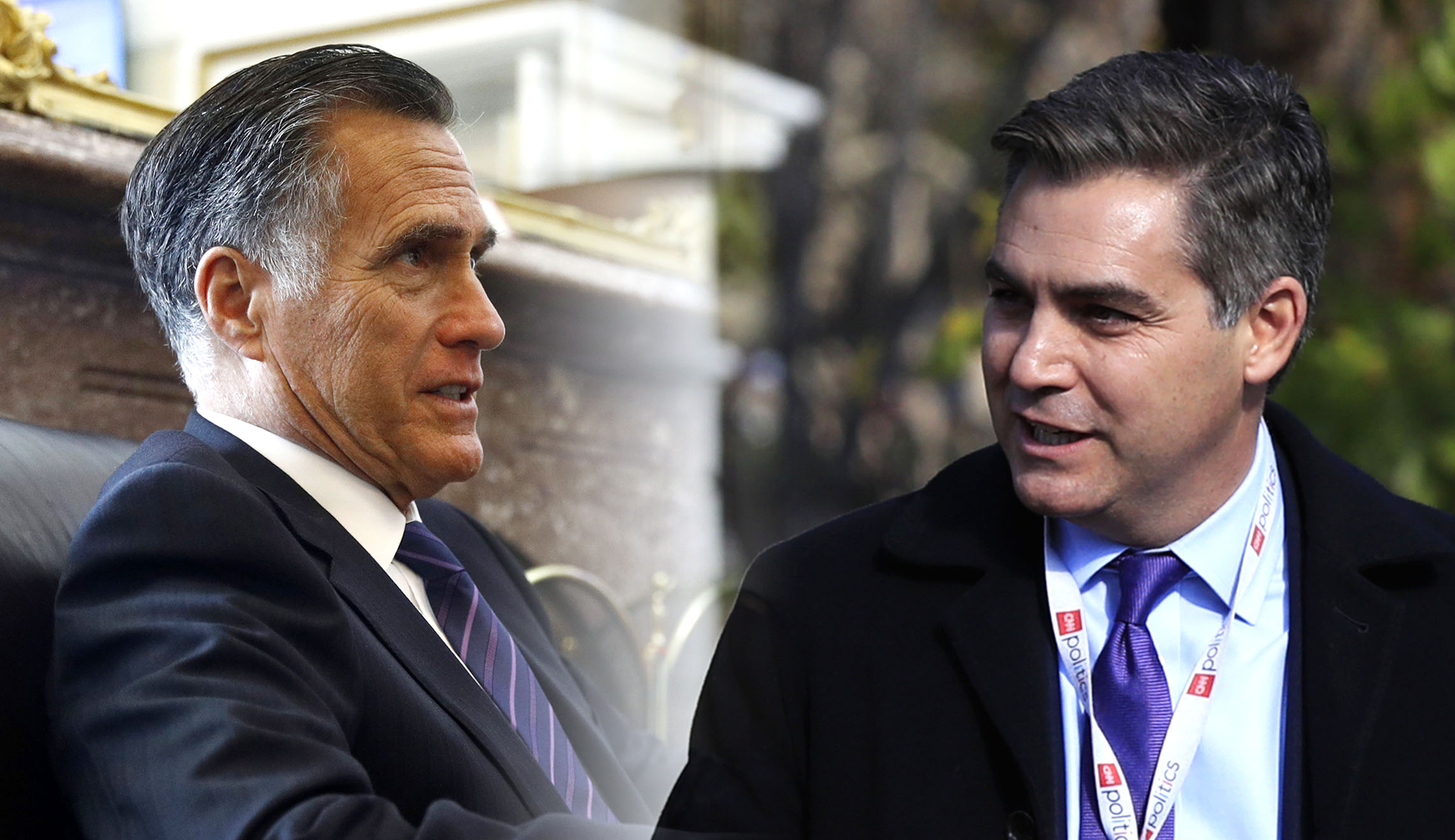
In his new book, CNN’s Jim Acosta comes close to recognizing that the news industry’s mistreatment of perfectly decent presidential candidates like former Massachusetts Gov. Mitt Romney prepared the way for a truly anti-media nominee to rise from the muck.
But the CNN reporter misses his moment of self-realization by this much.
“As a reporter on [the 2012 GOP nominee’s campaign] plane, I had come to see the Romney the rest of America didn’t really get to meet,” Acosta writes in his book The Enemy of the People: A Dangerous Time to Tell the Truth in America, a poorly constructed personal monument to his high self-regard.
“Stiff and awkward on the trail, he could be funny and disarming in his off-the-record interactions with reporters. Most of us in the Romney press corps viewed him as a rather admirable father figure — but golly (as Romney would say), he was a disastrous presidential candidate,” the CNN reporter adds. “Despite all his decency and his qualifications as a businessman and governor, Romney was a gaffe machine. Those gaffes seem downright quaint now.”
Astonishingly, Acosta points to, among other things, the “binders full of women” incident from the second 2012 presidential debate as a prime example of Romney’s supposedly “disastrous” incompetence.
You probably remember the moment: The Republican presidential candidate said of his efforts as governor to address pay equity, “I had the chance to pull together a cabinet, and all the applicants seemed to be men. […] I went to a number of women’s groups and said, ‘Can you help us find folks?’ And they brought us whole binders full of women.”
White House operatives were quick to attack, declaring on social media that Romney had said a terrible thing. Political pundits loyal to the Obama White House at once magnified the claim, which was then eaten up by an eager press and disseminated all over the electorate. Newspapers and networks alike agreed: Romney had said a terrible thing. But what neither newspaper nor broadcast network nor pundit bothered to address was why it was such a problematic thing for the former governor to have said or why it was worthy of more coverage than the fact that the Obama White House actually paid its female staffers less than its male staffers.
Voters were told simply that Romney had said a terrible thing because, well, political and media professionals said so.
This alleged “gaffe,” like so many of the Romney “controversies” and “scandals” hyped during the 2012 election, was nothing more than manufactured outrage. There was nothing offensive or even terribly awkward about what Romney said, except insofar as newsrooms chose to convince themselves and others.
Seven years later, Acosta casually mentions the “binders” episode as proof of Romney’s “disastrous” candidacy, adding further that such “gaffes” seem “downright quaint now” following the rise of Trump.
So, so close, but no cigar.
Those “gaffes” were never really “gaffes” at all. Like the “scandal” involving Seamus the dog and the “scandal” involving a haircut in high school, the “quaint” Romney “gaffes” were mostly innocuous incidents that an Obama-friendly media repackaged as grave character flaws for the benefit of the incumbent candidate. Those “gaffes” seem “quaint” now because they were always “quaint.” Networks like CNN merely treated them as serious outrages because, well, that is what the press does.
For many voters on the Right (myself included), the “binders” moment served as further evidence that it does not matter who the GOP submits as its presidential nominee. He can be as kind and decent as Romney, and Democrats and their allies in the press will still savage him as a retrograde monster, grinding him into dust with a relentless torrent of absurd attacks and criticisms. And if Democrats and their supporters cannot find legitimate controversies with which to destroy the GOP nominee, they will simply concoct them from thin air, as they did with “binders full of women” and similar episodes of ginned up outrage. It makes sense, then, that Trump’s inability to feel shame, coupled with his love for fighting with journalists, appealed to the same people who watched in dismay in 2012 as their perfectly honorable candidate was torn to pieces by the White House and the press.
“Romney ran a hard-fought, respectable race,” Acosta recalls in his book, referring to the former governor as a “thoroughly decent human being” with “good manners.”
Is that so?
Because that most certainly was not the message voters received in 2012, back when Acosta and others were busy obsessing over supposed “gaaaaaaffes” committed by the man who threatened to deny their beloved Barack Obama a second term in office.
